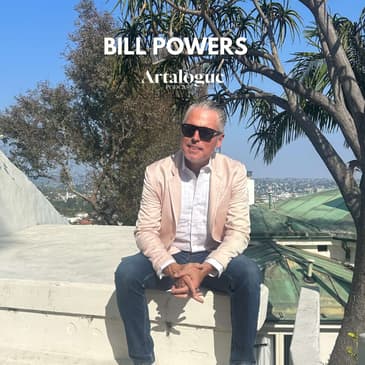
When I asked Bill Powers, owner of Half Gallery (who also happens to be an avid tennis player) what similarities could be drawn between the art world and the game, he replied "I guess sometimes people may pay more attention to their outfits than their backhand."
Throughout our conversation, Bill Powers, the owner of Half Gallery, serves some keen insight from his many years in the Art World. Starting as a culture journalist writing for magazines and esteemed publications like the New York Times, Powers pivoted to becoming a gallerist when the moment arose. "Why not me?", he thought. He now contributes to Muse, Purple and Autre magazines. He now has two books available through Junior Publishing, Glissando and Early 21st Century Art.
Alongside discussions about his career and gallery, we discuss the changing Art World and what the future holds. We chat about the shifting nature and relevancy of art criticism and the growing influence of market dynamics on artistic expression. From the recent spectacle of Maurizio Cattelan's "Comedian" at the recent Sotheby's auction to the disruptive force of NFTs, we try to untangle and understand how commercial success is reshaping taste and connoisseurship. Bill reflects on the delicate balance of business with creativity. His story is a compelling glimpse into the ways in which different aspects of the Art World converge.
Connect with the Artalogue:
Madison Beale, Host
Be a guest on The Artalogue Podcast
Hi everyone and welcome back to the Art-O-Log. Today I'm chatting with Bill Powers, owner of Half Gallery, with spaces in New York City and LA. Half Gallery represents 24 artists and has worked with many more. As well as being a gallerist, powers has curated exhibitions and is also a writer, having worked as a culture journalist with some impressive publications. He now has two books available through Junior Publishing Glissando and Art Memoir and Early 21st Century Art, which features a series of interviews with notable people working in the art world. Today, on December 6th, powers will be signing copies of his latest book, early 21st Century Art, at the Art Basel Miami Beach bookstore from 4 pm onwards. Hi Bill, welcome to the Art-O-Log.
Speaker 2:Thanks for having me.
Speaker 1:Now that your book Early 21st Century Art is out, how does it feel being on the other side of the interview?
Speaker 2:I think it was Franz Kafka who said once you start answering their questions, they've won.
Speaker 1:Yeah, I was hoping so to jump right into your book Glissando. You share an anecdote about meeting some established artists in the Hamptons when you're about 22. And you say that you didn't know anything about quote, unquote art stuff. How did you get from there to where you are now?
Speaker 2:I guess from writing for like indie magazines in the late 90s and then I think I started writing for the New York Times like Style Section and T Magazine, maybe in 1997. And sometimes that beat would involve contemporary artists. So I remember I did something on Lee Friedlander had done some photo project at a hotel or Mark Gonzalez had done one of his Sphinx-like creatures as a sculpture at a Supreme store, and so I got into covering art or being around artists on the journalist side and then collecting a little bit. There was a gallery called the Legend in New York that dealt with this, I guess loosely. It was a school called the Beautiful Losers and they're mostly artists from San Francisco like Barry McGee, chris Johansson, margaret Gilgallen.
Speaker 1:Nice. What was the jump from journalist to gallerist like?
Speaker 2:I wanted to live. I don't know if people can really make a living as a culture journalist anymore, culture journalist anymore. But also it was funny when we first opened Half Gallery in 2008,. There was a nonprofit called RX Art which puts art in hospitals, and they were moving to the Lower East Side and they were looking for someone to take over the front half of their space because they didn't need all the square footage and so they asked if I could find a gallery that might be interested in taking over part of their lease. So I asked someone at Loring Augustine, I asked a couple other galleries, because the Lower East Side, like the new museum, was about to open and it was like on the up down there and there were no takers and I just ended up opening that project space. It was almost like when they had Dick Cheney do the VP steering committee for George Bush. He was like maybe it's me. So that's how I first opened that space.
Speaker 1:From your work in journalism to opening the gallery in 2008, and to even now. What changes in the art world have you observed over your career?
Speaker 2:It's interesting how technology could really be a driver. I think back to the 80s, when people would be like I will mail you some transparencies or I could fax you a picture of the art. So I think that's really changed how people have access to images and artists, even in real time.
Speaker 1:You're an avid tennis player. Do you think the art world shares any similarities with the game?
Speaker 2:Ooh, that's a good question. I guess sometimes people may pay more attention to their outfits than their backhand.
Speaker 1:What's the biggest risk you've ever taken?
Speaker 2:Biggest risk? Wow, that's a tough question. I don't know if it's the biggest risk, but I remember going up to Jasper Johns once and asking him for an interview. He gave me a scowl and then I forced a selfie on him.
Speaker 1:And how did he react to that?
Speaker 2:He doesn't seem that psyched to be in the picture with me, but whatever, the one time thing.
Speaker 1:What's making you excited about art right now?
Speaker 2:Maybe it would be an interesting time for photography, because I'm going to actually interview Sheila Metzner in two weeks for Ultra Magazine and I believe she was like one of the first female photographers ever to be under contract at Vogue, like 50 years ago, and I'd seen a show of hers at the Getty in Los Angeles earlier this year. But because the photography market is dead on the commercial side, and I think when I interviewed Roberta Smith she was saying the ubiquity of photography means we now have to redefine what excellence is in that medium, that sometimes, when nobody's looking at a certain sphere or subset of art, that can be an interesting time to explore it, explore it. We can take pictures all day long, and so the idea of capturing imagery doesn't seem as novel as it once was. And so now it's. What are the moments we can find, maybe when no one's looking?
Speaker 1:What makes an image stand out to you?
Speaker 2:That's such a tough question. I think Megan Stevenson, although she's a painter, said to me recently sometimes painting or I would say a photograph can capture your imagination, when you feel like the artist is speaking to something that's right on the tip of your tongue, but you don't have words for it yet.
Speaker 1:Speaking of the artists that you represent. How do you maintain and nurture these professional relationships?
Speaker 2:It's a very soft science. I think sometimes the best way is when you meet artists through other artists, and sometimes it can come from collectors that they're already interested in someone. That's without representation, but there's not really any one path to it. It was in the Artnet article you read. But in the case of Ian Felice, I'd heard Jonathan Anderson on the David Zwirner podcast and Helen Molesworth was interviewing interviewing designer from Loewe because they have the craft award and so I started following him on Instagram Maybe this was like a year and a half ago and he had posted some paintings of Ian Felice and I looked at them. I started to follow him. We did a virtual studio visit and one thing led to another.
Speaker 1:So would you say that's the process for finding artists for all of the artists you represent?
Speaker 2:No, like when we did a show. Our last show in LA was a older painter named Chuck Arnaldi and I had met him through a curator writer named Michael Zielinski. That's in LA. So I think really you just want to grow your network and then just be open At Half Gallery. I think we've shown a lot of people when they've had their first New York shows and that's great and I really enjoy that, whether it's like Louise Bonet or Geneve Figgis' first show in New York City or Natalie Ball, who then went on to have a show at the Whitney Museum. But it's nice to feather in some older artists too. We've done like multiple shows with Rene Ricard, one while he was alive and then a few posthumously. So yeah, primarily we show paintings, but we've done photo shows with Mario Cireerenzi and Craig McDean, david Armstrong.
Speaker 1:Could you speak to New York as an art hub, like its legacy and kind of where it's going for the art world right now?
Speaker 2:Even though New York is definitely a culture center, I think it can be quite expensive to live here as an artist, and I think that LA might be a little bit more exciting in the United States right now just because you can have space as an artist. That's a little bit more affordable and you're less reliant on having to have a day job while you pursue your art making.
Speaker 1:What have been some career highlights for you.
Speaker 2:Definitely my friendship with Richard Prince, and then he did two different book covers for novellas that I wrote. That's been a really nice connection. And then I think just curating some shows for blue chip galleries like having done sympathetic magic for blow and Poe in 2021 or domestic horror for Gagosian in 2019 was nice to apply my skills in a different way on a bigger stage, my skills in a different way on a bigger stage. A screenwriter friend in Los Angeles said to me how do you make a hit movie in Hollywood? Two or three great scenes and no bad ones. And I think sometimes an art exhibition can be like that, that you should have two or three standouts and hopefully no duds, although the late Walter Don used to say you should always have at least one bad painting in every show, almost as like a control group.
Speaker 1:So what have been some harder moments for you in your career and how did you overcome them?
Speaker 2:Because often we give people their first shows in New York, they sometimes move on to, shall we say, like greener pastures, and my friend Artie Nelson in LA likes to say you're nobody until somebody leaves you. But that can be a hard pill to swallow at times.
Speaker 1:Yeah, so what do you see your relationship as a gallerist here? What do you take on a role as a steward for these artists? How do you handle that when they leave?
Speaker 2:I think, in the same way that some people argue we're all just custodians of art, you own the art but someday we're all going to die and the art will belong to somebody else. So in that sense we're all stewards to whatever we own. And it's interesting, someone like Rashid Johnson sometimes will include plants on shelves in sculptures that he makes, because there's a level of responsibility that the collector has then to engage with the artwork and keep it alive. So I think when you're dealing with young artists you're just trying to help people find their voice, and often it's about helping someone stress test their ideas. If you're just even in an interview, I find if you're just throwing softballs at somebody, it doesn't make for as interesting a conversation that like without some friction there can be no depth that if it's just you and I agreeing with each other for half an hour, it's maybe not that interesting to listen to.
Speaker 1:So how do you challenge these artists, then how do you push them?
Speaker 2:In the case of Leonard Baby, who's a painter that we're going to be doing a show with in New York in March, a lot of his imagery in fact maybe all of his when we met were appropriated from photographs or movie stills. And now he started to pull from his own life and he's doing some photo shoots and then using those as the basis for paintings. So he's trying to capture some of the cinematic in his own history. I would say that's an evolution for him. Other times it can be.
Speaker 2:Maude Madsen made the jump from acrylics to oil painting and I think we debuted her first oil paintings at the Armory show in September. So that's more on the medium side and just giving her the time and support to make that transition. So it still looks like her work, but it's just a little bit, feels a little bit more special, like one definition I have for artists, sometimes over the long haul, is you want to move towards elegance and that doesn't mean it has to be perfect. Like a Joyce Pensado painting can be quite elegant. Like a Joyce Pensado painting can be quite elegant and my definition of it is where concentration of intent meets freedom of expression. So it's almost Glenn Gould on the piano, like his hands, have the information, so he can let his imagination run wild.
Speaker 1:What's next for you in Half Gallery? Where do you see it going?
Speaker 2:I don't know. I think it's been an interesting year because there were a lot of galleries that closed and I think there was an overexpansion that occurred during COVID, and then people had 10 satellites and collectors are getting 20 PDFs from a gallery. I think people want to be a little bit more focused in 2025. And hopefully there's less of a churn rate where it used to be like here's a new artist, here's a new painter, here's a new sculptor that people are getting hit with a lot of novelty and not enough consistency. So maybe it's a time to refocus to consistency. I hate when people like you'll hear, like really high-end dealers saying like it's a return to quality, but hopefully quality was always part of the equation.
Speaker 1:How do you balance novelty and consistency?
Speaker 2:no-transcript. In Richard's case, with that particular body of work, it's interesting that when he first started making them he would have the nurse painting and then on the side he would write down all the reasons you might need a nurse and then I think, as he got more comfortable with the nurse paintings, he didn't feel like he needed that anymore. It can be interesting, even within an artist's practice, to see how they're refining their vision over time.
Speaker 1:Absolutely Speaking of Roberta Smith. What place do you think art criticism has in the 21st century?
Speaker 2:I think art criticism does not have the weight it once had, that it used to be. An art critic was almost like a theater critic, that like if you gave a show a bad review, like it closed, the Broadway show closed the next day and I think probably like cinema, it's unhitched itself from criticism like I didn't read any reviews for I don't know what's a big commercial movie that's come out lately. The next mission impossible isn't counting on a good review for it to be successfully commercially. And I think in the same way that an art show like whether someone gives the next Jonas Wood exhibition a good or bad review- I'm pretty sure that Larry can sell the paintings primary.
Speaker 1:Why do you think people aren't paying as much?
Speaker 2:attention to art criticism. I think art used to be more of a connoisseur's pursuit and maybe it's just that the money got in the way, and I think auction prices probably have a bigger impact on an artist's career popularity than a review an art forum yeah, can you expand a bit on that money got in the way statement?
Speaker 2:I'm really interested to hear more about that because obviously money's always been involved in art to some degree I remember alison gingeris wrote a think piece about that in regards to je Koons the production value created an obstacle between you and the art experience, because you're wowed by the money it took to create this piece rather than the idea. And even if you look at the whole $6 million banana thing with Mauricio Catalan, if you look at his history and his reverence for Duchamp, I think you have to contextualize it. Bad for the banana vendor who had sold the Maurizio piece that they installed at Sotheby's, because he only got 25 cents for the banana. And I read some article where they called him like he unwittingly sold. But it's never really about the banana, it's certificate art, so it's about him. Certificate art, so it's about him, mauricio, embracing the idea of memento mori. But rather than it being a painting, it's an object that we'll see over ripen in real time.
Speaker 1:Totally, and I think we're already seeing it overripe in the news cycle.
Speaker 2:Things move in and out so quickly because cynical is just assuming that the whole world is erupt and skeptical is wondering what someone's intentions might be. And in that case I'm not that familiar with the gentleman who purchased the work, but it seemed like he might have a hand in crypto and I wonder if, in buying the Maurizio Catalan, that's not helping his overall business, because art is very much a faith-based enterprise, as I would imagine crypto is, and maybe he can help create some linkage between the two that will serve him professionally in his other pursuits.
Speaker 1:Do you see cryptocurrency entering the art market in a meaningful way?
Speaker 2:I think largely crypto became part of the conversation with the rise of NFTs and it's probably to the detriment of NFTs, because then, if crypto crashes, nfts seem irrelevant, trashes NFTs seem irrelevant. But to me it felt like a 21st century manifestation of tulip mania, when people were collecting little tulip bulbs and they were going for astronomical prices.
Speaker 1:Yeah, absolutely. What do you think the next horizon of art will be? Because I think a lot of people thought it was going to be NFTs.
Speaker 2:I'd be curious if, on the heels of the Mauricio Cadlan comedian doing so well at auction, if we might not see more certificate art, which has been around for a long time, sol LeWitt would say draw a one foot circle on a wall and then make 99 more that are slightly overlapping, and those would be the instructions that you would buy with his signature. And then someone like Darren Bader is probably the best example of continuing that tradition. It would be interesting to me if you saw more certificate art and you could even apply it to performance.
Speaker 1:So to pivot more towards your writing practice, how do you balance, I guess, the business side of being a gallerist with a more creative pursuit as a writer?
Speaker 2:I've always tried to help my artists get exposure in different magazines and media. I think I did a Umar Rashid a cover story for Muse magazine when we first started working together where there was like an Emma Stern piece in purple. Because I come from a background as a culture journalist, I always wanted to have my hand in that game to some degree. I couldn't write for the New York Times or Art News anymore because then they wouldn't cover the shows that we did and that felt unfair to the people we were working with. But there's so many other dealers and curators I know that have specialized knowledge that often isn't public facing that I encourage everyone like that to share some of their information Because even though we live in an age where we have social media and what feels like so much information circulating, there's still proprietary stuff that never really gets out there.
Speaker 2:I know an artist that we worked with or still work with. I don't want to give a name, but he was approached by Pharrell when he was doing Louis Vuitton to do a collaboration for the first collection and he couldn't do it because he had other commitments to a different fashion house. But sometimes it's interesting to see the things that never came about that can be lost to history.
Speaker 1:Do you think the same qualities that make a good writer make a good gallerist?
Speaker 2:I think to some degree, because you have to write press releases. So it helps to have some chops there, but it depends on what kind of journalist you are. I worked at this magazine called Details back in the day, which was like a GQ-type magazine, and I was a stringer there and I'd have to come up with ideas to pitch them, because the lead time with printing would be like three months before they went to press, and so you did need to have a little bit of an ability to see over the curvature of the earth to see what might be coming up, and I think developing those muscles did probably help me in some ways as a dealer. But really I don't think you can predict what people are going to want or where the market is going. I think really you want to engage with art that excites you. I remember there was a dealer named Patrick Fox who said if I can't smoke it, I can't sell it, meaning if he can't get off on something, then how can he expect other people to?
Speaker 1:So would you say that not necessarily impacts how you take on artists. But do you think like that enjoyment of the art is first and foremost necessary to take on an artist, or can you see an artist's potential for growth?
Speaker 2:I've always thought that there's four pillars to a long art career, that you need institutional support. Institutional support and that can mean, obviously, museum shows, but also Dodie from Vogue will sometimes do shows at, like, the Newport Library in Rhode Island or doing an installation at the Met Opera House, I would say, counts as institutional support. Then you need critical support, so that's books, reviews, things of that nature. You need commercial support because we all need to live, but in some ways I think that's the least important of the four pillars. And then, lastly, you need artist support. Other artists have to like your work or feel like it's of some value, and if other artists don't like you, I think that's a tough position to be in as a painter. To have a long-term career, you need institutional, critical, commercial and artist support.
Speaker 1:Yeah, so I guess one part of the art world that we haven't mentioned yet is art fairs, and when this episode airs, you're going to be signing books at Art Basel Miami, and I wanted to ask you why do you think art fairs remain relevant right now?
Speaker 2:It's a chance to put everybody under the same big tent. I feel like maybe art fairs are less important than they used to be. Sometimes the unfortunate thing is the people on the steering committees of the art fairs. It's a little bit like a co-op board deciding who gets to be in it and with what presentation. Solo booths, because I feel like you get a little bit more of a vision, or curated booths that actually have some theme or conceit. I think too often you just see here's the stuff we had in the back room or that we were able to pull out of the artist's studio in the last minute. That's ready. So I'd like to see a little bit more finesse on the art fair scene. But it's definitely a great way for as a collector or an art fan, to be able to walk in and you can see a hundred booths. To go to all those galleries in New York and LA might take you a week to see as much art.
Speaker 1:What are you looking forward to seeing in Miami?
Speaker 2:I always like to go by the Rebels. I don't know if I've seen any particular presentations. I ran into John Armletter there once and he told me to go check out a place it's maybe about a half hour outside of South Beach called the Coral Castle, which is this weird little sculpture garden that this guy made objects and walls of coral and that they've preserved. That's a funny little day trip for people looking for something else to do.
Speaker 1:What advice would you have for someone who wants to be an art dealer?
Speaker 2:Yeah, I think sometimes people in the same way that everybody thinks they have a great sense of humor or style people can sometimes overweight their own taste and I think you need to do some homework and kind of look at other gallery programs to imagine how you see yourself fitting into the mix. I think it's important to have a perspective and I think sometimes when you're new to it, it's like Roberta Smith will say to young artists if you're lucky, you can escape your influences, meaning we all start off aping the people that we looked up to and I think sometimes as a dealer you might do that. You're like Ooh, it looked like George condo paintings, maybe we'll like them. And to have a perspective. But that's based not just on your taste but also having seen a lot of art and maybe read about a lot of art, that it's like informed taste.
Speaker 1:What do you think makes good taste?
Speaker 2:It's going to be the complete opposite of what I just said, but Dave Hickey would say that bad taste is the only real taste in America, because good taste is just the ghost of someone else's privilege. So maybe I should refine our last exchange that I think it's okay to like something that's new and very different, but you may not be able to sell any of it. I did an interview with Lisa Yuskevich and she called it baking cookies. That she's. Who doesn't love a chocolate chip cookie? You might need it gluten free or you might want it gooey or crunchy, but everybody loves chocolate chip cookies, and too much of the art world is about feeding people chocolate chip cookies. And she compared it to the experience of having wine or coffee for the first time. When you're a little kid, you'll have a sip of your parents' wine and spit it out Yuck, only to discover that 15 years later you want that every weekend, and so I guess she's talking about an acquired taste, and an acquired taste means that initially you weren't sure whether you liked it or not.
Speaker 1:That's amazing. Thank you so much, Bill, for your time and for all of your wonderful answers.
Speaker 2:Oh, super fun to talk to you.
Speaker 1:Is there anything that you want to let us know about before we close off here?
Speaker 2:I just think, as an artist, sometimes it's important to write just to see what ideas come out of you in a non-visual way, and also that people need to feed their eye as much as they need to create art. I remember hearing somebody saying that the key to a content life is where your output exceeds your input. But I would say too much of us go through life like we're watching TV or are overly reliant on the reserve of privilege, where we're waiting for the world to entertain us, and I think sometimes curiosity requires hard work.
Speaker 1:Can you give us a prompt to take away for the artists who are going to get to writing right now?
Speaker 2:Well, one thing that's interesting is find someone that's in the canon of art, someone that is beloved, that people are like that person is part of art history and then write down the reasons why you're not a fan. I think sometimes we too readily accept that. It'd be interesting to say write one page on why you think Picasso isn't that great, and then maybe you'll discover something about your own proclivities.
Speaker 1:Yeah, I think with that in particular, a lot of people may jump to Picasso as a person rather than an artist. Do you think that is a valid response?
Speaker 2:That's true because we want to believe only good people can make beautiful things, which sadly is not always the case. I remember interviewing Josh Smith and he said it's a shame that you can't only be a painter anymore, that you also have to be an entertainer, and I think that's very much. It's become increasingly prevalent in the art world that everybody wants the narrative or the story of the artist to be dovetailed with the work somehow, and that can be easy to get on the board at first, but more challenging long term.
Speaker 1:Do you think you need to be an entertainer to also be a gallerist today?
Speaker 2:You need to provide a platform and atmosphere. So I don't think it always has to be you on the cult of personality, but you have to create the spirit of something when people walk into your environment and that can either be with a dealer that works there or the kind of atmosphere in a particular space or program, and I would say that context is content in whatever manifestation that takes on for you.
Speaker 1:Yeah, thank you, bill. Thank you so much for this.
Speaker 2:All right, thank you.