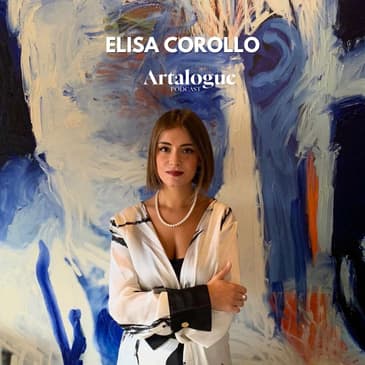
We all knew the art market slowed slow down, but we didn't realize the rules were being rewritten, too. Advisor, curator, and reporter Elisa Carollo joins Madison Beale on The Artalogue today to discuss the most important questions arising in the art market today.:Will there be more gallery shut downs? How are galleries adapting in a post-boom, post-digital art market? What can the next generation dealers do to keep their heads above water? Today, we connect the dots between prices, context, and staying power.
We start with Elisa’s journey navigating secondary and primary markets, curation, and daily reporting, and how that unique vantage point helps Carollo understand what moves value in contemporary and ultra‑contemporary art. She breaks down the pandemic’s fast‑track effect on emerging artists, why rapid price spikes can backfire, and how institutional recognition, biennials, and critical writing broaden demand beyond a handful of bidders.
The conversation then turns to the gallery crunch: mounting fair schedules, rising rents, thin teams, and the danger of overgrowth. Carollo explores how dealers these days believe that community is driving more sustainable sales. We also spotlight hopeful momentum, from the Studio Museum in Harlem’s reopening to Venice’s next chapter, and revisit the Malta Biennial as a model for site‑specific, context‑rich curation that builds meaning as well as markets in places less frequented by the art world's usual travel circuit.
Carollo offers grounded advice for aspiring art writers: be present in the industry, wear different hats, and ask better questions. If you care about how artworks earn their place (and keep it) this conversation is your field guide to an art world under renovation.
Subscribe to The Artalogue, share with a friend who collects or curates, and leave a review telling me what part of the market you want explored next!
Follow Elisa Carollo on Instagram
Connect with the Artalogue:
Madison Beale, Host
Be a guest on The Artalogue Podcast
Hi everyone and welcome back to the Artalog. I hope you've all had a restful time since the many different art fairs that were happening last month, namely Freeze London, Art Basel Paris, and Art Toronto. I certainly had a wonderful time at Art Toronto and I'm really excited to share my piece that I've been working on writing for my Substack, which you will be able to find next week on Substack at Artalog Pod, like all of my other social handles. Speaking of art markets, today I'm bringing you a conversation with someone who is working very closely with the art market circuit as well as private dealings. I think this is probably the most in-depth I've ever gotten on the artalog about the art market, and I'm really excited that that conversation happened with Elisa Carollo. Elisa Carolo is an art advisor, curator, art writer, and USPAP compliant appraiser with a focus on contemporary and ultra-contemporary art. She holds an MA in Art, Law and Business from Christie's New York, and a BA in Marketing and Management of Cultural and Creative Identities from IULM University, Milan. Starting in the secondary market and then transitioning to the primary market, writing as well as curation, Carula can boast over eight years in the art industry, serving in different roles in both commercial and institutional settings. Today, she mostly works as a freelance advisor for collectors, galleries, and artists, as well as writing about art and its market for American and international magazines. Since June 2024, she's been writing for The Observer in New York as the main art reporter. As a curator, Carello is part of the curatorial team for the inaugural edition of the Multi Biennale held in 2024. Elisa, welcome to the art blog.
SPEAKER_00:Thank you for the invitation, Madison. It's a pleasure to be able to share a bit of my perspective on the system.
SPEAKER_02:How did you first become interested in art?
SPEAKER_00:I've been always very curious. And I had humanistic studies in like the Lycee High School in Italy, so like philosophy and ancient Greek and a lot of literature. And for of course, for me at the beginning was growing up in Italy, it's a lot of old art, let's say, ancient art. And uh then I was able to come to New York starting from my 16, and that kind of opened up my world. In a sense, I realized that there was the contemporary, that was something that was still produced, and there was so much happening. So I started to get interested and also learning about the market to kind of justify my studies because I did my BAs actually in management and marketing of art. So it was more like cultural policies, economy focus, those first kind of classes that were starting to launch in Europe. Now it's very different in the landscape, also in the educational system. But at the time it was strange even to combine art and economy for many countries, for many universities. So many things changes in just a decade if we look for the art world. But yeah, art is something that combines all the different expressions of our humanity. That means you need to know a bit about history, politics, but also psychology, anthropology, philosophy. So it felt the right mix for me to keep on reading and researching to try to understand more what we see around us.
SPEAKER_02:From that management and marketing background, how did you move into journalism and writing about art?
SPEAKER_00:I've been always writing, I was writing sort of short novels and stuff, more like I always love writing and then getting into the arts, I started writing reviews. And from yeah, my last year university, I was already writing for a magazine in Italy, and then I started collaborating with the art newspaper, especially in Italy. But that happens in many countries. Journalism doesn't pay enough, so that's why I got involved more on the market side, on my daily job. But then at the same time, I've been always like reporting, and especially when I moved to New York later, I was covering for the art newspaper all the international affairs and what was happening here in the city. So it was always been on the side, and finally I was able to switch last year, last June, to make it full-time. I'm still creating, but that involves also writing. But yeah, stepping back a bit from the market and be able to find my real, I think, platform that has always been more like the storytelling and the context and the framing, framing the context around the artist, but also what is happening in the industry. What's your writing process like? I have a lot of freedom, I have to say now. So I pick my topics. I brainstorming can come from a conversation with other players in the industry, can come from a conversation I'm looking to have with an artist over with some of the players. In general, there's some stuff that I need to cover. Fairs and auction houses that follow a very precise process. Are fairs you talk with people around, you find out what they're selling, what's the atmosphere. Auction houses is really following the auction house, the auction that day, looking who was bidding, how was the real activity and reading the numbers and try to make a sense of those. But when it comes to more opinion pieces, it's really looking what people are talking about in the industry, especially now that we are, I think we are in a moment of reckoning of what is the artwork today, but also what it would be next. Or, and people are all trying to understand what will be next. So I think it's a really good moment to be in that position that you can ask questions, start conversation with different people involved in the business, different segments of the business or the creation, and try to connect dots most of the time. So trying to uh attune to what's the trend or what's really the people are concerned about.
SPEAKER_02:What's a typical timeline for a piece of writing for you from assignment to publication?
SPEAKER_00:I have a quota, daily quota, almost two articles per day. So I kind of go fast most of the time. I'm kind of prolific. It gets very fast if I have the topic and I don't follow, I don't follow really work, I don't know, like a work schedule. Maybe I have an idea at 10 p.m. after an event and I just write it down and then of course I go through it to the next day. So it really depends on the piece sometime, especially artists. I do those reviews, interviews, so I start maybe with a conversation with an artist and then I review the show. But those are pretty fast for me. They can come in 40 minutes to an hour once I have the conversation, the transcript, and I know how to frame everything together. What are your favorite kind of stories to report on? I love creating, love to be with artists, and love to find a way to make their practice or message more accessible. I would say those are my favorite and easier coming pieces, but I really enjoy also those more opinion pieces that I've been tapping into with more freedom recently. And apparently people are also interested in those where I take more of my personal tone of voice, and then of course I bring other people in, but it's really starting maybe from a provocation, and then start make this dialectic process that we can discover together what it means without giving a final answer, it's just bringing different arguments. So I think those are pieces that maybe we don't see that much now in the press for the arts. It tends always to be one side or the other, but I think they're really needed in this moment.
SPEAKER_02:How do you find writing in English as your second language? Do you find that you think in Italian first? And do you find that there are maybe words or phrases that you find are lacking in English that you would have used in Italian to give a broader, more nuanced understanding of what you're writing about?
SPEAKER_00:Yeah, the language is much more rich in terms of terminology in Italian and shades, gradients that you can give. But at the same time, I mean, I really saw the switch as soon as I started writing so much every day in English, I have a hard time on the opposite side. If I have to start in Italian an essay, I would be faster in English to find the words in writing about art, which is very interesting how our brain can switch so fast. From I've been always writing all my life in Italian, and then when you start writing two articles per day in English, it just gets on that way to use the language, way to use the punctuation. It's even different in that sense, shorter sentences, the English writing, there in especially in journalism, it's very different from what the type of period that we'll build in Italian on took in the same thing. So it's yeah, it's it's it's a different language, but at the same time, it becomes your language and your voice if it be if that's what you do every day, I think.
SPEAKER_02:As well as being a writer, you're also a curator. And I'm interested in what stories that you're interested in telling as a curator.
SPEAKER_00:I'm very curious about the humanity and what's the direction next. So the interests, it's it can you can be very various, but in general, I really love site-specific projects as we did like with the Malta Biennial, where you really need to interact with also with the existing sociological, cultural, historical context where you're gonna operate. So that forces you to have a more anthropological approach, but also intersect with other disciplines and experts to really make the project, the Arctic's vision, something that can mean something for the local community and then for the international audience, rather than a white cube, which can follow a completely different topic. What I feel I'm more interested in, it's definitely indigenous practice. All those artists are tapping into their knowledge to find deeper truths that maybe our model of civilization forgot. And then on the other side, but connects, all those artists are like trying to envision interspecies symbiosis or like how the human and no human can integrate in a different way, in a more symbiotic, harmonious way. So kind of suggesting new paradigms for our future through art that they don't need to give scientific answers, but they can kind of bring up some hypotheses. So I think that's also important for the human mind to try to envision different options.
SPEAKER_02:You specialize in contemporary and ultra-contemporary work. Can you let us know what ultra-contemporary means and maybe what trends are emerging among ultra-contemporary artists right now?
SPEAKER_00:The definition, which is pretty recent, I think, but we all agree that the ultra-contemporary are all the artists born after 1974, which is a strange threshold. But yeah, essentially it's all the up-and-coming artists that we've been seeing rising in the past decade, even less, most of the time in the past five years. Those are also the kids of the pandemic, most of the time. I call them in that way because it's it was a different time for the market, and they really were able to get a fast track on their career, get rising prices very fast, which is not necessarily good. But most of them who had really good messages or really a strong practice, they're starting to be institutionalized now more, hopefully, so they can stay longer without burning their careers. But in terms of trends, we've been through so many trends, I think, in the past, just from the pandemic and now we are not seeing anymore all these figurative paintings that were mostly connected with identity politics. That was the big topic, especially in the US, which is the leading market. So, of course, then it becomes global as a trend. So, you know, with the Black Lives Matters, with Me Too. And then I think now we're looking more there's a return of abstraction, but it's a type of abstraction that it's most of the time connecting with the subconscious or like uh trying to make the gestural transfer on canvas a way, way to tap into something beyond the physical reality or something psychological. I think that it's even if you look like Lucy Bull, these kind of artists there, that type of abstraction or that activates something, body and psyche, psyche. And then I think there's a lot of sort of dystopian and non-dystopian interspecies, all those artists envisioning both in painting, sculptures, integration with human or human material, or just going on the apocalyptic scene, like a nature without the human and what would be the world next.
SPEAKER_02:I want to go back to something that you were saying just now about rising prices not being a great thing for artists and how the exponential rise of prices during the pandemic is coming back to bite a lot of the artists that benefited from it during the pandemic. Can you elaborate on why this might be a negative thing for people who are not as close to the market?
SPEAKER_00:So I will start saying that we know that the value of artwork is essentially as both economical and a social construction that that means that is established through a group of players that agree that it's gonna be the next value for that piece. But that group of players that I it's the art ecosystem that should always include, I think, the galleries, of course, that they bring their own brand and they bring their own recognition, their own people they can trust them. So, of course, the collectors, but then you always need, I think, also an institutional or like curatorial critical recognition, despite today, for sure, the art criticism, it's some crisis, and there's not much space for that. But so the problem on these fast-rising careers, they were mostly driven by an auction result. An auction results is just one of the many elements of this ecosystem. And supposedly it's the public market, so because it's the most not controlled market, which is not true, as we know, because there are third-party guarantees, and now there are more and more popular, not only in evening safe, but also in the day auctions where those artists have been sold. So it's a public market, but it's also not really reflecting the public market of art, which is actually an ecosystem. It's not only about the demand on the market. So if you don't build a career with all those elements at one point, at one point you reach a price point that there will not be any more collectors able to buy on that price point, new collectors and who already could buy it, they have already. So, how to sustain that demand? Because the biggest role in the artwood, it's you can never go down. You can have once you read one price range. So it the problem is there's no more demand. And how you reactivate demand, it's probably if you have biennial or big museum exhibitions and bring in the recognition. So again, the ecosystem needs to play in tandem to support a career.
SPEAKER_02:Yeah. We've talked a little bit about galleries and the gallery system here, and many people in the art world are talking about this art world readjustment that you mentioned. So we're thinking about Kazan Gallery and Clearing Gallery that have just announced that they're closing. As someone who works closely with galleries, not only as a journalist, but as an art advisor, why do you think so many galleries are closing right now?
SPEAKER_00:There was what we've been through, I've been writing about this in the past weeks, and that's what all the players agree. There was this acceleration of the art industry that brought a very small art business, art industry that was one fair, two fairs around the world, and mostly the operation in one only city for the galleries to grow exponentially globally, but also multiply this number of events and the pressure for galleries to, of course, participate. The result, along with inflation and the rising costs in cities like New York or London or Paris, Paris is still decent prices compared to other like LA. It's the result, it's just a massive overhead that it's fine until things are going very well, which was this frosty market that we had during the pandemic. It was a bubble, it cannot be sustainable forever. Collectors didn't have much else to do than buy art. Then life starts again. And galleries have to go for five, six fares every year, plus paying the rent. So it's really just overgrowth, over capacities compared to what probably the market could sustain. And at the same time, also the multiplication of the number of players in the in the platform. So the main point is we need to find the buyers to support all this massive industry now. And the art world is still a very small industry, a niche industry, despite we know from data that there are more young collectors and there are more people that want to get involved. But the main question, I think, leading forward, how galleries will survive, is probably who is going to be able to engage with this new audience, because it's not necessarily your industrialist, also clearing was mostly selling to Swiss, French, Italian industrialists that they're now in their 60s and 70s, now even more in their 40s and 50s. It's what's next. So I really believe and I want to believe, and that was a piece I wrote for the observer at the beginning, kind of a provocation, but like this will leave space for other people. They're trying new models, they are younger, and they're still they still have this willingness to sacrifice a lot to because it's not a nice life to be a gallery. So it's because they really believe in it and they're still in their 30s, 40s, so they have done that much to lose at that point. How do you think galleries can bring in these people, bring in new collectors? I think what I'm seeing, especially that gener this generation, this new generation of dealers, they try to build a community first rather than building an audience, which is a very different approach. So trying to get people in your gallery, but stay around the gallery and feel part of something. And I feel it's something that can really work, especially in big cities where you have young professionals that they move oftentimes. They don't really have good friends or like stable friends more than like contacts that they go for a beer. So like creating meaningful connection, meaningful experience inside the space of the gallery can really bring people there and then make them maybe your supporters. So this type of extended programming that galleries are trying to do, having talks or like trying to have more engaging on a longer term and trying to share a journey together. And then there's all those money also in tech. So that's another question of how you can collaborate maybe with. I was thinking recently and discussing this recently, the money in the past, there were those patrons, mostly industrialists and different types of industries, but especially in the US, there were like people that wanted to follow the medici model, let's say, building your reputation as somebody that gives back to the society as a successful business person, which is not necessarily the case today. If you think who are the richest men in the world and businessmen, like Elon Musk doesn't need to show up with the art to be respected by society. It's about the money and it's about your stocks and everything. So it's maybe we need to find another way then to engage with them, how the arts can create value for their own company, how I'm a big believer on corporate art, how we can intersect those money in another way, like how artists can get those resources, maybe collaborating for innovative projects with those companies that are the future of our economy.
unknown:Yeah.
SPEAKER_02:I want to underline as well just how fantastic and comprehensive the piece that you wrote for The Observer about all of these gallery closures was. So I just want to say to the audience, I would really suggest going to read that if you're curious to know more about what's been happening in the art world. Definitely read that article. Do you think that we have passed a tipping point in these gallery closures and sales lumps? Or are we in for more in the upcoming quarter, maybe in 2026?
SPEAKER_00:We're definitely gonna see more, especially it's across countries. It's not all the US, but of course, biggest cities, it's the most likely that we will see more closure, or just people rethinking their containing costs. So we saw even yesterday, you know, it was the day before Tanya Bonacard announced that she's closing the historical location in LA. So trying to contain costs, see which location. Maybe you don't need five different locations around the world. Of course, this is not the case of the mega galleries. They already found a model to be like, let's think Ausher and weird, they don't have only the galleries, they have an entire empire between luxury and hospitality and publishing. So those are different types of corporations. I think in the mid-tier, mid-high tier, even we will see more, especially people that have been in the business maybe for more decades. Maybe it's also time again. I brought it as a provocation, but people, it's a hard job to be a gallerist. And maybe people want also to retire, and not all the galleries have a legacy plan in place, and not all the galleries want the gallery to continue be after them. So that's probably what we will see. It's a change of the generation. It's a we have also the great wealth transfer and kind of speaks also in terms of that the money are gonna go to another generation, and maybe there will be another generation of sellers that will be more able to meet that generation in between.
SPEAKER_02:On a more positive note, what are you looking forward to seeing in this upcoming year in the art world?
SPEAKER_00:I'm looking forward to traveling a lot, so um, it's hard to say I'm looking forward for something in New York or elsewhere. I'm looking forward to seeing more also galleries opening because there are galleries trying new things and maybe expanding in a different way. Even in New York, and we will have Latitude Gallery that literally started with a small space in Chinatown. She's taking two floors in Tribeca. So it means that there's a way to do it and grow over time. Gallery very focused on community. But in terms of museums, we have amazing museums that are reopening like the Studio Museum in Arlem, and that would be a very welcome back or important welcome back for the city. I'm looking forward for the Venice Biennale as I am originally from there, but it's always special in Venice to see the art there and see the artwork gathering there because it's a different place than Art Basel Convention Center. But at the same time, I think yeah, we will see the legacy of what she left behind, and I think she was an incredible curator before passing. So that would be a very meaningful biennial in that sense for sure. What's been some career highlights for you? I think also the most challenging ones. Definitely the Malta biennial. It was a great adventure. I was the inaugural edition of, so it was the first biennial. They didn't have a real structure, a real structure also in terms of just administration bureaucracy. So we really built up from the ground up. But we were able to bring artists from all over the world, and big names like Tania Bruguera, Predo Reyes, Ibrahimama accepted to come mostly because of the history of the place, because of the context and the challenge also to interact with very important heritage that's never been in contact with contemporary arts. And it was beautiful, I would say, even more than maybe the reception, or not everybody was maybe able to see that biennial, to see that group of artists, both local artists that they don't have always. We had a big group of local artists as well, and they don't have always a way to reach the international art world to get exposure on main magazines, international magazines, but at the same time I had the opportunity to gather this community. All those big artists were in the island, and it was a beautiful community level and exchange from all over the world. And I think it really made sense of what the biennial should be. Biennial should be that platform of encounter through art for different minds around the world and discussing what's meaningful today for us. So definitely that, and yeah, I'm looking forward for more adventure like that. But also I feel it was a great shift now to start writing. I think it's a perfect moment. So I really consider an eye highlight on my career finally switching on that side in this moment on the industry because I think we need more time to think about what's happening. So I'm glad I maybe jumped off of a rolling coaster or running a gallery to just look around and be observative and understand what's really happening before the next steps for all of us.
SPEAKER_02:Can you tell me a bit more about running a gallery and what that was like?
SPEAKER_00:It's 24 hours, seven. It's a job that it's not a job, it's a life. Because especially when you work with young artists, you need to be there for all the time for them. You're gonna be their mother, you're gonna be their dealer, of course, but also psychologists, friends. So it's really becomes like building your own family. But at the same time, it's beautiful all the production side and building up exhibition with total freedom, just starting with conversation with artists you're inspired by. But then there's all the pressure of finance because, of course, when you start to play seriously, you have the cost of the rent, you have the cost of fares. So it's always you need to engage with collectors on a constant base where while you are engaging also with artists on the constant base. I think it's not something that people really discuss about, but that's the biggest challenge for a gallery when you are not. That's why big galleries have teams, they have five people in sales, they have three in exhibition production, they have somebody that research that other people for logistics. But the real challenge for a small gallery is like even if you start growing, it's really like how you do everything in three people with the operation that the art world requires, even the pace that the art world requires. But it's beautiful what you can create. It's just it's commercial, it's on a commercial side, so it needs to make money also in between.
SPEAKER_02:If you had to give any advice for someone looking to write about art professionally, what would you say?
SPEAKER_00:I would say be in the art world. Because I think what why I didn't study journalism, but how I'm able now to write about it. It's because I also wore different hats in the art world. I've been in those places. So this allows you not only to have the network, to reach out to people, ask things, but also be able to enter in their perspective and ask the right questions. And so it's not it's important to have art history background, but it's important to be in the industry, look how people move, see what's really happening so you can be on point even when you speak with an artist, because there's something about the artwork, but there's something about the system every time.
SPEAKER_02:Well, Elisa, thank you so much for your time today. I really appreciate it. This has been a fantastic conversation.
SPEAKER_00:Thank you so much, Madison. Really amazing questions.