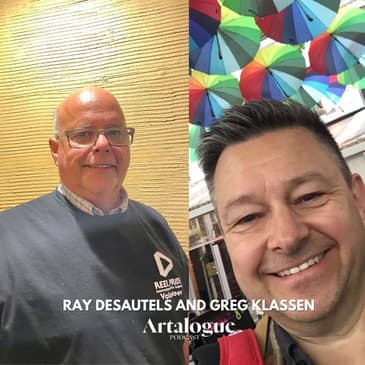
Step behind the scenes of Reel Pride, Canada's longest-running 2SLGBTQIA+ film festival, as Madison sits down with festival president Ray Desautels and marketing director Greg Klassen at Manitoba's Theatre for Young People. This fascinating conversation reveals how a dedicated team of volunteers brings dozens of authentic queer stories to Winnipeg screens each year.
From its humble beginnings in 1985 when LGBTQ+ representation was limited to stereotypical characters, Reel Pride has evolved into a multi-faceted celebration of queer cinema. "We want movies based on our lifestyle," explains Desautels, emphasizing their focus on stories where queerness is central, not incidental.
The conversation takes a compelling turn as we explore how the festival navigates today's increasingly tense political climate. "We're not going to be pushed back into the closet," Desautels states reflecting this year's theme: "Projecting Pride: Loud and Proud." Both guests provide thoughtful perspectives on the festival's evolution, from simply showing films to creating community spaces through art exhibitions, short film showcases, and social gatherings. They highlight international standouts like "Odd Fish" from Iceland and "Some Nights I Feel Like Walking" from the Philippines, showcasing how the festival brings global queer perspectives to Canadian audiences.
Whether you're a film enthusiast, an aspiring filmmaker, or simply curious about Winnipeg's vibrant queer arts scene, this episode offers valuable insights into how cultural festivals can adapt, survive, and thrive across four decades. Discover why Reel Pride remains relevant after 40 years and how it continues to create essential space for authentic queer storytelling. Check out the festival this weekend at the Gas Station Arts Centre and Canada's Museum for Human Rights!
Connect with the Artalogue:
Madison Beale, Host
Be a guest on The Artalogue Podcast
Welcome back to the Artilogue. Today is a special episode because it is a break from the regular programming. As you know, if you follow my Instagram, I've been doing a lot of work to promote Real Pride, which is Canada's longest running 2SLGBTQIA plus film festival. It's a wonderful organization and it's volunteer run, and I wanted to do everything I could to drive eyes to this incredible thing that is happening in Winnipeg. So today's episode is a bonus episode and it also has two guests Ray DeSotel and Greg Klassen.
Speaker 1:Desotel is the president of Real Pride and Klassen is the marketing director for the festival. Both attended the festival long before they started volunteering with the organization. Together we sat down in Manitoba's Theatre for Young People to discuss the festival's history, what's playing this week and what to look forward to in Real Pride's future. I was really lucky to receive passes to this incredible festival and I encourage all of my Winnipeg listeners to check out the festival this weekend. It's running Friday, saturday and Sunday. Friday and Saturday at the Gas Station Arts Centre, and on Sunday there's special programming at Canada's Museum for Human Rights. So, without further ado, greg and Ray, welcome to the Art-O-Log. Thank you.
Speaker 1:What is Real Pride about?
Speaker 3:Real Pride is about celebrating queer arts in the media and queer artists and giving them a chance to shine on the stage and an opportunity that they might not otherwise have.
Speaker 1:Can you tell me a bit about what you both do at the festival Sure?
Speaker 2:I'll start. I've been with the festival for three years, although I've been attending on and off for almost the whole 40. I am currently the marketing and publicity manager, which basically means that I'm trying to create buzz around the festival.
Speaker 3:I am president of Real Pride and I oversee the entire festival.
Speaker 1:Real Pride is a volunteer-driven non-profit community group. Can you tell me a bit about what goes into planning a festival like this?
Speaker 3:Hundreds and hundreds of hours. If I told you, you wouldn't believe me. Every little detail has to be thought of Because we're volunteers, we're not hiring professionals. In most cases, we've got to do everything ourselves. We have to think of every little detail ourselves, whether that's printing out a notice saying where to line up for a ticket, creating the tickets, everything. Thankfully we've hired Greg to do marketing and that takes a huge load off. But every other thing buying a pen, buying a felt pen, buying scotch tape, booking a movie, bringing in a speaker, absolutely everything you can think of has to be done by volunteers.
Speaker 2:And my only thing I would add to that is just that the programming aspect of it is huge, right, Because there's an unlimited amount of films that we can screen, and so you know, I don't know how many we screened this year be somewhere between probably 60 and 80. But it's a lot of work to look at all these films and to get consensus between all these people and to kind of refine our vision enough to know that this film actually fits into it.
Speaker 1:So we're in MTYP right now, which is where you work, Greg. How do you balance volunteering for the festival alongside your day jobs?
Speaker 2:That's a bad question to ask today. The honest answer would be that I was the marketing director for the Royal Olympic Ballet for 10 years, but worked there for 17, and it was wild, and so for now this doesn't feel too bad having two jobs. It's almost easier in a weird way. The truth is that I have a fairly flexible job during the summer, and so I can do Real Pride work a bit more then and then this week and the last week.
Speaker 3:That's when it started to get a little bit wild, because both of them are ramping up and it's not the easiest thing to do, but I'm a little bit crazy and like to be busy and also I really believe in this festival and I'm retired and, quite honestly, otherwise I would not do this job. I would not. I could not put in the time that I do now if I didn't have all the time I have on my hands now.
Speaker 1:And what were you doing before you retired?
Speaker 3:I was in education, in teaching, and I looked after the teachers in the St James Center Boys School Division as the association president. I taught for 30, just over 30 years.
Speaker 1:So both of these jobs have a lot of organizational work as part of it. How long in advance do you have to begin programming these festivals?
Speaker 3:We're starting right away. Next week, Sponsors reports have to be made. Sponsors, their deadlines are all coming up, so there is not much of a lag.
Speaker 1:What do you keep in mind when you're selecting these films?
Speaker 3:I say that we want to tell queer stories that reflect the community, that are entertaining, that are enjoyable, that queerness is part of the story. It's not just because there's a queer character written into the part. That's not the kind of movie we want. We want a movie that's based on our lifestyle, whether be trans or any of the 2s, lgbtq plus community.
Speaker 2:So I would agree with that and add that we're looking for movies that tell stories, hopefully, that this community hasn't seen before, ie, things that are international generally. And, yeah, we're trying to cover the whole gamut of LGBTQ+ and we're looking for that balance of entertainment and art and storytelling and all the things. I also think that it's kind of important to say. Historically, queer films have been and queer art generally has been fairly dark. You know, one of the films that we're showing, bulletproof, is all about that the fact that in the 90s, lesbian characters always had to die, and so I think we're trying to kind of reverse that and be a little more joyful and to come up with endings that don't always feel really tragic and yeah did we succeed in Close to you last night?
Speaker 2:I'm not sure, totally.
Speaker 1:I was going to say last night was the first time that I ever saw a transmasculine, trans man protagonist in like a wide release film, which was exciting. The festival began in 1985, two decades before gay marriage was legalized in Canada. Neither of you were working for the festival at that time, but can you tell me a bit about the festival's history pre-legalization?
Speaker 3:There's different kind of films. You couldn't see a gay character. You never, rarely saw them on television. If you did, it was like a Mr Humphphreys very stereotypical, very flamboyant, mostly always in a negative role. And now the festival has progressed. Films have progressed extremely high quality. They're great stories.
Speaker 2:You could remove all the queer characters and put in other characters in there and you'd still have a great story it was a very different time obviously pre-legalized marriage, I think where people were fighting for basic, basic rights and just to be seen and just to be in society and not feel in exile or whatever. So it's a really different time in terms of the kind of art that was being produced there was no internet, there was no netflix.
Speaker 3:none of that existed. You couldn't get a movie, otherwise, if it wasn't shown on television or go to a movie theater, and queer movies just were not. Those were the ones you saw in the back room, you know, or rented somewhere Dirty, nasty movies. So we've progressed quite a bit.
Speaker 1:We're living in an increasingly tense time right now regarding gay rights and acceptance. Most recently, Steinbeck Pride was canceled due to threats to the parade. How was organizing and programming the festival during such a tense time?
Speaker 2:Well, my answer to that is that we're living in a tense time always, that I've never really felt, as a queer person, completely safe. When I came out when I was 20, I had death threats. So I don't know that as queer people we ever get to feel completely safe. But we've been very careful in terms of how we're, our venue and knowing that we may need to call the police or that we may need some kind of intervention. We've known that for the last few years. It isn't just this festival, I think the other main thing and I loved seeing that last night that 150 people came out to close to you and said we can be loud and proud and we don't care.
Speaker 3:We're not going to be silent, we're not going to be erased. Our theme this year is projecting pride, loud and proud, and that's just it. We're not going to be pushed back into the closet and we're there and we're going to make our festival.
Speaker 1:What do you think has contributed to the festival's longevity 40 years on?
Speaker 3:Great question Evolution. It's evolved. At one time it was just a few movies on a weekend and it grew longer Since. We've added a short film festival, which has become very popular, and we added an art show where young queer artists get to display their work and sell their work, and all that is done at no cost to them. As a matter of fact, we pay them an honorarium to help support them. We keep growing. We've added a food component almost every night to make it more of a social gathering, rather than just let's go see a movie and then leave it's. Let's go see a movie, we'll meet in the crowd, we'll maybe make a new friend and we provide a little bit of refreshment and entertainment.
Speaker 2:Yeah, my short answer would be that we've tried to be relevant to the community.
Speaker 1:What makes this year special?
Speaker 3:This year we did a few things different. During Pride Week we had a free night at Good Neighbourhood Pub where we showed LGBT commercials from around the world. This year we've partnered up with the Canadian Museum for Human Rights and the Winnipeg Foundation and we're showing a special showing on Sunday at the Canadian Museum for Human Rights. So we've expanded outside of our normal little festival and added a couple things.
Speaker 1:What films should people see this weekend?
Speaker 2:Let's each talk about our favorites. The shows on both of the films on Friday night for me are highlights. One is called Odd Fish, from Iceland, and the second is called Some Nights I Feel Like Walking from the Philippines. I think they're just both really interesting views into different cultures and a way to sort of see what queer life is like around the world. And yeah, and they're beautiful. The cinematography is great. They're films I would go and see at any at.
Speaker 3:They're all great. They're great even tonight with Soiree Cinema, the French. Everything is different. It depends what you like. The films are all so different that you could see. You won't be seeing the same thing twice, same kind of film twice. You know. There's a love story, there's a drama, there's a psychological thriller, there's a gay rugby team. There's a gay rugby team.
Speaker 2:There's something for everyone. It's called In From the Side, it's populist and it's entertaining, which is it's got that sort of take to it. It's not something that comes up all the time.
Speaker 1:What advice do you have for emerging queer filmmakers?
Speaker 3:Get out there and do it, make your films and get them in contests. There's contests all over the world. We have a local filmmaker here, rob Macklin, who did a. We're featuring his film oh my Doctor. It's played all over the world and it's won awards all over the world Venice and Berlin and, like it's possible, you don't have to be a big time producer. This film has made lots of traction and it's been like I say all through the world, get out there and do it and get it out there yeah, and I would add like look for a mentor if you feel you need one.
Speaker 2:There's lots of people who've done it who can help you find a way in, and I mean rob macklin is one, gnome gonic is another. There's probably several others.
Speaker 1:I'm going to pick two you could access well, ray greg, thank you so much for being on the artilogue today. This has been a fantastic conversation thank you, thank you.