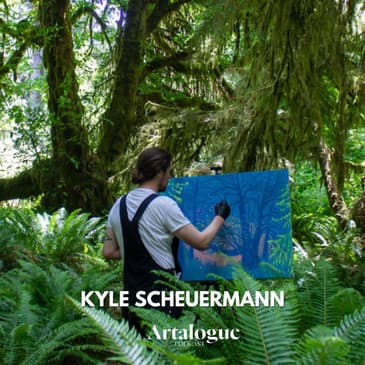
Kyle Scheurman paints more than just landscapes; his art illustrates the urgency of our changing climate and the need for its conservation. Madison's conversation with the artist and dedicated activist focuses on the precarious situation of British Columbia's old growth forests—a tale of both beauty and betrayal.
Kyle's narrative-driven, highly saturated paintings challenge us to see beyond his style and to grapple with the environmental reality they reveal upon closer inspection. Delving into the complex legacy of Canadian landscape painting, we draw connections between the celebrated works of the Group of Seven and Emily Carr, and the contemporary role of art and art history in environmental discourse. We discuss the how the government is addressing the situation, the tireless efforts of forest protectors, and the stark realities of ongoing deforestation in Canada. How can art address these problems, and can art be a solution to them? Kyle shares his journey as an artist who not only pictures the natural world but fights for its future.
Kyle's Instagram
Kyle's Website
View Kyle's available work through Bau-Xi Gallery
Connect with the Artalogue:
Madison Beale, Host
Be a guest on The Artalogue Podcast
Hi everyone and welcome to episode 4 of the Artalogue. Since recording this conversation, there has been a major announcement of a long-awaited nature agreement to help achieve BC's minimum protected areas target of protecting 30% of its land area by 2030. The tripartite agreement negotiated between the BC government, federal government and the First Nations Leadership Council will provide over $1 billion to support First Nations to establish indigenous protected and conserved areas, conservation initiatives, endangered species recovery, compensation of resource licenses and habitat restoration. This historic agreement is a giant leap forward for nature conservation and has a potential to fast-track protection for the most endangered ecosystems in BC, including the imperiled old growth forests. However, there's still work to be done In order to ensure funding goes towards protecting these critical ecosystems. It must be tied to ecosystem-based targets so that the most at-risk and underrepresented areas are prioritized. Otherwise, ecosystems that are not at risk in northern and subalpine areas will be targeted because of their lower resource value. In the meantime, conservationists from groups like the Nature-Based Solutions Foundation, who Kyle has been working closely with, are working to ensure that conservation projects and IPCA's focused on protecting endangered ecosystems and old growth forests receive the funding and resources they need, which can also unlock further public funding. Old growth logging continues in BC, but let's hope that these funds are soon implemented with the expediency that these forests deserve.
Speaker 1:Born in Winnipeg, manitoba, in 1988, kyle Sherman completed his Bachelor's of Fine Arts at the Ontario College of Art and Design, toronto in 2013.
Speaker 1:In 2018, sherman completed his Master of Fine Arts at Emily Carr University of Art and Design, vancouver, where he was given the honour of valedictorian.
Speaker 1:Since 2019, sherman has kept studios in remote wooded locations in order to document the incremental approach of climate change, while simultaneously working on conservation and activism efforts. In 2021, the artist was invited to participate in the Eden Grove AIR a residency at the Fairy Creek blockades on unceded Pachydot territory. During his four months' stay at the blockade camps, sherman served not only as a resident artist, but also as a journalist and legal witness in face of the injustices carried out by law enforcement against forest protectors who were fighting to save some of the last remaining highly productive ancient forests in Canada. Since his experience, sherman has been working towards systemic and legislative approaches to permanent environmental protection, including aligning himself with the Conservationist Group Nature-Based Solutions Foundation as the host of the art auction for old growth. He is also involved in the foundation of a new environmentally focused residency at the Harvest Moon Learning Centre in Clearwater, manitoba, collaborating with experimental regenerative farmers in order to share holistic approaches to land stewardship as a means for new art. Making Kyle welcome to the show.
Speaker 2:Thanks for having me.
Speaker 1:How would you describe your work, Kyle?
Speaker 2:I'm a painter. I always wanted to be a painter. I grew up knowing that's what I was going to pursue in my life, and over the last few years I've learned to think of my practice in a more holistic way, certainly with painting at the centre of it. But now I'm also an activist and I'm a conservationist. And painting as activism, painting as conservation those are the two things that are really the fulcrum of all the work that I do.
Speaker 1:What was your path to becoming an artist?
Speaker 2:Oh, I had a long path. I was very lucky, when I was a kid even, to have some really wise teachers and people to look up to who really pursued told me to pursue art making and who let me believe that being an artist was a legitimate profession that I could go out there and try and have for myself. So I knew from all the way back to being a teenager that I wanted to work for other artists, not just go to art school, but just be in studios as much as I can. When I was 17, I started working for Paul Butler at the other gallery in Winnipeg, and he was the one that encouraged me to move to Toronto, where I switched from the University of Manitoba to OCAD, and it was around that time that I also started working for painter Kim Dorland in his studio, where I ended up working for over a decade total for Kim. I also worked on and off her Haida artist, dean Driever, while I was living in Toronto.
Speaker 2:So I was going to school and I was just doing everything that I could to be around art making, be around the galleries that I was interested in, making crates in the back rooms of some of these galleries, such as Angel Gallery predominantly, and I just did anything I could to stay involved all the way through going to grad school at Emily Carr, when I was in my early 30s and by the time that I had completed nine total years of art school, I feel like I had a pretty good foundation and network around me of people that now had known me or known of me or trusted me in one way or another to take this seriously, and now that I'm 35, I'm very grateful that I can see that long through line, all the way back to being a teenager, of these relationships that are still in my life and allow me to paint every day, and that's really beautiful, I think.
Speaker 1:Yeah, I agree. Protecting old growth forests is really important to you. Can you explain what is going on in Canada with regards to logging and old growth forests?
Speaker 2:It's a very unique situation in Canada because Canada is home to most of the old growth remaining on earth and these forests are very special, very precious, not just to us in BC or in Canada, but right across the whole globe, and we have a real global responsibility to help protect these forests. These forests they store more carbon per hectare than even the Amazon rainforest. They're fire resistant, they're often able to regulate the climate around them and the wet absorption of all the precipitation that sits in stores hangs out in these trees. They're fire resistant. So we need to, especially during a summer where, as of the time we're talking, over 18 million hectares have burned this summer. That's 5% of the total landmass of Canada. So if we had a few more old growth forests around, there might be less fires.
Speaker 2:And when I was living on Vancouver Island, it was right around the time that the government of BC released the old growth strategic review, which was their own funded document, where they were trying to figure out what they should do with old growth. Of course, they'd been logging the heck out of it for centuries at that point. So they released this scientific review saying what we should do, and the first thing on the list was we need an immediate moratorium on old growth logging. That was the number one thing. We need to stop right now. And they didn't stop. And at the same time I could see the approach of climate change happening from my studio. My studio was on the side of Shonigan Lake in the woods, and I remember the first summer that I was there, the smoke from the wildfires coming and sitting in the lake and filling it up like a bowl Just this heavy smoke. And driving back into Victoria from my studio you could see the clear cuts on the hillside and I was new to the island and that was just so obvious that all these things were connected. So when I had an opportunity to go and attend the Fair Creek blockades, that's when my knowledge really took off on these things.
Speaker 2:I became so curious about learning as much as I could, because there's roughly only about 2.7% left of the highly productive valley bottom old growth forest left, and of course there's a lot of numbers that you hear out there. Even that number I can't speak to you with that much certainty. But in terms of the highly productive, you know what we think of, where the biggest, oldest trees are, those trees that we see sometimes in National Geographic magazine or things like that. Yeah, there's not a lot of that left. So right now, the state of old growth is that after three years now, since that old growth strategic review was released by the government of BC, nothing has changed. They're still doing as much as they can to cut down those forests.
Speaker 2:Right now, while we're speaking in this moment, there are people in tree sits working to protect the land, working to blockade the land on unseeded territory. West in BC there's also incredible conservationist groups fighting hard to protect what's left through mechanisms like conservation financing. That's the group that you mentioned at the top there, the Nature-based Solutions Foundation. They're really leading the way right now with trying to protect the forest because the government simply won't. The government continues to sell these tree farm licenses of the last remaining old growth that we have. The conservation is increasingly more important.
Speaker 2:And then there's incredible NGO groups out there that are trying to just raise awareness as best they can, of course big ones like the Sierra Club. There's also groups like the Ancient Forest Alliance or the Endangered Ecosystems Alliance. So there's this whole kind of push and pull network happening where the government is. What we most commonly say is talk and log. They get up there and they give a big speech about we need to protect the land and we're going to produce the furrows here, and then they just show up and they log it anyway. So there's that one side, and then on the other side there's the incredible work by the activists and the conservationists and unfortunately, in my opinion, right now it's a bit of a stalemate. There's a real uncertainty for what's going to happen to those forests going into the future.
Speaker 1:Do you think Canadians or the world at large really understand what's going on or the full repercussions of the situation?
Speaker 2:No, and that's maybe I'm naive to think that it's surprising, but at different points in my life I've been very lucky to live in other countries In Europe. I've kept a lot of good friends. So when I really became invested in this work and I started to share this knowledge with friends that I had in Europe, I remember hearing a lot of feedback along the lines of I thought you guys stopped doing that in the 90s After the first war in the woods in the Carmana Valley where they protected the Carmana Forest. Carmana Wall Brand Provincial Park is what it's called now. That was protected in 1990 as a result of a large activist movement and several artists out there.
Speaker 2:So there's this belief globally that we've stopped doing it, and then also domestically there's this belief that we don't really do it anymore, we don't really log these ancient forests anymore, or that maybe it's slowed or transitioned in some way. Although a lot of my work is focused on climate crises happening out west, a lot of the dissemination of my work happens out east, predominantly in Toronto, and a lot of the collectors of my work and people that are interested in my paintings I hear similar feedback. Really, you're still doing that. Wow, I didn't realize that, oh, we should do something about that. Yeah, so I think that's part of the mechanism that's in place here. Right, the talk and log again. Let's get up there and give a big press conference that there's new deferrals on the way we did it. We solved the climate crisis, everybody, we're going to never mind. Actually, we're going to go cut a few more ancient trees. So, yeah, we're unfortunately sold a lie and it's easy to believe if you're not up close west.
Speaker 1:Yeah, I think so many people are removed from it as well, which contributes to the problem and all the misinformation that goes out there.
Speaker 2:Yeah, I just want to make it clear that of course there's all kinds of old growth, such as alpine old growth, and there's old growth and that's not accessible in ways that could be cut and whatnot. That less than 3% number that's commonly thrown around is specifically the valley bottom highly productive old growth forest. But that's the forest that most people have that almost other worldly connection with right. It's accessible. A lot of these places Avatar Grove is maybe the most famous of these places where people can go and have experiences of these woods. They can hike them through the thin trails that might be cut Through different spaces. It's the most lush, the most green. They have the most number of different species and animals, different plants, insects. Where life is just overflowing are those valley bottom highly productive old growth forest and that's been the focus of my work, those specific forests.
Speaker 1:So you spent a lot of time in different blockades bearing witness to events, and I wanted to know what is it like to be at a blockade and create there?
Speaker 2:Yeah, my experiences have been ever-changing. I gotta say. When I first went out to the Fair Creek blockades in March of 2021, it was just a watch camp. There was just some pylons across the road. And I also want to make clear, too, that the Fair Creek blockades were a series of blockades that were spread over several kilometers on the Cheedot territory. So there was the main HQ camp, there was Ridge Camp, there's all these other camps that popped up, and I was predominantly stationed at Eden Camp, which was just in front of Big Lonely Doug, which is a very famous tree. A lot of people have maybe even read the book about Big Lonely Doug. So, yeah, when I got to Eden Camp for the first time, it was just some pylons on the road and some people camping out and, oh yeah, we heard there's gonna be an artist coming up. Cool. I went out.
Speaker 2:I was invited by a friend of mine, jeremy Herndle, who was also out there painting and living at the camp, and it was pretty easy going for the first little bit. We knew that stuff was coming. We could get bits and pieces of the news out there about what was going on in the legal system. P enforcement was on the way. We knew that, but there wasn't an injunction just yet and everybody was feeling it out. And then, over the course of the summer, enforcement started to happen more and more at different camps. So there'd be like little trickle down bits of news oh, there was enforcement on KQs at KQs camp. Oh, now they're trying to get the, but it was all. We don't have cell phone communication out there. So this kind of tension slowly built over the course of the summer that led to this incredible peak towards the end, where enforcement got really incredibly aggressive, incredibly violent, especially towards indigenous forest protectors out there protecting their territory, their unseeded territory. There's a number of people injured, unfortunately, lots of terrible scenes pepper spray and things like that that made it famous in the news. I'm sure that you might have seen some of those. So, yeah, there's this big crescendo at the end of the first summer of 2021.
Speaker 2:But I got to say that the whole time that I was out there, one thing that really just made me feel so valuable to the community was that the forest protectors, the people who were willing to give up their civil liberties in order to protect these trees, these people that were there to put their bodies between the saws and the trees, they saw the value of the art. I was out there to make paintings and work as a journalist and as a legal witness, as you said at the top. There I did a little bit of legal witness training and I had a press pass for a while. So the first summer I wasn't at risk of I didn't think at least I was at risk of getting arrested. But the folks out there that were actively getting arrested they wanted to make sure that myself and other artists that were working out there got access to the forest as best they could, that we had the time to work, even things like making sure that we had a good meal. There was always big communal meals that were cooked. And we'd go, jeremy and I, especially if we'd go way out into the bush to paint. We'd come back and there was always a hot meal for us. We'd come down to camp at the end of the day. So that was the experience of the first summer.
Speaker 2:But, like I said, it reached this really incredible, hence heated, point, becoming the biggest act of civil disobedience in Canadian history almost 1200 arrests. So that meant that by the time that the second summer came around, everything had changed. It took on the blockade that I participated in. It was on a different territory. It was on Diddy dot territory, not Pachy dot territory. It's not neighboring territory. It become unaffiliated with the larger body for a whole bunch of different reasons that had facilitated the first round of the Ferry Creek blockades.
Speaker 2:Security culture was something that was expressed all the time like mask up, took down over just your eyes. Everybody's wearing black, we're only wearing black. Throw a big tarp over your vehicle as soon as you get there and nobody says anything to anybody. Exclusively camp names always changing your camp name, and that's because the RCMP wanted it to be that way. There's only scare tactics that were involved to make it so that it was harder to organize and unfortunately this summer I was back out there.
Speaker 2:I wasn't staying in any of the camps this summer, in part due to an extension of the injunction being delayed. Another couple of years, or 18 months or so is what happened, just as I was getting out there. So I didn't actually end up at any blockade camps this summer, but there was this sense that everybody was worn down and there was a little blockade that popped up shortly after I was out there, right in the middle of the summer and the RCMP just came and crushed it instantly. Just they didn't let there get any momentum. So the tactics have changed entirely on on both sides and, yeah, it's a little bit heartbreaking to to see just how the media has portrayed it or wrongfully portrayed it in some cases and the spirit of some of my friends out there as it's been changed over the last few summers.
Speaker 1:Is there any hope in the situation?
Speaker 2:I think I'm certainly guilty of being nihilist on all of this, and one of the reasons why I love my friends out there so much is because they are, in many cases, much more optimistic than me. Yeah, in particular one friend, I think, about chickweed chickweed. She's just so optimistic about these things and this quick to call me on it when I'm being too pessimistic. And I'm very intimate that she put forward to me about how every action that she takes, even if it's pulling invasive Ivy, these invasive species that come and take over these trees and choke out these trees, even if her act is just simply to pull this invasive Ivy off this endangered tree, her action matters to just that one tree, and that's important. Unfortunately, the rest of the old growth forest is already gone. So what? What we have left are, in many cases, just symbols, but those symbols are important and that gives me hope.
Speaker 1:What are the?
Speaker 2:symbols represent for you, and all the reasons why I go to the forest in the first place. I am very aware, bodily aware, that I am so much more in tune with myself, with all of my senses, when I'm in the forest. My thinking is clear. Any of the lingering depression or anxiety that I might be feeling seems to shed away. I'm focused, I'm good, I'm good at everything just a little bit more when I'm in the forest. I'm a better builder and a better painter. I'm a better hiker and more fit, like all of these things that seem might seem trivial. After a number of years of being in those forests, I really believe that's true. I've seen it act out enough now that I know that it's true. So that little glimmer of hope that's still left there, that's, that's what keeps me going on with, what keeps me painting and wanting to get back out there to make paintings in the forest.
Speaker 1:How has becoming politically involved changed your painting?
Speaker 2:My paintings are much more urgent now. They were much more immediate. That's both materially and in the content of my paintings. Even though my paintings have slowed down, which I know is a juxtaposition to what I said, my paintings are much slower in terms of process and detail and being meticulous about layering paint and things like that the imagery is really immediate, often showing some of these scenes that I've talked about enforcement and the other things that are going on in the forest with regards to loggers and some of that imagery.
Speaker 2:Increasingly, climate change and the effects of climate change are working their way into my work. Forest fire is a big theme in my work right now, and actually forest fires started in my work even before I went out to the blockades for the first time, and these things they have to be immediate in their material use as well, so the colors are brighter. And then, on top of that, I would say probably the biggest thing that changed in my work is that I really think of all of my paintings now as narrative-based paintings. I've had so many experiences out there now good, bad and indifferent, some of them scary, some of them incredibly serene, sublime even, and everything in between, and I feel a real responsibility to allow those experiences that I have had personally, in concert with other forest protectors, in concert with the land, with animals, with fire. I want all that to play out in what to me, I'm increasingly aware is a long, continuous narrative that links paintings together. Now, so in my paintings there's often multiple figures or multiple animals, or the painting that I'm working on right now. Just this morning I counted as 50 birds in it. That's a lot for me. I've never painted that many figures in a painting before, these narrative scenes that link their way back to my experiences out in the forest when I was working.
Speaker 2:In journalism this like slow journalism. It's one thing to take a photograph and have that be immediate and in the news within a few hours in some cases, but what does it mean? To collage together a whole weekend of experience, possibly, or a whole narrative scene for many angles, where there's one thing happening, maybe on a bridge or something like that? How can I take a few hours of that experience? What happened on the bridge, what happened beside the bridge, what happened under the bridge? What happened in the sky, the helicopters or whatever that might have been circling? How can I knit that all together into one piece of slow reporting that maybe in some cases might be a better portrait of some kind of truth, or some kind of perceived truth, than any photograph might do. And the more that I do it, the more that I feel that I have a real responsibility to keep doing it.
Speaker 1:Yeah, I'm really reminded of Goya's Disasters of War series.
Speaker 2:Oh, I just was looking at him yesterday. Yeah, I had him yesterday on the screen.
Speaker 1:I love Goya, and when you talk about documenting, that's what I think of when you're bearing witness to these events and in some ways, or in a lot of ways, it is a fight right, it is almost like a war to preserve these places. So when you're talking about bearing witness and the long and slow record of the process, that's what comes to mind for me.
Speaker 2:No, I totally agree, 100% agree.
Speaker 1:Yeah, Goya's work is so good. In what ways do you think that art can create change?
Speaker 2:Those Goya paintings are pretty devastating and that's a whole lineage into its own. But in regards to making change, there's a lot of painting over centuries and centuries right that try and do that, not necessarily always for good, of course, the history of art is full of propaganda for all different types of reasons, across all different types of cultures and societies and stuff for centuries and centuries now. But I think that painting, if done effectively, can allow a viewer, can allow people to see things in a different way. I'm a big advocate for paintings that give space for the viewer to project some of their own lived experience into the painting as well. So in the case of these paintings of the forest, maybe you've never been to an ancient forest before, maybe you've never been to BC before, but most people have some kind of experience of a hike in the woods. Or maybe they live in rural areas and there's a forest behind their home or something like that, and these are often places full of exploration, whimsy or whatever it might be. So, even though my paintings can be incredibly heavy and difficult in their content, I like to imagine that there's space in my paintings that allow a viewer to have a certain layer of empathy, at least for the land, and if a viewer can enter the painting, enter one of my paintings or any painting for that matter in a way that is also embodied to them, that's going to allow them to maybe see things a little bit differently.
Speaker 2:I'm very aware that there's a trick. There's a bit of trick happening in my paintings, where they're incredibly saturated and lustrous and full of all kinds of heavy, diverse textures and the scale is increasingly larger as I make more and more of them and all of those things that are it's a complex word, obviously, but trying to be beautiful or enticing or stimulating in some way, while they mask the difficult narrative that's actually happening in the content of the painting. And trying to use that trick if that's the best word I can come up with to get a viewer to intuitively want to look, especially when they see them in person. Maybe get a little bit closer, look at the bright color in the sky, or actually take one step closer before they realize, oh, they're cutting those trees down or oh, the whole hillside's on fire and that lovely, sumptuous quality of paint that I'm so addicted to. I'm hoping that it allows viewers an easier access point to the complex narratives in my paintings.
Speaker 1:I'm really intrigued by what you said about landscape and art as propaganda as well, because I think that has a unique relevance to Canadian art specifically, and so my question would be do you see your art as being in dialogue or in conversation with that canon of landscape, painting and Canadian art, especially when you reference artists like Emily Carr?
Speaker 2:Yeah, chasing down the ghosts of Canadian painting is certainly core to my practice too, because Canadian painting cannot be separated from the history of colonization in this country. Certainly, Canadian landscape painting cannot be separated from the history of colonization, as most obviously seen by the group of seven. Right, those paintings in a contemporary context can be read as propaganda. A number of years ago I did a residency at Georgian Bay, Ontario, which of course is the site famously painted by lots of group of seven members, and I remember spending a lot of time over the course of two summers or I suppose a summer. In a winter I would go out and try and find the sites where a group of seven made paintings and I remember going to find a place where Varley had painted a large three by four foot ish painting landscape. I maybe heard a rumor that there might be like a smudge of paint on a rock somewhere. That was still there and they're like I'm going to go find it for myself. And I got there and I find the spot and I'm looking out over the vista that he painted and there's a cabin in the scene that's not in the painting and I did some research on the cabin and I found out that it was a heritage cabin and then it was actually built in like 1903 or something like that, even though this Varley painting was painted six or seven years after the fact and he chose to omit it, just to omit the cabin. I know that might not, maybe that's trivial, a really small example, but there's a romanticization there of the Canadian wilderness and the new frontier and all this nonsense that they're trying to depict, as these paintings were getting sent back to Europe in a lot of cases, or trying to be some kind of a portrayal of nature in Canada that was alive by that point. Like by the time the group of seven were painted, all that land had been clear, cut two or three times over, so it was a facade, those paintings. And I grew up loving those paintings and I still love those paintings, even though I look at them through a much different lens now.
Speaker 2:And I know that there's been a lot of new conversation around Emily Carr's work and maybe some of the appropriation and the imageries that she's used, and of course that's important to look at. But I do get a feeling, at least from Emily Carr, that there was an attempt to understand the rightful caretakers of the land in which she was painting and that there was a real attempt to communicate with the indigenous cultures, specifically on Vancouver Island where she was painting. That was sorely lacking from the art that was happening out east at the time. Now, like I'm just talking about landscape painting right now, I realize there's lots of other examples across lots of other Canadian painting painters, Canadian painting disciplines, of course. But yeah, a part of my work too, also in the last few years, has been going to try and find some of those same spots where Emily Carr painted as well, going all the way up north on the mainland trying to find some of the sites where Emily Carr had painted different scenes and whatnot.
Speaker 2:It has a different feel. Maybe it has a little bit more of some of those kind of journalistic qualities that I'm talking about. We look past them sometimes when we look at Emily Carr's work. But there's a lot of stumps in Emily Carr's paintings, a lot of big, massive stumps. There's a lot of short, brushy trees and then a hard line and then big, massive, monster old growth trees right next to them. It might be easy to just think of those paintings as landscape painting, but they're documents of earlier logging, documents of environmental destruction, and a lot of our writing reflects that too. So, yeah, of course, painting is a conversation. I'm very grateful that the painting that I do is not just a conversation with other contemporary artists, other artists that I am lucky to call friends, that we're responding to each other in real time right now. But also, time is a bit of a flat circle when it comes to art history in that way, and, yeah, I'm certainly in direct conversation with Emily Carr when I'm painting.
Speaker 1:Yeah, how do you see your work developing in the future?
Speaker 2:I'm increasingly learning to trust myself with these increasingly complex compositions. I really feel passionate about continuing to investigate that. Lately I've been making actual collages, rather than just the collage logic of combining all these different experiences. As I was talking about earlier, I'm actually now taking photographs and drawings, and sometimes video clips and sound recordings or text message conversations or notes, and I'm putting them all into the computer and in Photoshop. I'm actually collaging them together digitally or putting them into different folders and arranging them in different ways. So I'm learning to trust this process of collaging a painted narrative well in advance of actually starting on a large canvas.
Speaker 2:Usually that collection ends up getting distilled into some kind of a work on paper, maybe a small painting, a small oil painting possibly, and then all of that information becomes the prerequisite for a large painting. So I know that the next body of work that I'm going to be making here is going to really push the boundaries of what does that mean, such as maybe painting 50 birds in one painting. But I'm very lucky in the next year to already have two confirmed exhibitions, both with my gallery representation here in Canada, bogee Gallery, and they have a space in Toronto and Vancouver. So I'm going to have a show in Toronto in April and then in September in Vancouver, and I'm approaching this as one long project too, which will be the most ambitious thing that I've ever attempted. So now I'm already forecasting not just narratives within one painting, but linking together multiple paintings to tell a cohesive narrative that is first steered at that Eastern audience who, as I was saying earlier, maybe doesn't have the history or the personal knowledge of what's or the lived experience of what's happening with climate crisis and deforestation at West, and then pulling that all the way to Vancouver to have a more intimate conversation with folks out there who live with these realities every day.
Speaker 2:So I don't know what that's going to look like. I've got lots of ideas, I've got lots of notes, I've got tons of research. It's all there, it's all ready to go, but one of the things that I find the most exciting about painting is that not knowing, trusting that the literal, active painting is going to reveal meaning in the process, right, that a painting is going to come along to a certain point and it's going to require something of me or ask something different of the research or a revisitation of the research, or maybe it's going to require a follow-up conversation with another force protector or Lance Stewart, or something like that. So I don't know what's going to happen, but I feel really grateful to be able to set an intention, like I've just been doing over the last few weeks here, to create this year-long project across two exhibitions.
Speaker 1:Yeah, it's incredible. I can't wait to see what you come up with so exciting.
Speaker 2:Me too.
Speaker 1:My final question is what advice would you have for people looking to become an artist or looking to become an artist that fuses activism with their art?
Speaker 2:The unfortunate advice I taught a course when I was in grad school is a lot of grad students do, and that was always another question how do I be a painter, how do I? And the unfortunate answer is make more paintings. That's not necessarily always satisfying to people but, yeah, make more paintings. That's the only way. I'm a firm believer that everybody on earth has a way of painting that only they know how to do. There's a way of painting that only you know how to do. There's a way of painting that only my mom knows how to do. There's a way of painting that only I know how to do, and they're all different and they're all unique and of course, there's going to be varying levels of success within those different ways of painting. But I am confident that if you want to find success within painting, then you got to go find out that way of painting that only you know how to do, and that simply means make more paintings.
Speaker 2:How do you do that? That's a lot of time and a lot of commitment in the studio, but it's also a lot of lived experience, right, that's I think that's been the through line of our conversation so far today is doing it, being on the ground, whatever that means in any given case. Maybe that's activism, maybe that's invested in some kind of travel or some kind of exploration or adventure, or maybe it's within your own community, or even within your own home, within your own family network. Whatever it is that might interest you or feels like it's something that you genuinely and passionately want to pursue. You got to live that entirely as best as you can and allow that to become the content of your paintings in some manner. Now, that doesn't necessarily mean in a didactic way, in a one-to-one representational way. The result of that could be abstract paintings, minimal paintings, could be performance or sound installation or something totally different. But interesting artwork comes from interesting lives A big believer of that too. So yeah, just make more stuff, just go make more stuff.
Speaker 1:Yeah, I think that's great advice. Do you have anything else that you want to plug before we end off?
Speaker 2:Yeah, maybe I just want to use the opportunity really quickly here to just say once again thank you to all of the incredible people that just helped make the art auction for old growth such a big success last week. This is our second year. This year we had 22 participating artists, which was a bump up from last year even. The goal of the project was to unite artists from right across the country to help protect what remains of BC's most endangered old growth forests, and in two years we've raised over $60,000 doing this now. So I'm very grateful for that and the plan is to do it again next year. So I know that's a long ways away from now. That's well into the future plug. But yeah, all the money that we raise is in support of the Nature-Based Solutions Foundation.
Speaker 2:This year they're two big projects. Currently they're two big projects are the Kanaka Bar Band IPCA IPCA stands for Indigenous Protected and Conserved Area and the Salmon Parks Initiative on North Vancouver Island, where they're, in total, going to be protecting over over 1,000 square kilometers of endangered old growth forest. It's a really important project, really important group of conservationists who's just come together. They're a little bit like the Avengers of conservation. They've come together from these different groups to form this new Nature-Based Solutions Foundation to implement this novel and Canada at least this conservation financing method to just buy the land and give it back. Of course it's more complex than that, but an easy way to think about it is to use private money to buy the land and give it back to the natural ancestral caretakers of that land to implement strategies and programs that allow them to have prosperous communities financially, holistically, in every way, without cutting their ancient forests. Yeah, very grateful to be raising money for the Nature-Based Solutions Foundation and I hope we can raise a lot more in the future.
Speaker 1:Great. Thank you so much, kyle, for your time today and for taking the time to talk more about what you do. I really appreciate it.
Speaker 2:Thanks for having me.