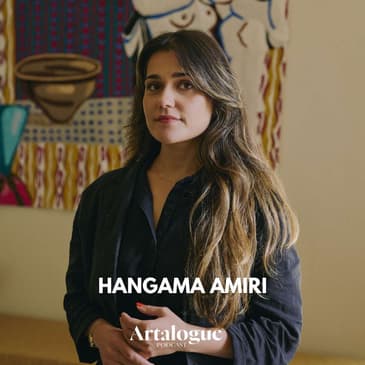
Hangama Amiri, an acclaimed Afghan-Canadian textile artist, joins us to share her remarkable journey from painting to textiles, drawing deeply from her Afghan heritage and personal history. In our conversation, Amiri explains how she transforms fabrics to tell a story with her art and how powerful the medium is to express authenticity and connection.
We also shine a light on the resilience of Afghan women through salon culture, a fascinating aspect of Amiri's experiences during her visits to Afghanistan that have become prominent in her work. These salons are more than spaces for beauty—they are bastions of resistance and entrepreneurship in male-dominated settings. Amiri reflects on the art world's often narrow views on textiles and shares insights inspired by her academic journey, challenging the notion that textile art is merely craft. Her experiences at NSCAD and Yale underscore the importance of diversity and representation in fostering artistic growth and confidence.
In our final segment, Amiri reflects on her transition to an independent artistic practice and the freedom it offered to develop her unique voice. Aspiring artists will find her advice invaluable: understanding your relationship with your materials and staying true to your intuition as key to authentic expression.
---
Hangama Amiri holds an MFA from Yale University, where she graduated in 2020 from the Painting and Printmaking Department. She received her BFA from NSCAD University in Halifax, Nova Scotia, and is a Canadian Fulbright and Post-Graduate Fellow at Yale University School of Art and Sciences (2015-2016). She is also a Kaiserring Stapendiatin of 2023 by Monchehaus Museum in Goslar, Germany. Her recent exhibitions include A Quiet Resistance (2023) at Monchehaus Museum, Goslar, Germany; A Homage to Home (2023) at The Aldrich Contemporary Art Museum, Ridgefield, CT; Sharjah Biennial 15: Thinking Historically in the Present (2023), Sharjah, UAE; Reminiscences (2022) at Union Pacific in London; Henna Night/ Shabe Kheena (2022) at David B. Smith Gallery, Denver, CO; Mirrors and Faces (2021) at Cooper Cole Gallery, Toronto; Wandering Amidst the Colors (2021) at Albertz Benda, New York, NY; Spectators of a New Dawn (2021), Towards Gallery, Toronto; and Bazaar: A Recollection of Home (2020) at T293 Gallery, Rome, Italy.
Follow Hangama on Instagram
Cover photo taken by Denis Gutiérrez-Ogrinc.
Connect with the Artalogue:
Madison Beale, Host
Be a guest on The Artalogue Podcast
Hi everyone, welcome back to the Arlog. Today I'm chatting with Hangama Amiri. Amiri is an artist that works predominantly in textiles to examine notions of home as well as how gender, social norms and larger geopolitical conflict impact the daily lives of women both in Afghanistan and in the diaspora. Her work has been shown around the world and I'm especially drawn to it because of her masterful grasp on the textiles she uses their bright colors and how her work tenderly engages with traditionally female spaces. Continuing to use textiles as a medium, amiri searches to define, explore and question these spaces. The figurative tendency in her work is due to her interest in the power of representation, especially of those objects that are ordinary to our everyday life, such as a passport, a vase or even celebrity postcards. Right now she has work on display with Cooper Cole at Art Toronto and booth C30, so make sure to check that out before the fair closes on Sunday, the 27th of October 2024. Without further ado, welcome to the show. Hangana.
Speaker 2:Hi Madison, thank you so much for having me. Can you describe your art practice? Sure, I've always been, I guess, as an artist. I've always been interested in the themes of like childhood memories, like identity, but also creating a space for, like contemporary voices from Afghanistan, specifically focusing on women's social and gender economy, but also spaces that they are making in that political landscape. So for me it's really important to bring those voices through my textile products, and my medium is fabric. These days it takes a lot of dominant role in the practice, since I used to be a painter. I started as a painter, but then the grad school slowly changed towards fabric. These themes are really explored and expanded through this medium. Usually.
Speaker 1:When did you know that you wanted to be an artist? That's a good question.
Speaker 2:I think it was really young. I was very young. So in my family my older brother was an artist. Growing up he had the penmanship in a sense, like he used to draw portraits, and watching him as a child I got really inspired. And this was way back in Afghanistan. Then he continued working on drawings, like even in Pakistan that we lived or when we became refugee, and also one of my cousin was an artist too in Pakistan and he actually used to go to school, to an art school. So having these two role models in a sense are just like a way to get myself introduced to the art, to the drawing. I got really inspired and I was I believe I was only nine or eight years old that I also started to pick up pencil or color pencil and just start drawing.
Speaker 2:The more I got serious into this practice was when we were refugees and or like free refugees in Dushanbe, tajikistan. So I was grade eight. I still continued making drawings, but not in a sense of seriousness, I would say. And during those time we were also being supported by UNICEF and organization and these programs always had creative workshops for children and for adults and you could apply to them and then you would get like a certain prices or scholarships, things like that. So during those times it was early 2000s, I would say 2001 or 2002, that I applied for this art workshop and my piece got first place and it was a drawing of I never forget this I did this drawing of a statue of Buddhas of Bamiyan and it is in a landscape that is being reconstructed by new people going back and reconstructing this. That first place took me an opportunity to do an art college for two years and it was really fascinating.
Speaker 2:I was very young I was, I think, grade six or seven that I dropped to school and I went towards art. So I was hanging out with people that were like triple ages than me. It was really great and I learned a little bit Russian because they speak Russian. That was their second language and every subject that we learned it was all about introduction of Russian arts and post-socialism as well. So I just fell in love with the practice of drawing, practice of observation, practice of design, even, but through a very Russian pedagogy of what art is so very like academic, very observational, and having those skills just opened up another world for me. And from that age, as I was like 13, maybe by then, as I think I want to be an artist. This is amazing.
Speaker 1:What made you gravitate towards textiles from painting?
Speaker 2:That's a great question. I think in my painting I used to be really fascinated in bringing cultural materials into my work, whether those cultural materials would be patterns or certain fabrics or certain texture of a fabric that I was interested to paint on my figures, right. So that idea of getting the exact fabric, getting that sensuality through oil or through acrylic paint, it just becomes so harder and harder for me because I really was earning to oh, what is it for me that I'm so obsessed with this sort of ideas of familiarity, ideas of touch, ideas of this kind of like authenticity in that space. So the more I think I question my relationship with the medium of paint and the more I become drawn with the material, with the content that I was painting. Again, these were the fabrics that I wanted to put into my figures in order to have some form of identity or context for the figures. And I think through that phase I started to do a lot of collages and I started bringing patches of fabrics and cut collages of fabrics and then, with the paint and then do painting on the side as well, paint and then do painting on the side as well. So these kind of assemblages of different materials opened up my world into fabric, into using soft material in order to make painting, and they were still in the language of painting at the end, which was really interesting, because I came as a painter, I'm still as a painter, but my medium is now fabric, so I just become so in love with this material.
Speaker 2:And then the other point was also that the more I questioned the history and my relationship with this material was also that growing up we didn't have many tools or we didn't have watercolor. These were very expensive materials to grow up with and I guess we were really poor and the only thing that we were so creative and we had our hands on was these fabrics and cloth and we would make like little dolls, little things outside my girlfriend's. So this was my foundation of material. So I think that also had to do in my adult life as an artist that those foundational aesthetic that I was so introduced to this world, which was fabric and cloth and shreds of embroidery that I was used to, taught that kind of became elevated more into my practices. What is craft? Because I was taught that craft or anything to do with soft material is not art, it's not finance, it has to be painting. So that's also a question of like how I've been educated through this Western canon of one thing only that is, art should be painting. But just like questioning that power as well, but also bringing this fragile material and putting them in the same lane or aligning them with the painting was also a challenging part to do too. So just like starting from zero again in order to find my language as an artist. So that was really beautiful as well.
Speaker 2:I grew up in Kabul. One of my uncles was also a tailor I guess I talk about this a lot in my interviews and he actually had a small tailor shop that was very close to the apartment that we used to live in, macriano Kohna, and before school I would stop at his shop and I would be introduced to fabrics that he had in his own shop, in his own shop, people that would work for him as well, the sounds of scissors, the sounds of linens and beautiful. But he only would tailor for men, not so much for women. So you could see the colors are a little bit muted and subdued. So these were also like a foundational spaces. That kind of brought who I am as an artist today.
Speaker 1:Do you find working in textiles to be more freeing than paint?
Speaker 2:Yeah, that's interesting.
Speaker 2:I think in painting I had this solid constructed frame that like nothing can go outside of certain frame or certain scale, that I was working and it was either rectangular or vertical and that idea just like the frame just was. So this idea of perfection, and part of me also wanted to just let it loose, like what happens if I take the stretcher bars away. How awkward I could have through this canvas even. I think I've always been into that idea to let me rip this off and free the fabric more of this structure. Because I'm really also drawn to work with memory and I've mentioned this before because memory is a portion of an event. It doesn't have the beginning or the end, it's something that lies in between and stays in between. It's something that lies in between and stays in between. It's something that doesn't have perfect frame, it doesn't start with A and B right, it's something in between, and that in between could be also this fragmentation, this fragmented world.
Speaker 2:And that's what I've become really interested to get rid of the stretcher bars and just use the canvas as its own fabric, as its own veil. And it's really freeing, because now with fabric I could stretch my entire wall, I could create a whole world of my childhood, which I have done a little bit in my solo show like Bazaar, a Recollection of Home. It was really fascinating to see how fabric could stretch so far because rip apart so much memories. And it's really freeing because your entire body works into that process. So much color, so much folding, so much stretching, ripping, cutting, the sound, it all. It's very performative. At the end it becomes very theatrical in some sense too. So it is very freeing, I would say.
Speaker 1:So your work now features many women's salons in Afghanistan, and I'm curious what is it about these spaces that's become so compelling to you?
Speaker 2:as an artist, I grew up among a lot of women as a young girl. This is also because my mom was away from her husband or from my father due to migration for nine years or so, because he was seeking asylum in Europe and she was in East Asia. So you can imagine a single mother, literally our age by now, with four kids in a foreign land. So she found a community for herself which were all women, and so she would take me to the salons, to all the celebratory events that she would go, as if these spaces were by women, for women, made for women, whether a woman wanted to be beautiful, whether they wanted to feel a little bit a sense of freedom, a sense of belonging, a sense of community. And I think, growing up and observing these spaces for today, when I see these spaces, it plays a huge, vital role because, yes, women in those societies, you know, there's a lot of gender construction spaces that are about women don't feel too much free to their hairs while there is a man sitting, so you could see a little bit like the gender landscape is a little bit different. So for me, seeing those, I just found a sense of coolness about it as well, because it was just so interesting, so amazing, that women, even though whatever landscape they're living, they're still finding this space to come together, to feel beautiful inside this space, which is also in the public space too, and I'm specifically talking about salons. And also when I went back for the first time in 2010 and 2012, I saw a lot of salons that were made by women. Like there were a lot of business, women and entrepreneurship, which was something very new wave to see from Afghan women.
Speaker 2:After 25 years of war, it's not easy to really think about those specific spaces to flourish again, to be open again after like 20 years of silence of women not even could not even go outside. Seeing that change was really vast for me, because when I left Afghanistan it was very quiet. Things become really silent. Women were really in danger, specifically their spaces of businesses especially.
Speaker 2:But I think when I went back, things changed and women were again carving their names on the streets, carving their names on the banners, and you would see that like a beautiful voice of women's representation in public, and that was also a form of resistance, a form of taking over, a form of making a space for themselves in those male-dominated constructed landscapes. So for me that was really inspiring and going into this salon was that fashion, that contemporary nuances, that they were living and they were feeling really liberated. I get really excited that also, when I include these subjects in my work, that's also a form of resistance, that I'm also carving some space in the art history because we don't really see much of this in my work or through my work or through fabric work. Even so, that's another context to talk about as well. In the arts we don't see that much of these spaces being redrawn or restitched in our art history. So for me it's a beautiful battle to see the reality.
Speaker 1:I wonder if you can speak to the connection that a lot of people make between femininity and textiles. Does that feel relevant to your work?
Speaker 2:Yeah, I think it will be relevant because it's one of the tools and access women had in my culture and they always have. This is something that we all know by heart. This is something it's not so much of a woman's duty, but women tend to have these tools in their home. It's also economic, so they don't have to take their ripped jeans or ripped shirt or fallen buttons to a tailor. They would just know the tools of embroidery and they will just do it at home. So this is something that were passed along to whoever younger daughters they had, even sons they had, so we all know how to stitch. So it was one of the practice. That is like a mundane practice, to be honest, so nothing to do with in relation with the femininity or masculinity. This is a tool that we all should know how to do embroidery or how to mend things. But of course, when we put it in the art history, in the contemporary art history, there's another huge battle there as well, that they always categorize craft or anything that's soft material to be women's hobbies or women's activities and they're just doing it for fun. But it's not really. It really depends on those, on that artist, of what she wants to reclaim her practice to be right.
Speaker 2:I think, speaking on that note, I was really inspired I still am very inspired by the artist Faith Rangel, because she fought those language a lot, because she would call herself as a painter, because she would paint on quilts, on fabrics, called her practice as a craft and she got a little bit defended. She was like what do you mean? Because you also paint on canvas, you're just installing it. Different, it is fabric, it is still quilting. It could be also craft.
Speaker 2:So the fact that you're calling my work craft because it has that quilting technique but there's a lot of paint on it, so why can't you see my work as a painting as well? It really I think it's just the canon. It's been the art history canon that always divided things what is valuable more and what is not, what is more masculine and what is more feminine or what is more queer. So it's a battle we all have to really go through but really understand what is happening. I think every artist has a right to see what they want their practice to be or categorize, and they also have that choice.
Speaker 1:So, speaking of learning about the art history canon, how did art school affect your practice?
Speaker 2:be honest, even at Nascar University that I did four years just doing painting. I had an amazing, great time with the professors and with small lectures or like here there that we used to have our guest lectures. It really helped me to really understand what is the Western art, because I also come from a background that I don't have much academy behind me. I didn't grow up walking in the galleries or talking or seeing art. So my world is very fresh, very new and also everything is so surprised. When I landed to Canada and just going to that art school was a whole Wikipedia for me, even the undergrad. So for me I just become so in love of this idea of being a student. I think we all should be a student in life. No one is a master. I don't go with those words a lot, so I just like taking that backbone of identity that, like I've always wanted to be a student and I'm seeking to learn more whatever this art world is offering, especially from the western art world as well. Nascad was a great space of introductory for me to art history or the 21st century art history, but I was still trying hard time to find myself, find my voice through this, because we also. In those times we didn't have many representation of. Even student bodies of were not so diverse. So I felt a little bit alone in my voice and my work ethics or my politics in that department. It took a while to really get comfortable to speak up and going later on doing residencies, and then I become interested to go back again in the art institution and do my master's and I was really focusing at Yale because I also did an independent research from Fulbright and when I was doing that exactly at the same institution from different program, it also allowed me to see the program up close, the MFA program up close, and I saw that the bodies of students were very diverse. Everyone was very open to talk about their work and there was this level of confidence that I felt really attracted to and I really wanted to have that skin for myself as well and I just believed in that department a little bit more than the other departments that I saw in my early adult life. I think coming to Yale definitely helped a lot. I don't regret any minute of in that institution.
Speaker 2:Of course everyone had different experiences. We all have different experiences with MFAs because it's such a close family program you have to go through so many personalities, so many directions, so many egos and all that. But I guess when it came to me, for me it was just an exciting world. I just wanted to experiment as much as I can. I wanted to make as much as mistake I could, because I came with the solid of knowing what is my language in art and what is my language in painting, and I think having those two questions really opened up the door that it really doesn't matter.
Speaker 2:It really matters for you to take this two-year experience and just experiment as much as you can, use all the sources and resources that such certain university offers and just be open to that, get your hands to that material and just be more familiar with material. And I think I did that. I learned so many different techniques and I think I did that. I learned so many different techniques printing on canvas, using digital printing, screen printing that they had etching printing and embroidery. It was really fascinating because my year there were so many artists that were not painters but they were sculptors that would also embroider. Through the sculpting they were people who knew how to do like a specific technique of meshing fabrics together, dyeing fabrics, so it was like an amalgamation of so many different ways of thinking about material and working with material. That also opened up my world, that like maybe there's a space for me to also learn and be a student again, and that was really fascinating. I was really deliberate.
Speaker 2:I think it really had to do with the individual criticism as well, but also be open to learn how to critique your own work as well and take those criticism to see how it benefits or not benefits. So there's a lot of different types of critiques, but it really depends on you if you want to listen to them or if you want to block them, like you have the choice. That's something that I learned being in that institution, because in my first year I would say yes to everything and then I was like, wait a minute, I'm not five people in one body. I really have to focus. What do I want? What is here that makes me feel good and how can I push that more aesthetic more and just focus on that material? How can I bring my own structure? How can I make, how can I create work that speaks that authenticity?
Speaker 2:And that's how I learned how to sew, how to make collages, how to find this small structure that I could leave off of this two-year experience so just learning a lot of different things and making a lot of bad works it got me to a place that it built me a space of confidence.
Speaker 2:I was like, okay, now that I have these tools, now that I have this knowledge of different ways of working and seeing how language plays in the art making, then I'm confident enough to use these things outside of this institution and see how I will do it. So, yes, it did help a lot, especially having that body of other artists around me and advisors and professors that really took a serious lens into the work. But also the professors in that institution were also from South Asia, from Africa, from so many different continents of the world that also were familiar to my world and that also really helped me to like, okay, there's this language and there's this conversation that I never had in the past and here I could actually talk and people could actually talk about the work really freely, very openly, and that was also liberating for me too. So it was the institution, the scholarship really helped.
Speaker 1:So the culmination of your Yale MFA was your master's thesis project. Can you tell me more what you were dealing with in that?
Speaker 2:Sure, the thesis project really delved into again my current memories of going back into Afghanistan, but also this idea of revisiting this childhood memory. I left Afghanistan when I was six years old but then when I went back, the community, the landscape of that gender community was very different. I saw so many men, women, children playing in that backyard or front yard of this building that I was growing up. So it was really beautiful to find this language of community through kinship of fabric and I created this large-scale panoramic view of that community that I grew up in Afghanistan and it was called Makryan Kohna. Makryan is a Russian word, that Russians back in the 70s when they invaded Afghanistan under Russian occupation, they built a lot of complexes in Kabul and these complexes were only for middle class and lower class families that they could live. It was very efficient and we grew up. I grew up in those specific buildings, so that's part of my childhood grownups. So, going back to those Makriana Kohna, to that community, I saw huge different change. The landscape was very different, people were very different. The exchange, culture, the exchange of this idea of community was very liberating for me to see again.
Speaker 2:So for my thesis show I did this panoramic view of that landscape and it had a lot of figurines. They had a young woman taking selfies and they were a soldier. There were two guys just walking around. It's a very mundane day in Kabul. It's a very mundane day in Kabul, but also in that landscape you will also see security guards or soldiers that were wearing American uniforms. So that also gives you a context that this community, this happy image that you see they're still under the umbrella of post-imperialist America. There's that politics I love.
Speaker 2:When I work with fabric, when I bring this kind of protest voice, they tend to speak very softly, they're not speaking very like protest, a little bit more loud and into your face. But I think what is powerful with fabric is that you can mend, you could still show them, but in a very quiet voice, and it will still be there forever. So me bringing a camouflage fabric and cutting it down into a figure, that's a lot in that statement to make. Again, fabric, textile patterns, it has so much to do, it has so much to say and that's what I also love, working with fabric that I couldn't do with painting that much. So it was really beautiful piece. I think I was very proud of it, to be honest, and it was also something that I found that I could stretch things out of the piece and then create this other space in between, because this piece also had these power poles that I stretched it from a corner of that gallery to the other.
Speaker 2:So when you came, you're being enveloped and weaved under this umbrella of work. So that was a unique thing to learn how to stretch and make a thread really functional. Learn how to stretch and make a thread really functional, really sculptural, and use the space as a material to navigate what you're seeing on the wall. So it was beautiful in that sense. I guess when I'm saying beautiful, it's something that I learned in that thesis project as well, that I still use in my current work.
Speaker 1:What were your career expectations upon leaving art school, and did your experience more or less match what you were expecting?
Speaker 2:Yeah, Really good question. I knew that when I would graduate from Yale, I knew that I still wanted to continue making work. That was the only mission I had and I just decided not to worry about the finance department pandemic. So studio got closed, every student got kicked out of the schools. But I was really lucky enough because I thought it through I'm also here as a refugee, so I was applying for my visa after and I still wanted to be in this community of college which is Yale and I already secured a studio space before the pandemic hit. So that also was a great idea for me.
Speaker 2:So once my school got shut down, I just moved my stuff to my studio and continue working, because now it was very quiet, no one came to studio, no one could visit and I was already into it. So it's like there's no other job for people to work outside either. So this is the only thing I have and I'm stuck with it. So it was a really beautiful thing to be stuck and I just felt so liberated. Also, being outside of that umbrella of institution was a little bit freeing for me and I was like okay, then I could also be my own teacher now and a student at the same time, since I don't have any other voices speaking to my work. So I just continued making work and continued to learn how to understand practice, how to understand consistency, how to understand that religion of making work what is my religion and believing in the craft that I'm making and how I can worship that every day and how I can make myself better through it, not only how the work becomes mature and confident, but also how I can grow with the work.
Speaker 2:So it was a beautiful transition to go there and that was my mission as an artist to just keep making work and keep learning how to have that consistency of practice outside of that institution, learning how to have that consistency of practice outside of that institution. Yeah, and then things just showed up after that A lot of shows, a lot of exhibitions found me and, of course, graduating from this institution a lot of people know who's graduating from this Ivy League or whatsoever, so there's that also connection network already there. So I didn't have to work too much. It's like my privileged position to see and speak, to be honest, but I think that also helped me to. Okay, I'm just going to focus on my work and if people are interested to see my work. I'll decide to collaborate with them or not.
Speaker 1:What was the first moment that made you feel like you made it as an artist, so to speak?
Speaker 2:Thank you.
Speaker 2:I think when I saw a lot of institutions or museums become very interested in my work, that not only they wanted to see it, but I think they also saw something that they could write about and that they could fit in the art history.
Speaker 2:It was very refreshing to me and to them, to the conversation that I started having with them and them learning about my practice, and that was really beautiful and I was like, okay, there's something important ingredients that I'm making work that actually excites this genre of art history that I didn't know or that I wasn't introduced to. So it was really both ways in a way and I felt okay, I'm doing something important in my practice, that I'm also learning from it and my viewers is also learning with me, so they're also growing with me. It felt that way and I felt, okay, this is good, I could be an artist, also a student. I'm a student. But then I felt okay, this is also good. I think this is important and I think when the institution got more interested to write in their texts and their academic papers, that was really one of my goals to see my work drawn to that educational platform, not so much with the commercial side, but also there first. So I was focusing towards that path as well.
Speaker 1:Yeah, what have been some career highlights for you.
Speaker 2:I think one of them was to receive a call from Amy Smith-Stewart, who used to be the senior curator at Aldrich Contemporary Museum.
Speaker 2:She saw my work a year before that, which was in 2021, my solo show in Chelsea and she really got interested in the work in Chelsea and she really got interested in the work and then a year later, she wanted to do a studio visit and she came to my studio in New Haven and we had an amazing chat.
Speaker 2:She's one of unprofound curator that I work with and she knows so much about the work, the fabric, also the feminist scene or like women working in the arts, and she really advocates for that as well, and I guess receiving a call from her after that, the studio visit that I had, was like really liberating. She offered me as my first solo museum show at the Aldrich Contemporary, which is another institution that brought so many well-known artists in the art history that we could see today. That brought so many well-known artists in the art history that we could see today, and just representing my work as part of that pedagogy, as part of that institution, was one of the highlights of my career as an artist to have. So that was the most exciting news. Yeah, that was another idea. That was like, oh my God, there's like a chance that I could work with her and curate this show, so it's really exciting.
Speaker 1:What have been some growing pains for you in your career.
Speaker 2:Growing pains how to say no, how to say no and how to be confident in that statement, because no is also a statement. Be confident in that statement, because no is also an statement, and something that took me a long time to understand. That, and I think it really happened during the pandemic. There were a lot of people wanted from artists and it was a constant need. It was a constant gratification from artists. That's something that I learned to say no.
Speaker 2:I have the privilege, I have the space to say no to certain spaces that I do not want to work with or that I do not want to show my work. But things like that just took me a long time to understand. To say no, and we don't have to please everyone. No, not everyone has to like your work, or you have to like their work. You can also say no, I'm just not interested, and that's good enough. No, I don't understand, that's great enough.
Speaker 1:How do you see your practice evolving in the future?
Speaker 2:That's a beautiful question. I think for me, I'll always be that full-time artist. I think I'll always make sure that consistency is beside me, beside my bed. The other part of me is also really interested to how to give back, how to give this knowledge or this practice that I created for myself, how to find ways to bring it back and engage with newer generation, newer students and institution. So teaching in institutions would be also a plan of me or a goal of me to enter slowly.
Speaker 2:I'm not there yet because I don't want to see myself there yet. I even though I have been invited so many times, but I do know that I'm still really young in the practice. I still want to make sure that I'm mature enough. I am mature enough, but I do still want to keep working, keep mastering these skills so that I could also feel that confident to give back to students and have new conversation through that scene. So I do see my practice as that space to relearn and a space of making more new communities through the practice. I'm excited for that to happen.
Speaker 1:What's one piece of advice you'd give someone looking to become an artist?
Speaker 2:I think it's really good to just take a pencil, write it down what is my relationship with this tool that I'm making, what is my relationship with the material that I'm so drawn to? And if I could find that context, that social, that economic, that historical or political context through this medium, then you are in a great place to expand that. When I came to school, I was also really confused a little bit. I was like, oh, do I really want to paint it or do I really want to do drawing? Or oh, photography is interesting too. I was like oh, performance and all these things, which is really great to put your hands on, but just also question your relationship to those materials, like, how do you see yourself in?
Speaker 2:And I think that was a beautiful advice that I got later on as an artist not really early on, but I still use it and I still give it away as well To really find your relationship and your authenticity through that and be really honest within yourself, within your own feelings. Don't pretend to be someone else, don't pretend to follow. Just really follow here first yeah, your guts, your intuitions, your means as an artist, as a human. That's really important.
Speaker 1:That's fantastic advice, Sangama. Thank you so much.
Speaker 2:Thank you so much, madison, for having me in your podcast. This is really beautiful. Thank you, yeah, it's been great chatting with you. Likewise, thank you.