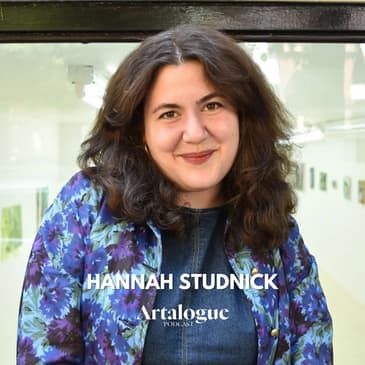
The art world is notorious for its gatekeeping. This makes Hannah Studnick's story all the more remarkable. At 31, with zero art world experience, she opened Ruby/Dakota Gallery in New York's Alphabet City because a psychic told her she would.
The space (originally found on Craigslist) transformed into something profound. In this candid conversation, Hannah reveals how Ruby/Dakota honours her late twin sister Emma, turning personal grief into a platform for artistic healing.
Hannah's journey from the reality television industry to dental assistant to gallery owner unfolds like a screenplay, complete with chance encounters, spiritual guidance, and a driving belief that supporting living artists creates something meaningful in a fractured world. With disarming honesty, she discusses navigating the commercial gallery landscape during "the worst period in history for art sales," and creating daring exhibitions.
What makes Hannah's perspective so refreshing is her commitment to democratising art collecting. Her advice to aspiring gallerists pulls no punches: "Don't do it unless you need to do it," she warns, describing the "manic-dead cycle" of exhibition preparations followed by quiet gallery hours.
In just one year, Ruby Dakota has been visited by art critic Jerry Saltz, featured in New York Magazine and The Wall Street Journal, and participated in Future Fair. Beyond these achievements, Hannah's greatest accomplishment is creating a space where emerging artists can process trauma through their practice, collectors can discover meaningful work, and the traditional barriers of the art world begin to crumble.
Today also happens to be Ruby/Dakota's one year birthday! I'm excited to share Studnick's story and see where the gallery goes from here. Listen today to learn how an art world outsider is challenging conventions and proving that genuine passion, coupled with business savvy and an authentic voice, can create space for new perspectives in contemporary art.
Connect with the Artalogue:
Madison Beale, Host
Be a guest on The Artalogue Podcast
Hi everyone and welcome back to the Artilogue. I hope you all enjoyed last week's episode with Christopher Stoll, the Artistic Director of the Royal Winnipeg Ballet, and speaking of. If you're in Winnipeg and have some free time, tonight you have the chance to see the incredible ballet Tall, choreographed by friend of the pod, cameron Fraser-Monroe, in a set of one part for free. You can check out my conversation with Cameron basically anywhere you get your podcasts and learn more about the creative process behind choreographing this ballet. I'm in Nashville on a last-minute trip so unfortunately I won't be there, but I cannot recommend this ballet enough. It is so beautiful and getting to experience this ballet outdoors is going to be a really unique experience and one that you should not miss. So, as I said, I'm in Nashville this week and taking in the local art scene. Keep an eye out for some videos about the city on my Instagram and TikTok and you can follow me there at atartalogpod.
Speaker 1:In today's episode, I'm chatting with Hannah Studnick, who opened Ruby Dakota in 2024 at 31 years old, because a psychic told her to. It's also an homage to her late twin sister, emma, and you'll hear more about that in just a moment. In their first year, the gallery has been visited by Jerry Saltz, written about in New York Magazine and the Wall Street Journal, presented at Future Fair in New York, mounted eight exhibitions and acquired an intern for the summer, all with zero working art world experience. It's actually Ruby Dakota's birthday today. The gallery is one year old. You can find Hannah and learn more about the gallery at ruby underscore Dakota dot n y on Instagram. There are two shows happening right now, through August 9th Choi Jin Young's the Young Girl and Catherine Sepulveda's Kelowna Politics. Hannah believes art should be fun at every level and every stage, and she's just getting started. Hannah, welcome to the Art.
Speaker 2:Blog. Hi, thank you so much for having me. It means a lot when a writer, slash, journalist, has any interest in what we're doing what made you want to start a gallery?
Speaker 2:So Ruby Dakota is really in honor of my late twin sister, emma. Her name was Emma, she passed in 2018 and she was almost named Ruby and my name's Hannah, but I was almost named Dakota and I really opened the space because I had an epiphany that if we had only been encouraged to take these risks, that maybe she would still be here in some sliding door scenario. In short, I wanted to support living artists living artists.
Speaker 1:When you were in the process of getting ready to start the gallery, you went to see a psychic. Can you tell me more about this experience and how that led into Ruby Dakota as it is today?
Speaker 2:Yeah, she didn't tell me to open a gallery. Of course it was a prophecy. So she told me I would open a gallery and, to be clear, I did not pay this psychic. She was not someone I sought out. I was living in Los Angeles, I was working in television and I really didn't like LA. A writer's strike happened that really affected the whole industry and, truthfully, my heart was not in what I was doing. I've always had an interest in art, which dates back to to childhood, and I think at my core I always knew that I was an artist and I was trying to figure out a way, like all of us, to somehow make that financially viable. Entertainment seemed somewhat of a creative track and I got caught in it for 10, 11 years. So anyway, I was living in LA and things slowly fell apart. I moved back to New York. It's like very classic act.
Speaker 2:One scene one I was getting coffee in town. There was a woman in front of me who was asking the barista if she knew anyone that needed a job and I was like, what is the job? She was like, like it's from a dentist. That's where I I call her next door, I meet the dentist. She was like you want to work here? And I was like, yeah, I think she was so confused. But she was like, okay, we need a dental assistant. And I was like, cool, what is that? But she was like we can teach you, anyone could do it. So I start working for this dentist. Very quickly. We all discovered that where I shine is away from people's mouths. I start doing social media for him. I do office tasks occasionally. Sure, I'm suctioning saliva, I'm passing instruments.
Speaker 2:I was working for her for eight months or so, maybe closer to a year, and there was a patient of ours who was holding a gala of some kind for newcomers in a wealthy town in Connecticut and she wanted to go to. She was a sponsor of the this gala event or party, I don't know, but there was a psychic that was sponsored by someone else. She read me like a book. She tells me for me that creative success and financial success are one in the same, and of course that's what everyone wants to hear. And I was like, okay, tell me more. And then she says that and this would have been early May of last year. Yeah, I'm pretty sure, early May, yeah. And so she tells me, by the end of the year I will be successful in the arts, that I'm going to have a very successful career in the year I will be successful in the arts, that I'm going to have a very successful career in the arts, that it is going to be incredibly lucrative, but that it's also going to be about healing and what she keeps getting. What she keeps getting is that I'm going to do it by myself, I'm going to do it on my own.
Speaker 2:After I speak to the psychic, I go on Craigslist and I find a commercial space available in Alphabet City and it's like pretty cheap for the square footage. I was like this seems relatively doable. Like I was pretty shocked because I always thought commercial space in the city was like 30k minimum a month. I had no idea. I really had no idea what I was doing and of course, this weirdly cheap space was not available. But he was like I have another space that you might be interested in and it was this one and the second I saw it. I was like okay, okay, like similar to the psychic, this space had remained empty for a little bit. Of course I was asking myself like what is the catch? Which there are some, but like overall, I just feel that the space found me.
Speaker 2:What kind of artist do you represent? We show mostly women artists and queer artists, but I don't know. As we go into our second year, I don't want this to be a gendered space in any capacity. I want it to be an inclusive space. I want it to be a safe space and I want the focus to be on the quality of the work. I would say the larger thread through everything, like over identity of the artists themselves. I would say Ruby Dakota is a grief space and it's a space for healing. So I look for artists that are fully dialed into their practice in a way that is almost religious and in a way that is their version of healing some major trauma.
Speaker 1:What's your process for taking on artists at the gallery?
Speaker 2:Instagramcom. I'm just kidding. Instagram is a big. It's a really helpful tool and, like I, hope that eventually we will have a better platform for sharing art. But yeah, I do connect with a lot of people over Instagram. That's how you found me and it's been nice to create community in a virtual way. There are people that I've been following as long as 10, 15 years that now I had an excuse to reach out and request a studio visit.
Speaker 2:But usually how it begins, I'll just send a message and ask if they are open to a visit with me and then I'll go over there and we will look at the work and talk about the work and I'll tell them about the gallery program typically and I don't want to set any false expectations for anyone listening but, like typically, if I reach out for a studio visit, I am scheming something already I saw your work and I have an idea for it, but generally I do try to go in with some level of neutrality and I think, as we continue to grow and our program is booked out further and further, I am doing visits now that are more informational, but especially in the beginning, like I was looking for art to hang quickly and like I was looking for work that was already done.
Speaker 2:And I was, and that was the way I was going about it. Now we're having the privilege of working with artists who are like making bodies of work for the gallery and that's more of a collaborative and longer process speaking of programming, what do you have on right now?
Speaker 2:so right now we are in the final week of two concurrent duo shows with this show cycle. I started started to use the back of the space as a separate gallery and so we have the annex in the back and we have the main room. So in the front we have Ellen Hansen and Erica Newton. It's a two person show called Stretch Mark, and then in the back we have Elijah Anderson and Lee Smith and it's another two-person show called Nosedive and I think in general it's some sort of investigation of material and surfaces, memory time.
Speaker 2:Curating these shows because each artist's work is so different from the other, like I wasn't necessarily looking for cohesion in that way, like in similarity, so it was fun to figure out what the ties were between the pieces. For example, in Nosedive, lee Smith, who formerly was a professional skateboarder but now he's a painter and he's a really wonderful painter, self-taught from the Bay Area, san Francisco, and yeah, he has a really interesting practice. But he has these oil paintings, figurative oil paintings that are of scenes around New York, and I paired those with these sketchbook spreads of Elijah's that we framed and their ballpoint pen and whiteout drawings and yeah, the work seemingly has nothing to do with each other but in so many ways it does. And Elijah is exploring so many of the same themes of solitude and also, within solitude, finding community, and I think Lee is very connected to those themes as well and, as someone who grew up in and around New York, like I've always been very fascinated with California beach culture and surfing and skateboarding. I just I find it very touching that and Elijah also skateboards, I should mention but I find it very touching that it's this community of like. There's a community of masculine men, right, typically heterosexual men who really love each other and they're really supporting each other and it's a sport that you do by yourself, together. I was finding a lot of metaphor on this and I think it makes sense that so many skateboarders are having studio practices and making art now, because I see a lot of parallels.
Speaker 2:And then in the front, erica is an artist I've worked with before. She went to Bard and did not do a BFA, she just went through their liberal arts program and then did an MFA at the New York Studio School, which I think really makes sense for her and her practice. And I find her to be somewhat of a renegade. She's really just yeah, she's very creative, very unique, and she's making work on plaster that I really haven't seen anywhere else and also has a sort of there's a visceral quality to the work and an immediacy of the plaster that she really likes and she's manipulating the surface and then painting over it. For Ellen, she's also doing something very unique she's painting on lycra and she's doing it. She's doing the underpainting on the lycra before she stretches it. So's also very connected to this, to the process. The ink and the charcoal does get distorted when she stretches it and then she's painting over that and locking in that distortion and then adding to that distortion within.
Speaker 2:In so many ways, we are trend forecasting right and we're also working within trend and creating trend, and I feel like with Ellen's work there is a tether to a certain type of oil painting style which I've noticed become very popular over the past couple years, which I call it greasy painting. There's this a little blurry, it's like looking at something in the distance, but I think the way that Ellen is doing it is incredibly successful and I think the fact that there is a manual component to it in terms of the stretching is just beautiful and interesting. There's a lot of surprises in the work and I feel really proud to show it, and this is Ellen's first time having a presentation this large in New York, which is cool. I think she's done a couple group shows, but we were really happy to debut her work here and that was someone from Instagram, yeah.
Speaker 1:I want to go back to something that you were talking about earlier, about this California fascination, and you've been to LA before and now you're back in New York. How do you find the art scene across the coast compares to New York.
Speaker 2:When I was in LA I was not really connected to the commercial gallery scene. I was more so a patron of the arts and I did this variety show. That was connected. But I feel like, in terms of sales and traffic and all that like for traffic, I couldn't really say I would imagine that having a gallery in LA is different and you aren't getting people walking by. I would assume, yeah, I would assume it's just there is a slightly different culture. For example, la doesn't do Thursday openings because of driving, like the driving culture. They do weekend openings, which I feel like in New York we're afraid to do that because weekends are valuable and sometimes people leave the city. So, like in that way, there are some differences but in terms of like art making and what's coming out, people in LA have more space. Categorically, people in LA are likely thinking about like different environmental factors. I think they're struggling, just like the rest of us.
Speaker 2:What I will say in general about LA is I grew up in New York and I didn't feel comfortable really going public with my art until I moved to LA, and I don't know if that's because I'm too close to home here and it was too hard for me to separate from who I had always been and who my friends and family had known me as Like. Maybe that was part of it, but I felt that there was a very supportive creative community out there. Night Gallery has such an incredible program and they are this sort of prestigious white-walled space and the fact that they let me do my variety show there, I think is just a testament to the culture of the city which is that end of that gallery. But it's supportive in a way that maybe I never felt New York was. New York in general can be a little bit more intimidating and competitive.
Speaker 1:How did you find going to Future Fair and do you have any more art fairs coming up?
Speaker 2:Fairs coming up. I would love to do NADA at some point in New York. I think it's also interesting that I'm keeping my eyes open for more alternative models, and I think historically, there have probably always been these ancillary things surrounding the traffic that an art fair brings, but I would really love to see someone fully break the mold and do something a little different, perhaps even in an off season. Future Fair was great, though. We met tons of people. We got a write up in the Wall Street Journal, so what can you want other than Other than? But it was great.
Speaker 1:How have you found running a gallery this past year during a particularly challenging time?
Speaker 2:Markets will go down and they'll go up like any. Any market is going to be doing that, and the art market is no difference. It's no secret that we're down right now and I think that's part of the reason I made that video, because let's stop pretending like everything's fine. We all know that it's not. That doesn't mean that we won't recover. In terms of my first year owning a gallery during kind of the worst period in history for art sales, I think that is where my sort of naivete and lack of experience in the commercial gallery world really served me well, because I had nothing, and I even say it in that stupid video I have nothing compared to.
Speaker 2:I'm really just trying to meet a bottom line and I'm trying to keep a space open, and I'm really just trying to meet a bottom line and I'm trying to keep a space open and I'm trying to eat, and I guess another way to say that is like I'm running a business. I'm running a very small business and that's really the way that I was thinking about it. In terms of the larger art market, I do think things will recover. I think that the art world is on the precipice of major change and that's very exciting. I think that a lot of power is going back to the artists and I think that we are about to see a different type of collaborative model from the top down, and I think we're going to keep seeing that. I think that artists are going to be more involved in the sales process. I think that maybe we are moving towards center, maybe we're moving towards a more democratic version of this, but people will always need art. The way that's delivered to them is ever changing and I think, based on the response to Ruby Dakota, based on the fact that I am a complete outsider to this world in so many ways, but it has been received so warmly, I would say that is an indicator, that's a recession indicator. That's people saying thank God, thank God, something is going to change or something is different. And because things are not good right now and I weirdly feel grateful to have started in this moment where perhaps people were feeling a little hopeless feeling a little hopeless, and I was perhaps able to bring some level of light back to a pretty dark situation.
Speaker 2:What are some of your goals for Ruby Dakota's future? Oh, worldwide, of course, I would like a port in every city and several husbands. No, I am. It's funny. I feel like I abandoned the idea of a traditional life at 31 in order to have a gallery instead. My goal for the gallery is just to continue to grow. I just had a wonderful call with an artist, like right before I spoke to you, and I told him the same thing. Like in our second year, I would like to start developing a roster of people who will stay and who want to grow with the gallery. I think in our first year I was hesitant to offer representation to anyone because I was unsure of what I could really offer an artist.
Speaker 2:But now I have a better handle on what that could be and I would love we will continue to grow with and show.
Speaker 2:It's wonderful that, like already, ruby dakota has put a couple people on the map and they've left the coop and that's totally fine and that that's that is the goal. Honestly, if you can go from showing here to showing with a larger gallery, like that's wonderful and I just want what is best for the artists. What is best for the artists is what's best for me, because holding those people here would only breed resentment and then there would be no chance to work together in the future return. But if they go in a different direction and blossom somewhere else, I'm equally happy. There's there's really no shortage of incredible artists in New York alone. I will say in the beginning and part of this was cost related like I did plan to focus on showing New York artists only and really trying to focus on hyper local, like within Alphabet City even, and since then I just Ellen is based in Mexico City, but the work, some of the work, came from LA.
Speaker 2:But yeah, ellen is the first artist where I've invested in getting the work here, but I felt it was really worth it because of how unique the work is. And sometimes that's just something you have to do, but for the most part and sometimes that's just something you have to do, but for the most part I would like to continue to grow with New York, with the neighborhood and with the artists that we show.
Speaker 1:What are some of the biggest lessons that you've learned in your first year running a gallery? Oh my God.
Speaker 2:Lessons oh my god, lessons. If I've learned any, I haven't. They haven't resulted in any sort of tangible change in my behavior. I think that I've learned in the hard way a couple times that there's something to be said for the old adage in the art world say the least amount possible. I think there's something to be said for that I'm not capable. While I know this to be true, it is not something I practice.
Speaker 2:I've learned so many things like love. What you do never work a day in your life is a lie. It's such a lie. It's so hard. It's so hard to do what you love. It's actually the scariest thing in the world and I could really cry thinking about it because, like it's, gallerists get such a bad rep.
Speaker 2:But it's an incredible sacrifice. Not the ones who come from like tons of generational wealth For them. It are quite a few regular people that are in this game who have just hid that they are regular people. But yeah, I think it's a tremendous sacrifice. It is a nonstop grind, it is a nonstop hustle. People think you are a vulture by definition. Incredibly hard and, that being said, like I have never been happier and I feel incredibly fulfilled and the success and privilege that would come with this project is just to keep doing it, and that's really. You asked about my goals for the gallery. It's like that's the goal to just keep be able to keep doing it and, given the state of the market, we'll see if that's going to be possible. But I'm certainly going into our second year with with an open heart and a open phone line.
Speaker 2:If anyone feels so inclined, we are here and another lesson, I think, is this is actually more accessible than they want you to know.
Speaker 2:Really, most working people who have a real appreciation for art and these are people who could work in, like entertainment lawyers, I don't know. Obviously, the finance art connection is longstanding, but I'm just saying like, there are many working creatives that could absolutely afford to buy contemporary art. They don't know that, they don't think that they're of a collecting class. But that is a huge takeaway from getting into this game is to realize yes, absolutely, you could buy a $1,500 or $2,000 painting and pay it off in installments, and that is one version of a standard of this industry and it's really just a matter of what you are placing value on in your life. Do you want $1,000 pair of shoes or do you want to have a piece of art that you can live alongside for the rest of your life. Art is much more nebulous and it's understated and it's private oftentimes. I just don't think you can really have anything that indicates who you are and what you stand for and your values like a piece of art.
Speaker 1:What would be some advice that you'd give to someone looking to start a gallery?
Speaker 2:Oh, don't do it. We have too many, I don't know. Honestly, yeah, I would say don to do it, need to do it. You really need to prove that you want this particular type of suffering, and I don't think many people do. Like it's a painful, painful life.
Speaker 2:I understand that I'm probably more front-facing than most gallerists, but for the most part it's not about you Like it is not about you part it's not about you Like it is not about you. You are giving yourself a lot and you're giving a lot of yourself, and at the end of an opening and the doors close, you're in a room alone, and so I would just say, be prepared for that. Like it is a sort of manic dead, manic dead cycle. I feel like I saw an interview recently where someone, a gallerist, described New York that way. But that is to me the gallery cycle, and same in entertainment, the whole hurry up and wait thing. It's like you're just going so hard, running on fumes, putting together a show, getting a show up, and then it opens, and then you sit in an empty room for a lot of the time, especially in the beginning, and that can be very scary.
Speaker 2:So I would just say surround yourself with community, become friends with other gallerists. Do not see each other as competition, because you're not. Everyone's program is different. Do not see each other as competition because you're not. Everyone's program is different and every artist is different and there's a collector for everyone. I feel very confident about that.
Speaker 2:So I don't feel threatened by other galleries. I think that there is a culture where maybe some mid-sized galleries do feel threatened by smaller galleries because they don't want them to become mid-sized galleries. But I've had a wonderful time getting to know a gallerist named Fairchild from Aubrey Mars. He recently opened on Stan Brown from Post Times is also wonderful, and he has a small gallery on Henry I think the street is yeah. And then there are other people like March is around the corner from us and in the neighborhood. Philip has been in this game for a long time and he's someone that's been really open and kind to me and their director, Maria, is my peer and has come by the gallery and also shown a lot of support, and so I think we all try to support each other, knowing that is the way that we can grow and survive this.
Speaker 1:Thank you so much for your time today, Hannah. This has been a fantastic conversation.
Speaker 2:Hi, I'm so glad. It was so nice to talk to you. Thank you so much.