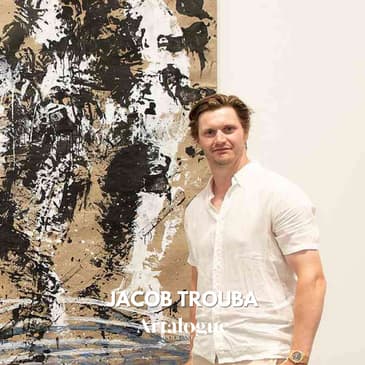
Jacob Trouba's artistic practice couldn't be more connected to his day job as an NHL defenseman. When the Anaheim Ducks player (and former New York Ranger and Winnipeg Jet) starts painting, he's not leaving hockey behind. He's channelling his skills into a unique visual language.
"I think it's kind of a unique way of mark making that's special to me and ties into hockey," Trouba explains, describing how his approach clicked when he began viewing painting as mark-making rather than trying to create a representational image. Inspired by artists like Yves Klein, Trouba uses his body as the primary tool, incorporating the physical movements of hockey into his artistic process. The result is dynamic and apstract, capturing the energy and movement of the sport.
Trouba's artistic journey began unexpectedly during summers in New York while his wife completed her medical residency. What started as curiosity about what makes art "good or bad" evolved into a genuine passion. Now, he visits museums and galleries in cities across North America on the road during the NHL season, constantly expanding his artistic education. This dual identity as professional athlete and emerging artist culminated in his first gallery show at Harper's in New York .
Beyond his personal practice, Trouba and his wife founded the Trouba Creative Expressions Art Program, working with adults with epilepsy to experience the therapeutic benefits of painting. "To see the excitement that they all had about the pieces they made and just how proud they were... I think that struck both of us as pretty special," he shares. Trouba exemplifies how seemingly different worlds can meaningfully intersect. Maybe art and sport aren't so different after all.
Connect with the Artalogue:
Madison Beale, Host
Be a guest on The Artalogue Podcast
Hi everyone and welcome back to the Art-O-Log. Today is a special episode because I'm chatting with an artist with a unique Winnipeg connection. I have a feeling we're going to get some new listeners today, so welcome back, or welcome to the Art-O-Log. My name is Madison and this is a podcast about careers in the arts.
Speaker 1:Today I'm chatting with Jacob Truba, who's an artist, but you probably already know him as an Anaheim Duck, former New York Ranger and Winnipeg Jet. Within his approach, truba stewards an intimate relationship between his body and the canvas. The artist dresses in his traditional gear as he strikes and skates into the canvas, resulting in a frenzy of energetic marks that speak to the combative nature of the beloved game. Truba distills the sport into a flurry of stick slaps, skating lines and punches. Once they land on the visual plane, these violent gestures transform into an invigorating imagery, dynamic and fast-paced, much like the game itself. So, without further ado, welcome to the Art-O-Log. Jacobs, thanks for taking the time to sit down with me today, thank you, thanks for having me. You're a self-taught artist. How did you become interested in art?
Speaker 2:It's kind of a funny story a little bit. So when I was in New York, art was never something I was crazy interested in as a kid. It was always hockey, hockey, hockey. And then I came to New York and I was spending my summers here. My wife was doing her medical residency so I had the dogs and I usually golf in the summer and that's kind of a hike to get around and golf around New York.
Speaker 2:My best friend he was a real estate agent's husband and he went to art school.
Speaker 2:He had a studio and he invited me, luckily enough, invited me to the studio.
Speaker 2:I just told him I was interested in trying something new and learning and I told him I'd give it two weeks and I wanted the goal at the start was to paint something that I could hang and my wife was pregnant at the time to hang in my son's room. And so I got there and obviously frustrated at really knowing how to do it, what to do, and I guess the curiosity originally started of what makes a piece of art good and bad. I didn't understand that difference and then, talking with him over the past, I mean especially that first summer he kind of taught me how to paint, or how he learned to paint and then started showing me artists, read books, started recommending books, a lot of stuff about, I guess, the the history of art, and I'm very much still learning. But I think that's something I've enjoyed of the whole process is I don't think I'll ever stop learning this and it's kind of a different thing than hockey and something that I've become pretty interested in and very curious about.
Speaker 1:How would you describe your process?
Speaker 2:I think it's kind of a unique way of mark making that's special to me and kind of ties in the hockey, and I think evolving my way of art would be kind of expanding my own artistic language through the game, because that's a big piece of me and my identity is the hockey piece.
Speaker 2:But I think what really clicked was when he described painting instead of viewing it as a painting, do it as a collection of marks or mark making. And I think that was when it kind of not an aha moment, but made me think of things a little bit differently and then started showing me other artists and then eventually came across Eve Klein and that was kind of when it clicked. I was like, oh, I don't have to use this brush. That frustrates me so much. So then I started, I guess, using my body as the tool to make the mark, and since then I've, I think, learned a little bit more with the brush and tried to evolve and get better in different ways. But that was kind of the first thing that gave me the feeling of oh, I think I like, I enjoy this, I'm onto something, this is really fun for me, and that was kind of what it took off, I guess, for me personally.
Speaker 1:So you mentioned Yves Klein as an inspiration for your work. Who else inspires your work?
Speaker 2:There isn't like a ton of, I guess, inspiration. I mean I obviously watch a lot of YouTube, I watch a lot of read some books, I think de Kooning and he had a show here at Gagosian this summer that I went to. So I think I the thing that I'm most fortunate to is I obviously travel a lot to all these cities and we have practice days and then have the rest of the day and I've ended up going to a bunch of great museums and seeing a bunch of great artists and I think that's over the past two years. I think that's been one of my favorite things on the road to do is go Buffalo. They have a fantastic museum there that I went to Vancouver. Some of the ones in Canada, they're kind of all over, I mean DC. So being able to do that, I think that's where I've looked at most of the art. It's a lot of the best art out there and I think I'm very fortunate enough to have the opportunity to go to those places and do that.
Speaker 2:What are you hoping to explore in your paintings? I think? Just continue to evolve like my own language. It's not, I don't know. There isn't really like a thing I'm chasing after or wanting to explore. It's continuing to find different avenues, to play around and experiment, and I guess that would be my way of exploring. There isn't really an outside game I'm chasing. I would say it's more of just something that I enjoy doing, and if other people enjoy it and it can make someone smile or make someone think or cause something, that's great and I think that's where I get the most satisfaction of it.
Speaker 1:So you mentioned going to galleries during the off season, but I'm curious do you work on your art during the hockey season or is it purely in the off season? A?
Speaker 2:little bit. Obviously, there's way more time in the off season. I'll do a little bit, I guess, during the season, on an off day or maybe after a game for like an hour. Do a little bit, I guess, during the season, on an off day or maybe after a game for like an hour. But yeah, it's definitely way, way more hockey focused during the season and then in the summer there's more time to do your workouts and do what you need to do hockey wise. But then you also have some free time to go paint and hang out and do what I like to do in the studio.
Speaker 1:Do you find the act of mark making and painting in your work to be therapeutic or restful at all, even if you are physically checking the canvas as you would in the rink?
Speaker 2:I don't really think it's therapeutic at all. I think there's some days that it's almost more frustrating, but I think that's part of the exciting part is there's good and bad days in the studio where sometimes things are working and everything seems to be going right, and there's days where it seems everything's going wrong. I think that's part of the fun. Is you kind of you chase those great days and how awesome they are at the end of the day? Yeah, I think it's just completely different than hockey. Obviously there's similarities in some of the motions and what I'm doing, but the way of thinking about it, the preparation like all just the whole process, is completely different versus playing the game, versus painting, and I think that's that's been enjoyable for me.
Speaker 2:I think something different, yeah so I think it's been fun. When does a painting click for you? I guess my process of doing it would be like make a mark and just respond to the mark. There isn't really much of a predetermined idea of what I'm trying to accomplish. That's changing a little bit now. I'm trying to create some different compositions, but I think sometimes it just it works. You'll make a couple, make a couple marks, and you're like oh, that's, that's great, like I love it. Or sometimes you'll go backwards and sometimes you'll have something you like and end up going backwards and find a different way to go forward. So I think that's kind of the, the puzzle, or the, I guess, the journey you go on with, kind of every painting, I guess, and that's it's frustrating, but it's also at the same time, and when I feel like it's finished and I'm happy with it and there's nothing that bothers me about it, I think that's a pretty good spot to be.
Speaker 1:Which is more of a challenge to you art or hockey?
Speaker 2:I mean both challenging in their own ways. I think hockey is definitely challenging, with the career and evolving over time and the moving and changing teams and everything that goes into it arts, I mean it's definitely challenging in its own way. But it's me in the studio by myself the majority of the time, so a little bit slower pace, I kind of more in my control. Obviously the game's fast and physical and there's a thousand things going on at one time or it's a little bit slower, but I think it requires a bit of a different thought process. But yeah, I think it's nice for me to kind of slow down a little bit in here and take some time to relax and think. And I guess the biggest difference between playing the game and the season and everything, Further on that.
Speaker 1:Do you think there's any crossover between what makes a good artist and what makes a good hockey player?
Speaker 2:Yeah, I think what makes you good at anything is the repetition, the want to be good at it, the focus, the time you put into it. It's not like you're magically good at something. I think I'm obviously still learning this art side every day. Hockey I feel like I'm still learning too. That's obviously been a longer journey, but I think the future on the artistic side is going to be pretty exciting and that's going to keep evolving and growing, similar to how I guess my hockey career did. So I think there's crossover in the sense that if you want to be good at anything, it's time and focus and energy and dedication. Besides that, there isn't a whole lot thinking wise and it's completely different.
Speaker 1:So when you retire from professional hockey, do you plan on pursuing art full time, or will it be kind of a side thing for you as it is right now?
Speaker 2:I think I'll probably dedicate more time to it? I don't ever. I've never really viewed it as a second career. I've never really had aspirations for that. As long as I enjoy doing it and I'm having fun and it's something I want to spend my time doing, I'm going to continue to do it. I hope it. I guess it turns into that, but I don't think the second it stops. I've had the same role with hockey. I guess the second I stop enjoying it and having fun and have a smile on my face coming to do it like I'm not going to stop doing it, but I hope that that never happens. That hasn't happened with hockey yet, so I'm hoping art's the same way.
Speaker 1:You've worked closely with the Epilepsy Foundation in New York and you founded the Truva Creative Expressions Art Program to paint with adults with epilepsy. Can you tell me more about setting up this program and what it means to bring together your passion and a cause close to your heart?
Speaker 2:Yeah. So I mean, my wife has epilepsy. She's been public talked about that. So I think we've tried to find charitable ways that we can combine both of our careers and things we enjoy, and that was one that kind of came up pretty organically and was pretty rewarding for us.
Speaker 2:So it was, I think, a two, three-week program where adults with epilepsy came in and did art therapy through painting, and then we had a little show for them downtown and to see the excitement that they all had about the pieces they made and just how proud they were and us coming to look at what they did, I think that was something that I think struck both of us. That's pretty special and pretty rewarding for us to do we did very little in the grand scheme of things and to be able to make an impact and hopefully make some lives a little bit better. I think that was very cool for us. Hopefully there's more coming in the future. We'll see how it evolves. Maybe we'll do something out in Anaheim now, but yeah, we'll see how that evolves.
Speaker 2:But, that's something that we were very, very fortunate to be able to do. How do you find the art scene in California compared to New York Didn't really explore a ton when I was there for the couple months I went to LA one time and just stopped into a couple galleries. I haven't put a ton of time, I guess, into learning the LA art scene yet to really have an opinion. But even the New York scene gets so big and crazy and I'm still learning that. I think I don't know if I'll ever stop learning that one either. But yeah, I think I'm excited to explore LA art scene a little bit more this coming year. Yeah, we'll see. I don't really have a great opinion on that one yet.
Speaker 1:Do you have any favorite galleries in New York, like museums or private institutions?
Speaker 2:Obviously, I did my show with Harper's, so he'll always probably be one of my favorites. I like David Kordansky. I go to Aquavella a lot. He's been very nice to me, and so he's another guy who I've become friends with and he sends me a lot of books of shows that they do or they've done in the past, and that's another great way that I've continued to learn. Those are probably some of my favorites. I don't know.
Speaker 1:I haven't ton. I'd say I walk around like the Chelsea area a little bit, but just Coppin and Gagosian is obviously great. All the big ones everybody loves yeah. So, speaking of Harper's, you had your first show at Harper's Gallery in New York last year. Can you tell me more about what inspired landing my mark and what that show was like?
Speaker 2:So really went back to the start and then figuring like finding that mark, and I was, I guess, encouraged by my mentor to have a little show and I was like I'll just do it with our friends and like a little thing in the studio I invited like three teammates that were in the city but it wasn't the most comfortable thing for me to share, I would say at the time.
Speaker 2:And I think as that show or I guess little show transpired and saw people and talk to people about it, that kind of pushed me, I guess, to share it a little bit more publicly. And then I think they were talking about on a telecast of a game and Harper's daughter I heard them talking about it and was watching the game and so she shared with him. And then he got in contact with me and came and looked at the paintings and yeah, it was kind of a whirlwind in a way. It's obviously something I wasn't very familiar with and talked to some people to try to get a gauge on what the right thing to do was. He was great in helping and figuring out everything because halfway during the season obviously the show wasn't during the season but the planning and all that was during the season. I kind of let him do his thing and try to stay hands off so I could focus on hockey. And he did a fantastic job and it was pretty fun.
Speaker 1:It was special to see all the people show up and talk about it and I don't know, it kind of blew me away. Did you ever have any reservations about sharing your work with your teammates? I know you mentioned a little bit of hesitancy with the public, but was it any different with your?
Speaker 2:teammates, teammates more. I mean they're more like your friends and your buddies. There's obviously like it's a little bit out of the norm, so there's some of that. But we auctioned one, for we had like a rangers like our big casino night is what we call it for Garden of Dreams Foundation. So I donated a painting to be auctioned off there and then that one sold for a decent number and everybody got a little quieter after that.
Speaker 1:What are you looking forward to exploring in your work over the next coming years?
Speaker 2:Just continuing to try to evolve and try to create different things. See where it goes. There really isn't a plan of what I want to do next year, five years or when I'm done playing. It's just kind of whatever I enjoy and things somehow seem to just happen naturally and keep popping up and whether it's pieces of art or different marks or just keeps evolving naturally on its own and I've just embraced that and enjoyed that. I haven't really pushed anything that's been unnatural or forced anything and I think it's been very enjoyable for me.
Speaker 1:If you could give some advice to anyone who may be torn between working in art and something else, be it sport or any other field. What advice would you give them?
Speaker 2:I would say just enjoy it. I guess, go at your own pace. I don't think I've I wouldn't say I've done completely headfirst and forgotten about everything in my life, but art I think there's. Obviously, hockey is my, my main priority in my job right now. This is been a little bit more of a hobby in my free time, but maybe it transitions after, I don't know. But yeah, I think everyone has their own speed and their own pace. And be comfortable with what you're doing, as long as you're you're enjoying it and having fun and you wake up excited and have a smile on your face. I think that's, that's all you can really ask for well.
Speaker 1:Thank you so much for your time today, jacob. This has been a fantastic conversation, awesome. Thank you for having me. It's my first, first podcast.