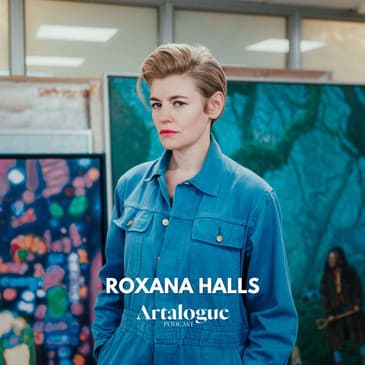
"I think of humor as being a sleight of hand, like a magic trick. I think of it as being a way of talking about the thing you really want to talk about by not talking about it at all. I'm very interested in the way that people use humour and the way that humour is often used as a vehicle for telling the truth." - Roxana Halls
On today's episode, I chat with award-winning British painter Roxana Halls. Roxana's art explores how laughter can be an antidote to the opprobrium women face everyday, making it an excellent topic for International Women's Day.
The invaluable advice Roxana offers throughout the show underscores the importance of valuing your unique voice and starting with whatever you have, no matter how humble. Halls details her journey as a young artist who struggled to make ends meet after leaving home and pursuing her passion. As a self-taught artist, Roxanna opens up about the difficult decisions she's made, like choosing art supplies over basic necessities, and how she crafted her own artistic education against all odds. Her determination and resilience are inspiring and a testament to the power of passion.
Roxana's Instagram
Roxana's Website
Connect with the Artalogue:
Madison Beale, Host
Be a guest on The Artalogue Podcast
Roxanna Halls is an award-winning British painter whose solo exhibitions included the National Theatre in London, the House Kwan Smidt Museum in Berlin and in worldwide group shows, most recently at the Marlborough Gallery in London. She was featured on BBC Radio 4's Women's Hour Only Artist and the first episode of BBC One's Extraordinary Portraits. She's exhibited and collected in the UK and internationally, including the permanent collections of the Scottish National Portrait Gallery, the Science Museum and the Disney Archive. Roxanna, welcome to the show as a self-taught artist. What's been your process to becoming a painter?
Speaker 2:I'd say a really convoluted one, and one that I couldn't have predicted at the outset. It's still relatively uncommon for artists who are practicing and continue to practice as artists to be self-taught and to not go through the art school route. I did do a foundation course, which is a one-year course, which I just about completed, but I did end up spending most of the course A large proportion of the course at home, because midway through that course I rather realised that a lot of what we were being taught on the foundation course was related to a range of different media and different approaches to art. By the time I got there I already knew I wanted to paint and I only wanted to paint, and I knew that I wanted to paint figuratively and I knew that was being discouraged in art schools. So I dropped out. People thought that I had dropped out entirely from the course, but it couldn't be further from the truth. I'd actually just secreted myself away at home and worked incredibly hard on my own, because I weirdly had a very strong sense of direction.
Speaker 2:From the minute that I started painting, I felt what I can only ever describe as a sense of vocation, which is a really. I'm not a religious person. It's a very old-fashioned way of describing it, but from the minute that I started to paint at all, I felt I'm a painter, it's what I am, it's what my being demands, there's nothing else for it. And I've created my own education. In a sense, I've created my own art education without really knowing what that would mean or what it would entail. I think so many people who find that they've suddenly seemed to have become something somewhat of a mystery how that coming into being has taken place. There's a lot of things that I know now about what it took and what it was demanded and how difficult it was. Where I think me now I would think why would you put yourself through it? I often feel if I talk honestly about the process of becoming an artist in the beginning, then it sounds rather discouraging.
Speaker 2:I often think so much of coming into being in any sense, and almost in any sense, of a vocation. A career in the arts requires of you that you dispel cherished ideas about how it's going to be and how it's going to pan out and what the path will be, certainly how straightforward the path will be. And the reality is there's so much that you have to leave behind. There's so many dreams that you have to necessarily don't have to be shattered, but they have to be dispensed with so that you understand the reality of being an artist, and actually that ends up being a richer experience than you might have anticipated. So I think being self-taught really meant that I had to find a way of being taught by everyone who had gone before, and that didn't necessarily just mean visual artists. I'm very interested in film, I'm very interested in cinema and I reference cinema a lot in my work. So I was interested in kinds of media and all kinds of approaches, not just visual artists. Along the way.
Speaker 2:A lot of that has to do with class. A lot of that has to do with money and class. I'm from a working class background. There were no artists in my family. There was no real precedent. There was no precedent for anyone in my family becoming an artist. So I had nobody to turn to really for advice or for guidance, and certainly not for financial support. So that was a big component in why it has not been easy. But there's something very particular about rewards that are hard one, I think, that are more cherishable. They mean more somehow.
Speaker 1:Could you elaborate on some of these growing pains that you experienced as an artist coming up?
Speaker 2:I had no money, I would save coins small coins in a jar so that I could afford to buy material. I really barely had enough money to eat. Sometimes. I would not eat, I would just buy materials because it really was that difficult. I left home very early, so I really didn't have financial support. It was really tough.
Speaker 2:But also I think I've always been really sure that I was an artist. I was an artist, not that I wanted to be or that I wanted to take a career path, it's nothing to do with that. Really a sense of vocation I am an artist, it's a fact, so somehow or other I need to find a way of doing it but also a combination of that certainty absolute certainty and a really deeply, profoundly insecure feeling that I didn't know if I was any good or not. It sounds like I had absolute self-confidence and I was totally self-assured and I was the opposite of that. A healthy dose of that is useful throughout your life and certainly in your work. And there's very common painters. Those are painters. Do you have this odd combination?
Speaker 2:I was at an exhibition only this week, last week in Philip Guston's work, who I greatly admire, and almost nobody has ever talked so candidly about the struggle of being a painter and about that weird combination of having a certain kind of self-certainty and crushing uncertainty, and how you hold these things in tandem. Somehow you manage to walk with them and create things. You're absolutely sure that our education was not for men, that formal art education wasn't going to work. That was Now. I think what an odd choice. It's such an odd thing to do, to do something with great difficulty and alone as well.
Speaker 2:But I just really knew that's what I needed to do. And part of that decision was that I just didn't thrive in an art school environment. I thrive in solitude. I always have. I'm much happier on my own. I don't tend to integrate information unless I've figured it out for myself. I don't tend to find anything very satisfying or worth doing unless I've figured it out for myself. It doesn't mean I can't take instruction and I can't learn, but I have to learn in a very particular way.
Speaker 1:Yeah, you know, something I hear when I'm talking to other artists or people who are looking to get into the arts or make a career in the arts is that they're afraid to fail, and not only that, they're afraid to fail publicly. So I was just wondering if you can tell me a bit more about failure in your work and how you move through that process.
Speaker 2:It is a kind of stubbornness. I don't value it, unless it's hard one possibly, I just don't. It's just a deep feeling that I don't find things satisfying unless I've experimented and I've got things wrong and I've made really major errors and I've really messed something up. Errors in work are very often the thing that tell you where you need to go next. I really value and cherish getting it wrong. For a long time now I've integrated into my process of working deliberate error, so not to get cozy.
Speaker 2:I think one of the most valuable things you can do as a painter is to wrong foot yourself and to not always know quite where you're going. I love feeling that I don't quite know where I'm going with something. I love feeling that I don't know if it's going to work. But if I have a nose that it might work, then I'll try it. But there are ways that I'd like to integrate that into my practical way of working. Maybe once I be 18 months, two years or so, I will introduce a new color on the palette, and sometimes they're wild and I think that it's not going to work. But I find a way of making it work just so that I don't quite know where I am. I like that feeling that I don't know where I'm going with this. This might be wrong, but I think it's worth trying. I think it's really vital that you change and you evolve and you don't get cozy.
Speaker 2:So I think the other thing I'd say about growing pains is just that I found my own way of doing things, being self-taught, mostly self-taught. The thing I didn't have was a feeling of kinship with other young artists. A lot of artists coming up and being taken on by galleries etc are noticed at art school. A lot of artists who know how to be in the art world have been through art school and they've learned from their tutors and they've learned from their cohort, and I didn't have any of that, so I was completely in isolation. So the amount that I didn't know about how an earth can be an artist and make a life as an artist I could write you a very thorough report and it took. So I feel like there are things that I came to know as an artist, as a painter, that were quite advanced for somebody my age, but I knew nothing at all about the art world and how to be in it. So a lot of things that have come my way. They've been like incredible accidents.
Speaker 1:One thing that I'm really interested in is this idea of being noticed in art school. So, since you didn't go, how did you get yourself noticed by the galleries?
Speaker 2:I didn't set out to do that at all. I've never been somebody that's gone out looking for a gallery. I've never turned up a gallery with a portfolio. I find it profoundly embarrassing to try and say how about me then? I've never been good at it. I think I am so continually so preoccupied with what I'm making and the demands of that. I don't think that much about strategy.
Speaker 2:But the way it started was I started entering competitions. So I heard about painting competitions, figurative painting competitions and I thought, from when I was around about around the time when I stopped the foundation course, when I left and decided that I wasn't going to carry on with any other formal art education, I was aware of painting competitions, painting exhibitions in prestigious places like the National Portrait Gallery in London, and I thought I might as well enter them and see what happens. But you never know. I don't know. I don't know if what I'm doing is any good, but let's try that. And I didn't know a couple of painters I moved to. I was born in London, then my parents moved to Devon when I was young and then I moved back. As soon as I finished my foundation course I moved to London on my own, thinking I need to be in London to go to the National Gallery, to go to the major galleries to learn from the master. I got to know a couple of figurative painters and I knew that some of them had reasonable success by entering competitions and getting their work seen that way, and so I entered them and, incredibly, I got in. And the first time that I got into an exhibition which is a major portrait prize at the National Portrait Gallery in London, I actually lied about my age because I was too young to enter. I was ten years older than I was and incredibly, my painting got in there and my painting was written about by one of the most famous art critics of the day in a major newspaper, the Evening Standard, and so I suddenly started getting attention from people. And then the next year I got into that exhibition again and I ended up being that exhibition five, five separate occasions, which is a lot. It was quite. It was very hard to get into this show. It's an amazing accident and this person wrote about me and a lot of people contacted me and I entered a couple of other prizes and my work was accepted into those competitions as well. And then I was contacted by a woman who ran a very good gallery called Bozai Gallery in Bas, and I was very young, but she offered me my first solo show and I was the youngest person they'd ever exhibited there, so I was 26 by then.
Speaker 2:I've always said yes to things. I thought that might be interesting and I think I've developed a really healthy sense. Healthy, I don't know, it's worked for me, I suppose. I like variety and I like to be available. I've done quite a wide variety of things in the spirit of let's give that a go, let's see where that leads. I did some teaching.
Speaker 2:One of the things I would often say to students is I think when you're young you have this sense that one big thing will happen and then everything will be okay. It's like you'll suddenly be on a safe plateau and you'll be with the right gallery or you'll get into the right show or you'll win a prize, and then everything's fine. And life doesn't work like that. It really doesn't. For a few it does, but for most artists I think it's really important to not to go into it thinking that you know that it's a foregone conclusion, not to go into it thinking, if I get this, then everything's okay. I think it's really good to approach it. Thinking I want to have a rich and varied life, I want to try different things and to know the artist you are when you're young is not who you're going to be. You can't know where you're going to go with things. So, whatever, you don't get trapped into a way of thinking, don't get trapped into trying to replicate the same work that you make, except change, except experiment and except risk.
Speaker 1:How would you describe your paintings right now?
Speaker 2:That's a really difficult question. It depends on what I'm working on, because I generally I'm often working on different things at different times. So currently I'm working on a portrait of somebody, a very esteemed English writer, and that's very interesting. I only paint portraits when I'm particularly interested in the subject and they're generally not commissions. I do almost no commission as an artist because I'm too busy making my own work. I just don't want to do what anyone else tells me to do. Mainly I'm so single-minded I'm working on that at the moment. That has its own demands, but I'm always working on a variety of different theories.
Speaker 1:One of the things that I love about your paintings is that laughter and humor are running themes throughout your work. So I wanted to know what do you think humor can convey in a work of art and what's the significance of women laughing in your work?
Speaker 2:Humor is a difficult one because I don't. I often think I don't think they're that funny. Humor is really distinct from a joke. I'm telling a joke Often. A joke is something which doesn't may or may not land for a start, but it has an intention of being punctually funny. There's something very different about humor because of its inherent seriousness. I think of humor as being a sleight of hand, like a magic trick. I think of it as being a way of talking about the thing you really want to talk about by not talking about it at all. I'm very interested in the way that people use humor and the way that humor is often used as a vehicle for telling the truth and very often it can be a way of describing something that means that the person it's being described to doesn't entirely immediately register what's really being delivered to them. I think very often when we want to talk about things which are profoundly painful, we involuntarily laugh in the process of telling that truth. I think there's something very particular about painting humor or painting laughter which I find endlessly fascinating.
Speaker 2:I first started painting laughter with a self portrait, so a lot of my work is generally. I often paint self portraits because I use myself as a vehicle for telling. I use myself like a kind of tool with absolute freedom. So I often paint myself wearing hideous disguises or do something particularly garish or strange or extreme with myself, because I'm never going to mind what I do with myself. I can do anything with myself, and the laughing paintings came about that way. So that was no different. So I started. I wanted to paint. I wanted to paint a picture which was about the difficulty of telling a hard truth. I wanted to paint something which was simultaneously funny, funny but also quite dark. But the painting was of myself laughing with my mouth full, and I really I wanted what my mouth is full with to resemble blood or viscera or matter. And really it wasn't about laughter at all, it wasn't about eating at all, it was about trying to say difficult things. It was about the act of trying to say difficult things and in a way, it's what painting is to me. It's a means of communication and it's the one that makes most sense to me. Trying to talk about what a painting is is so much harder than trying to formulate an image, to talk about things. It's a language. Painting is a language, and it's the one that makes no sense to me when I did this self-portrait.
Speaker 2:When I painted this self-portrait, I suddenly started to think about laughter and I suddenly started to register. I registered quite quickly. I don't think that I almost never see laughter in painting, and certainly not in paintings of women. It's so rare, so rare that there are so few, relatively historically, images of laughter, particularly women. And it made me think a lot about depictions of women and how static they are and how much you get the sense that when you look at women in paintings they look like they're waiting for someone, like they're still, they're silent, they don't. And I was thinking, I started to think quite a lot about what that suggests, about agency and about the ability to speak and who has the ability to speak and what one can convey with that, what one can communicate with that, with laughter.
Speaker 2:And as I started to make this work, I started finding it really interesting how the viewers responded to the work, and I'm generally quite oblivious to or I'm intentionally oblivious to how people react to my work, because the work demands what I do with it. I'm not that reactive to how other people receive them, because I think that's not my job. My job is to listen to what's happening in the work and what that demands and I do think a lot of painters talk about this how, over time, the work that you make ends up having its own life, to the point where you don't exist as an entity at all. It's very odd, I think, when you're younger, when you're a younger painter, I think often you approach it with this feeling of I want it to do this, I want it to say this, I want people to understand this about me, I want this to speak the truth about me and I want you to know me. And this is all very symbolic of me. And increasingly, as you get older, you think it's got nothing, this is nothing. I'm receding to the point where I don't exist and the work somehow knows what it wants and I just have to manifest it. I just have to sort some spiritual thing. It's just a really odd thing about another level of consciousness that really comes into play when you've been painting a long time, as I have.
Speaker 2:But, having said that, when I started to make this work with laughter, I noticed that people were reacting to it in a totally different way to other work that I've made, and I did find that really fascinating and I started realising the power of laughter in painting. I started to realise the significance of it and what it could do, and it was particularly fascinating with certain paintings that I've done and hearing from other people weirdly getting random emails from people. He'd started to see my work in various exhibitions and when I started painting laughter, I started getting lots of people contacting me and telling me what the work meant to them and what it made them think about, which is just baffling to me and it happens regularly. It still happens. People tell me about ways they've been trapped in their lives or they felt trapped or they felt scared in their lives, or they wanted to break free from a situation, or how they've broken free from a situation, how that work reminds them of that, of the process, or they'll talk to me about where they feel they can't free themselves from a problem in their lives. It's really interesting.
Speaker 2:I think there's something about painting freedom which is really provocative and is powerful painting a freedom from consequences. So I often talk about that work as being almost like a kind of speculative fiction of sorts, not like a dystopian, like creating a dystopia, necessarily, and certainly not a utopia, but creating a world where the usual feeling of consequence of your actions and fear of reprisals or fear of approbrium censure are suspended. I think it's particularly women who respond to the work, but it really isn't only. I do get men responding to the work in an interesting way too, because I think so many of us carry that feeling of self-surveillance. I can't do that because there will be consequences. I'm not talking about go and commit murder. I'm talking about the way that we put self-police in our lives, and women do particularly do that.
Speaker 1:Absolutely. Yeah, I'm thinking of a quote specifically of Virginia Woolf and her relationship with Vita Sackville West. There's this one quote in Virginia's diary where she's oh, vita is so beautiful, but she's inclined to double chin. And so not only is there surveillance of oneself, but there's also a surveillance that we women do for each other, and I think that starts very young.
Speaker 2:Yes, and I think most of us are not cognizant of it Mostly you're not. It's just, it's so embedded that you're not even aware of it. And we do read, as you're suggesting, that we do that with one another. We do, we're aware of one another's approbrium or appraisal continuously. But I think what's really interesting is how women do get to a point when they start to realize how much they've done it. It's not about realizing, oh, I'm starting to do it. It's because it's just, it's almost just inherent in volunteering. Yeah, but there's something about there's. There are moments when you suddenly realize what are the things I'm not doing in my life because I'm so afraid? And that does seem to be how people respond to that work in particular, which is interesting. They operate. There's something about lot, very particular about laughter, which is like a kind of interruption, it's like an eruption in like a fifth year in life and in the normal service of self policing, and that idea is provocative.
Speaker 1:Yeah, I absolutely agree. To finish up, I was wondering if you had one piece of advice for young artists, maybe especially self taught artists or artists with limited resources. If you could say one thing to them, what would?
Speaker 2:you say. I think I think the world is even harder than it was when I did it. I say that tough enough, I think. Don't forget how incredibly valuable it is that everyone's voice is heard, with minorities. That's what. That's where intersectionality really counts, and class is very much part of that. We need to amplify the voices of people whose voices haven't been heard sufficiently, and I speak not only as a working class person, but as a gay woman, and so I know my voice needed. Not that I'm so important, but I know I've been around long enough to know that I haven't heard enough of the voices of people like me. I'm not the only demographic that needs more amplification, and I think you can.
Speaker 2:It's very easy to be downhearted, particularly when you see similar kinds of people, let's say, achieving amplification, and you can feel like nobody wants your voice, nobody wants to hear it. But the reality is, I think there's so many times I can remember being a young artist and thinking but there's nobody quite like me or I'm not seeing somebody like me. I'm not seeing someone from my background, I'm not seeing. I don't feel I have kindred people, I don't feel I have family, I don't have lineage. If you look for it. They're there and I think, don't be downhearted, because I now know I needed those voices, the people who represented anything about my life. My experience meant the world to me and they gave me the feeling that I could do it, that it was possible, that one day, at a small volume, my voice might be heard. And I now know, because I've kept going and I haven't stopped and I haven't let myself become too downhearted not always, and I've kept going. I now know that I served that function for some people. I have been fortunate enough to be contacted by people who have said who I know. My work has meant something to me and has meant that they have felt less discouraged and less downhearted.
Speaker 2:Don't give up on thinking that actually it matters whether you make this or not, and I think you can. Very often, but also in tandem with that, you can feel that you're not seeing enough of what you want to exist in the world and you can long for it. You have to remember that if you want something to exist, then you have to make it yourself. You do have to make it yourself, and that's but that's a wonderful thing. Just find a way of making it. I was talking a bit earlier about having this sense that you know what the trajectory of your life and your career will be and that it's good to unlearn, that, it's good to not second guess that.
Speaker 2:But I think one thing that's totally critical is don't sin against your talent and that sounds really simple, but it really isn't because you have a talent. Everyone has something and it might not be the thing that you wish it was. You have a voice and you have a language, and your job of work is to figure out what that is, and it might turn out not to be what you wish it was, and it's hard cheese, I'm afraid. You are what you are. Don't sin against your talent.
Speaker 2:I will say one other thing about that is that people very often forget how pragmatic you haven't been an artist. It's vital to be an artist. It's an act of bringing something into existence. It's manifesting something with not much, and it's really common to think I don't have this, so how can I possibly do it? And then you're constantly putting it out of reach the act of making something and manifesting something, creating something out of reach. Don't do that. Look around you and think I've got nothing. Believe me, I did this. I have nothing. I only have crap materials. I've got cardboard, I've got string. I can't afford anything. How can I possibly make something? You can do it. You can do it. You've got to let go of the sense that everything will be fine if only I have this. You need to start. Start with nothing, start with a small thing and manifest that, and everything else will grow from there.
Speaker 1:I think that's such great advice, so important to hear For Xana. Thank you so much for being on the art a log. It's been so lovely to chat with you and I can't wait to see how the painting turns out Me too.