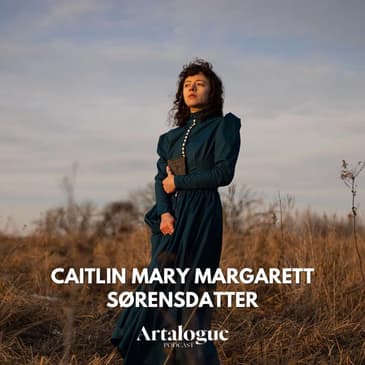
Let's talk about debt, baby! What does it mean to take on thousands of dollars in debt as an artist?
This week's conversation with performance artist Caitlin Mary Margarett Sørensdatter explores how the Midwest's transformed prairie landscapes serves as a canvas for CMM's work, spotlighting the cultural and ecological shifts that urge us to rethink our relationship with a changing world.
Our conversation takes a turn to the all-too-familiar struggle with student debt, a reality that many in the creative fields take on to pursue our dreams. Caitlin opens up about her experiences navigating student finance as a teenager at the University of Northern Iowa, where the pursuit of an arts degree came with a heavy price tag. We delve into how that debt is affecting her today as well as Caitlin's honest account of the systemic barriers to low income students within the American education system. The episode reaches its crescendo as we dissect the artistic growth within the demanding environment of an MFA program, and whether going to university is necessary to become an artist.
Follow Caitlin on Instagram: @caitlin_mary_margarett
Check out Caitlin's website: https://www.caitlinmarymargarett.com/
Connect with the Artalogue:
Madison Beale, Host
Be a guest on The Artalogue Podcast
Naiman. Mary Margaret Sorensdottir is an American artist working in durational performance and contemporary craft Through the combined use of antiques and handmade objects. Cmm generates memoir and autofairy-based work that aims to evoke apparitions, that which cannot be fully recovered or fully known. Her visual and written work operates within an aesthetic, spiritual ambiance, punctuated by a frenetic urgency to discuss cultural issues such as ecological and emotional erosion. By invoking nostalgia and solostalgia. Her cyclical, symmetrical, hyper-repetitive performance projects demand the analysis of our ties to place, ancestry and future children. Cmm strives to emphasize the importance of looking back as we move forward, to escape our own chimeras surrounding an individual agency in isolation, especially as we brace for the full impact of our climate crisis. Her work has been shown throughout the Midwest at 2022's Fringe Arts Bath Festival in Bath, england. At 2021's Miami Art Week as part of the Performance as a Live Satellite Show that runs concurrent with Art Basel Miami. At Louisiana State University.
Speaker 1:For the 2019 Queer Amic Symposium in ceramics, monthly Emergency Index 5N9, and Aesthetica magazine. She is currently a third year MFA candidate at the University of Wisconsin-Madison. Caitlin, can you introduce yourself and your research?
Speaker 2:Yes, I'm Caitlin Mary Margaret. I am primarily from the Iowa, minnesota, wisconsin area. I'm currently in Madison.
Speaker 2:My research sits at a cross-section of emotional landscapes, so a history of public and domestic performativity, religious fiction and auto theory, gathering that which may be lost and that which I cannot conceive the full scope of and its potential to be lost, drives that unknowable haunting presence in a lot of my performance work.
Speaker 2:Using my Danish matrilineal line as an interface to reflect on larger cultural and environmental and sociopolitical queries, I also ask about cycles of behavior and trauma and the repetition of an action or a singular statement in my live-duration. Performance vignettes are framed by these antique furniture pieces and century-old garments that I find throughout the Midwest to add a sense of depth and context. The other aspect of my practice is a diaristic, epistol practice. I have this archive of lasting anxiety and chronic worry that also offers a history of my family's shifting attitudes or concerns, as well as my own in relationship to this contemporary moment, but also looking back. So, while looking back, using aesthetics that evoke a sense of nostalgia, I'm also looking forward and asking about future nostalgia and future apparitions. That's kind of the core of what the work is, and I work in performance and ceramics and photo and video and the nagery of things.
Speaker 1:Growing up on the prairies. How does the landscape materialize in your work?
Speaker 2:Yeah. So I think it's important to kind of clarify that Iowa doesn't really have prairie anymore. So we say the prairies but it's not really something that is extant, it's more foreign fields and soybean fields. So something that I reference a lot in my work is my grandmother's grandmother, who immigrated here from Denmark here being Iowa in 1886. And when she moved here Iowa was I can't remember the exact percentage at this moment, but Iowa was still almost half prairie. It hadn't been eradicated for the agricultural industry In my time.
Speaker 2:Since leaving Iowa it's significantly less than 1% and from my understanding, a lot of the prairie that is quote-unquote, original or from centuries of existing or being curated by indigenous folks are in Victorian greyyards, victorian-era greyyards in Iowa, and there's some areas that have been reconstructed, of course, but again, those are reconstructions and in a way it's another form of curation because there's a supposing as to what was originally there, but it's still a form of some group of people's ideas to what it could have been or what it probably was.
Speaker 2:So I think the thing that really kind of influences the work in my work in terms of reflecting on landscape is this knowledge that the true, original, quote-unquote or what we think may have been. We cannot know, and it's the supposing that kind of presents an interesting question. Moving forward, when we think about how landscapes might need to be adapted for what is to come in terms of our climate emergency, I think there's a lot of supposing of going back, but there's no such thing as going back because that knowledge doesn't exist. So it's sort of a hope. Moving forward and standing in places that are these big cornfields and these big soybean fields, you kind of know that there is no such thing as returning. So you have to think about well, what can we hope for? Moving forward, that is not this, but maybe has an echo of what had been from the little knowledge that we do possess, but it ultimately will be a reconstruction.
Speaker 1:I think that's so crucial. I think it's so important to think about that, because it's difficult. How do you communicate a grief for something that you have personally never experienced, in just a general sense of the landscape that's shifting in ways that's totally out of our control, and the decimation of the prairie has been totally out of our control. So moving forward, understanding our past as a means to move forward, is so interesting.
Speaker 2:Yeah, and I guess, to kind of build off of that I would say our generation has no control of, but the eradication of the prairie was no accident, right? The eradication and the complete reworking of the whole layout of the Midwest is all because of, you know, white colonialism and violence. We, in this moment, when we think of natural disasters the 2020 DeRay show that swept through Iowa and inspired the piece that I did for Miami Art Week when you think about how those climate events are going to become more and more common and these storms of the century are going to become more prevalent and not just these freak events and you think about how Iowa, in terms of even atmosphere, has shifted because of foreign sweat, because the corn emits so much. I'm not a scientist, I'm not giving this description justice, but basically because the corn sweats in the summer so much, it creates this humidity. That is why we feel like when you walk outside, your clothes are immediately happy.
Speaker 2:You know it's a shifting of so many different things, as well as the soil, and then the ways in which Iowa's water systems have also been completely changed because of all of the big ag runoff. So, again, not a scientist, I'm just a lady who's lived there. But when we think of these freak climate events and their prevalence and thinking about disasters to come, and thinking about disasters not as like something that is completely not man-made, but a freak weather event creating a disaster because of an, at an institutional level, people not being able to be prepared or have the proper infrastructure for responding, how can we, with that knowledge, move forward and maybe consider a reconstitution of certain places, a different means of stewardship for these landscapes, to kind of protect ourselves but also to protect the future, you know?
Speaker 1:As a source of inspiration in your work. I'm curious as to how, through education, your work has changed.
Speaker 2:Yeah so.
Speaker 2:So I first started doing performance when I was an undergrad and my understanding of performance before I started my undergraduate was very different from what it is now. Obviously. But to define performance, I guess, instead of at the end of this whole art process, you have this product and then people, the audience, experiences this product or this object or this photo or whatever. Instead the art experience is the live unfolding of an event or a series of actions. It's the combination of visuals and drama in a way. But if anyone's familiar with Marina Abramovic, the idea is that it's not fake, it's not staged in the same way as a play is where the I think she famously says in plays the blood is fake, but in performance it's real. And so my understanding of it was kind of skewed a little bit. And then coming in and studying it with April Thompson who when I was an undergrad she went by April Peepers and understanding that performance is a process of unfolding and kind of discovery through repetition and through duration, it really shifted how I also navigated myself as a person and how I dealt with these large, really kind of isolating feelings that I was experiencing as a young, overwrought person and still experience as a slightly older, overwrought person, but studying art enabled me to have a sense of mercy for myself and a sense of grace for myself that I don't think I would have possessed otherwise because of the people that I was surrounded by, in this sense of method and labor being a means to solidify myself in some way. And so there's that and I also studied ceramics and I have a degree in art history as well, and I think the confluence of history and art practice and having a deeper understanding as to how these norms that we just sort of accept in terms of visuals and art production kind of come from a canon that's not really interested in equity or in any sort of fairness if you're not a white dude. So it made me into because at the time I would not have said I was a feminist, but it made me into a feminist. It made me into somebody who was able to perceive intersectionality and its needs and it made me into, in a lot of ways, an activist, because I was able to see how there were these institutional barriers that were overwhelming even within my own university, in terms of funding, in terms of access, in terms of ability to study well and study in the way in which my more affluent peers were able to, so it did that for me.
Speaker 2:But I also was in a class, an undergrad that kind of changed my life and it was called Eco House and it was a performance installation class and that was led by Angela Waseskuk. Eco House Eco is the word for house, right, so it's kind of a house house, but presenting this idea of engaging with the environments as a co-collaborator and thinking about the ways in which we produce art and the trying to think of a better word for this but the ways in which we generate our work and the consciousness of it and thinking about is this the material that it absolutely has to be, or is this creating, in a way, harm, and where is this material coming from? And it was really a shifting for me. So so, yeah, and then now.
Speaker 2:So I'm in graduate school and I'm currently in the process of applying for PhDs, and I'm going to sound a hypocrite because I also am kind of anti-institution in a way.
Speaker 2:She says, as she it's submit on her PhD apps, but I think being in this cohort and having access to people who are so brilliant and so much smarter than I will ever be, and seeing what they have to offer in terms of their own practice and how they navigate these complex world issues, and who they're reading and who they know and thinking about things in a more grayscale capacity as opposed to it is this or is that, and beautifully, I think.
Speaker 2:A lot of my performance education from undergrad is a bit black and white, which is great for foundational work, and now I'm in this space where it kind of by necessity has to become very nuanced and convoluted and at times make people very upset and at times make people feel very safe, and sometimes both at the same time. So so yeah, I think I wouldn't be the person I am without having gone through this whole process, but and my work wouldn't be the same, it'd still become a trait and just like sad girl art, but I think now it's sad girl art, who but this girl thinks a lot and she's trying to pay attention and contribute.
Speaker 1:So yeah, I'm thinking of Arthur Dantos art world a sad girl art world.
Speaker 2:Yeah informed by theory. Yeah, except this one is informed by theory and also reading so many memoirs and going oh, I am not special.
Speaker 1:Thank God, you know I'm always out of my reading slump.
Speaker 2:Yeah, oh my gosh. I'm not related at all, but just listening to and rice's whole cannon on loop and being like this is this makes sense.
Speaker 1:Absolutely, I think, and rice is the only thing that makes sense right now.
Speaker 2:You know retweet.
Speaker 1:So to explore a little bit of what you were saying there about the experience of studying as someone who is less affluent in these institutions that are very costly, can you tell me a bit more about your journey with student debt in the arts?
Speaker 2:Yeah, I would love to. So in a way I again I am a hypocrite and I will say that from the get go because I am applying for more education. But for context, I'm moving to the UK and I cannot teach in a UK university without a PhD, so point blank, that's. That's kind of the gig. So for my undergrad I went to the cheapest at the time, the cheapest at state school, which was the University of Northern Iowa. It's a very high acceptance rate.
Speaker 2:I applied literally on the last day that you could apply and got in and said, whoa, I guess I'm going there because I didn't have a plan when I was 18. No one around me really had a plan either. I was really going in wide-eyed and not knowing what it meant to take out loans. I didn't really know what FASFO really did other than it made this bill disappear, but I didn't really know what it meant For people who are not in the US. I don't know if there's something that is equivalent in other countries. There has to be this process of applying for loans. You can do these different tiers of loans through the government with your parents' cosine. I didn't have any of that. I was very much on my own. I had just turned 18, so I was signing all of this paperwork not really knowing what it meant. But even if I had known what all of that meant, it wouldn't have changed anything because either way I didn't have $16,000 per year to just shove out of pocket.
Speaker 2:I didn't walk into college with any credits. I was working like 25 hours a week at a grocery store. I was aware that I would eventually run out of financial aid and that might be a problem later. The occasional scholarship that was $1,000, maybe $500 from wherever, but if your bill is $16,000, that's not going to really make a dent. That's before you have to buy your books and before you have to pay these other fees that you're like. I don't know where this is going. I think to a gym that I'm never going to go to, but whatever, doesn't matter. There's all of that stuff. I never lived away from home, so I didn't really know. I got a job and was working 10 hours a week, but I was taking 18 credit hours because I was made aware of how behind I was, because I didn't walk in with any credits.
Speaker 2:I felt like the first two years of being an undergrad was me just being confused not only by the massive amount of debt that I was suddenly aware that I had, but by the sense of like I'm doing something wrong because I'm accruing this debt and I don't know how other people are doing it, because it's also kind of taboo to talk about, because some people have money and some people don't and everyone wants to proceed themselves on the same level and not talk about it. But I think that's part of the problem. There's a cap on FASFA so I ran out of funding basically. But it's not funding because it's loans. I ran out of loan money in my last year of undergrad and it took me because I walked in with zero classes and zero credits. It took me five and a half years to finish my undergrad because I had two and a half degrees and I couldn't afford to do summer classes for the most part. So I ended up working full-time in my last year and also doing school full-time and the last semester I only had like two classes, so it was technically part-time, but in the studio every single second that I wasn't at work I was working crazy hours and I had a professor who was very kind to me and really took care of me during that window and I was like, oh my god. And just drowning.
Speaker 2:So that experience was really, really hard for me because I, from the get-go, didn't have the luxury that a lot of my peers had, where they were like, oh well, my parents don't want me to work because they want me to focus on school. And I was like, well, I don't have that choice. You know, I moved off campus as soon as I could because it was so expensive to live on campus. But then you have the responsibility of feeding yourself and paying your rent and doing all this other stuff, which was kind of good for just general-life skill building, but also still very stressful when you're working like 90-hour weeks. So yeah, I made myself very, very ill when I was an undergrad because of the amount of stress I was under, but because I couldn't do it any other way. You know, when your jobs only pay you 25 cents an hour, you're going to have to work a lot of hours in order to make your $450 rent and then also pay for your books and also pay for art supplies and also pay for this, that and the other and pay for internet and pay for you know. So I guess in some my experience is not special and I think that a lot of the smaller state schools that are quote unquote less expensive are, in a lot of ways, more expensive Because they don't have the same funding streams, so there is not the availability of getting scholarships. In the same way, I also think it's folks who go to R1 institutions like the university on that now, university of Wisconsin Madison. Hopefully they don't come after me for saying this, but I think, unless you are only getting an undergraduate degree, don't go to an R1 Institute Because it's so much more expensive, obscenely so, and also, I just don't think, as an undergrad student, you should go to an R1 Institute.
Speaker 2:When I was at UNI which is not an R1 Institute it's actually don't know what its official status is I was treated like a graduate student in the BFA program and I was given a lot of attention and I was given a lot of resources and I was given a lot of time and energy by the faculty. And as a graduate student here, it's very much the same. And I see these undergraduate students who do not get that level of attention and they don't get that level of curated care and that specificity of person to person treatment. I would say don't go someplace as a graduate program. Go someplace that you will get a lot of attention and a lot of one-on-one with people that are kind of in charge of your being, and I guess not to spend too much time on this. But I'm in this program, which I'm very thankful to be in. I'm very, very thankful for my time at UW Madison.
Speaker 2:That being said, it is a quote, unquote fully funded program which means that we get health insurance through school and we have a work requirement where we work a certain number of hours through appointment or a particular job that the university thinks that we would be a good fit for within the department, and on the surface that is really fabulous and in a lot of ways it really is. But fully funded is a misnomer, because what it really is is it's tuition remission, which is grand, and we get paid a little bit of money per month, but it is not enough to live on and it just is not. And I hear what my colleagues in the science department are paid and it's significantly higher by multiple grants higher, but at the end of the month, in terms of leftover, there is no leftover. I'm in the red because I have to buy supplies and I have to pay my rent and I have to pay my car bill and I have to pay all the stuff. And I'm not alone in that, you know, and I'm a graduate student. That's pretty lucky. I am not somebody who has children or dependents to take care of. These are the really large and life consuming and money consuming responsibilities, but it's still not enough. In the city of Madison it's a coupon, so fully funded is a misnomer. I'm getting basically a coupon for my monthly expenses, which is great, but knowing how much peers and other parts of the school get there quote unquote fully funded is sort of. It's uneven, I guess, is what I'm saying.
Speaker 2:I feel like the first year you're just kind of flailing and you're going what the hell am I doing? I came in with this idea and with this kind of work and I've sort of run it through because it's sort of was at the tail end when I applied and I was ready to move on a little bit from this idea. But I'm still making this because I haven't fully flushed out the new idea. The second year we have to do a qualifier or a master show. I sort of finally was like oh, this is what I want to do. I'm finally in a place mentally, spiritually, physically, where this is the work I want to do. And then, third year, you're representing your MFA show. This is the thing that I did for the three years and it's just for me personally.
Speaker 2:I feel like I'm only just finally arriving at what I want the nexus of my work to center in on and really speak to.
Speaker 2:And I personally want that extra three, three and a half years to have that theoretical framework flushed out and to really dive into more clearly the philosophical relationships I'm trying to develop in a sense of auto theory and looking at Kierkegaard and looking at other veins of thought that's kind of buoy and support, this memoir-esque auto theory work that I'm leaning towards, especially as I pull together all of these ideas surrounded by things kind of based on environmental concern, which also flavors every other concern that I possess, and my desires for creating a family and children in reflection of that, but also my sense of responsibility to the community as somebody who is sort of I wouldn't say a lone wolf, but like somebody who is more internal as opposed to external and their expressions of solidarity and wanting to be up, building in the community and trying to find what that you know.
Speaker 2:How do I make that personal work like a part of the public political work that I'm invested in? And then, also, speaking to this other aspect of restraint and perceiving goodness, questioning how I have been trained, by where I come from, as perceiving goodness as withholding and not taking up space, both physically, socially, mentally, through resources and all of those things. And so looking at anorectic behaviors and how those are reflective of that religious friction, that performativity of the domestic and the public, and then concerns about the ethics of like taking up space with environmental concerns, you know. So I feel like, for me personally, that three and a half years addition is something that I am desirous of and that I want.
Speaker 1:What advice would you have for someone hoping to pursue a career in the arts or specifically as a performance artist?
Speaker 2:I am a firm believer that you should not go to school when you're 18.
Speaker 2:I think that you know, if I had waited until I was like 20 and I had maybe gone to a little bit of therapy and also just developed some basic life skills, I think that I wouldn't have floundered so much in my first few years of college because I would have had a better grasp on basic life things. So I think that, depending on what type of artist you want to be and what your passion is, I think that if you give yourself time and not immediately enroll in a school because you think you have to at the age of 18, if you give yourself the mercy of time and not perceive it as this rushed thing, you can make better choices for yourself, better school choice. You can visit those schools, you can actually talk to the faculty and see what they offer, and also if you just vibe with them. So I think that being really honest with yourself and being like I want to go for this, I'm a firm believer that no one should go to university before their frontal lobe is developed.
Speaker 2:Yeah, well, and I think you know when I think about when I was 18, this sense of just not knowing what to do because I didn't have people besides my art teachers and this is not shade at my mother or my family, but my mother at the time hadn't gone to college in like 20 years Like it's not applicable language, it's not applicable knowledge, and so she kind of and she also isn't somebody who really does internet, so her knowledge of what was out there was sort of as scarce as mine. And I had high school art teachers who were like you should go and I was like, should I? I knew nothing. And I think going in sometimes not knowing anything is really great, but when thousands and thousands and thousands of dollars are on the table, it's not, especially when you're going to have to pay those thousands and thousands and thousands of dollars back with interest.
Speaker 2:But I wish I had done it in a way that was more knowledgeable so I wasn't so freaked out. And I think a lot of students are in the same position as me, where they are very aware that there's that fast for cap and they are very, very aware that their resources are a lot more finite than their peers, and I think it's unfair in a lot of ways how, especially in the United States, students who have to work are punished and faculty who have been affluent for a very, very long time do not understand the gravity of that and who have no concept as to what current rental prices are or what current wages are. So, and that's on that.
Speaker 1:But, caitlin, thank you so much for your time today. I always love chatting with you and catching up on your life and amazing, amazing performances. And, yeah, thank you so much for being on the show.
Speaker 2:Yeah, thank you for having me and letting me carry on Always a pleasure.
Speaker 1:I could listen to you talk for hours.
Speaker 2:Oh my God, it was so good to see you.