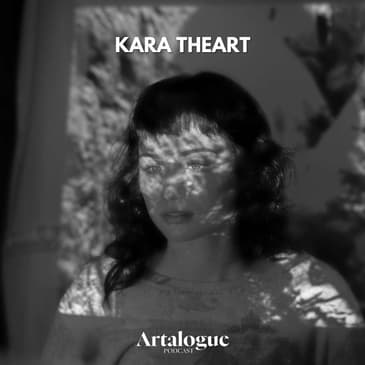
Ever wondered how an artist’s cognitive makeup shapes their creative journey? Get ready for a captivating exploration into the world of Kara Theart, a rising Birmingham artist whose large-scale ink pen drawings blur the lines between human forms and landscapes. Theart explores how neurodivergence has not only influenced her artwork, but also added a unique vibrancy to her artistic expression. A recurring theme in her work is her personal relationship with the female form, a subject she speaks on with raw authenticity. We also delve into the story behind her viral sculpture, "My Dear Buck," and how the attention it has garnered has impacted her personally and professionally.
Enter Kara's world as she navigates a new benchmarks of success for a young, emerging artist. Cara’s journey is filled with passion, perseverance, and the occasional hardship. Her love for creating is contagious, and her words of advice are a must-hear for young artists navigating a changing art world with new demands for a digital presence. She encourages emerging creatives to channel their emotions into their work, and to diversify their artistic mediums. As a bonus, Cara tells us more about with the details of her upcoming exhibition at Wavelength Space in Chattanooga. Be sure to follow her on Instagram (@karathe.art) to keep up with her latest work.
Connect with the Artalogue:
Madison Beale, Host
Be a guest on The Artalogue Podcast
T Art is a young emerging artist in Birmingham, alabama. A 2022 visual art graduate from the Alabama School of Fine Arts, t Art continues her art education at the University of Alabama. At Birmingham, t Art primarily creates large scale ink pen micro spiral drawings that merge the human form and landscapes into one another. She also works as a metal sculptor at Sloss Furnace and practices sculpture and new media at her university. She works to balance life as a full time artist and student, as well as marketing for herself. Kara, welcome to the show. Hello, can you tell me a bit about your process and what ideas lay behind your work?
Speaker 2:So I typically create ink pen drawings with this scribbling pattern or texture, and these drawings will be the merging of these landscapes and bodies and forms, either together separate, and what I'm trying to represent in these works is the idea of relating the human back to the earth and showing their shared vibration and experience through that texture. And for me, what that really means is how we came from this earth and the chemicals that our body is made of were here once the earth was born, and I just I really want to bring sympathy back to both the body and examining it as big as a landscape, as well as giving sympathy back to the earth and how it's nurtured us. It's brought us here and we are a part of it.
Speaker 1:Yeah, what are your earliest memories of art?
Speaker 2:So I have ADHD and it's been undiagnosed since I was a senior in high school and that came late to me, but I feel like it should have been more obvious with how restless I was and drawing was always an outlet for that and just creating art in general. I remember I made my own pinata for my birthday because I really wanted one, but I was like, no, I always found my own way to create something or someone or little forms and stuff, and doodling was low key a problem. I remember one time I was really pretentious as an artist, even as a kid, because I told my mom I can't do my math homework because I just cannot stop drawing, which was not true. I just didn't want to do my math homework.
Speaker 2:But yeah, I still like doodling and drawing has always been so therapeutic for me and once I found this form of work that I create now, these drawings, I just knew this is it. This feels right. This is something that I want to do every day. This is something I still. I'm not going to get sick of it, I'm not out of ideas, it just there is a flow to this process and I feel like that comes from when I was really young and just obsessed with drawing.
Speaker 1:Yeah, what does it mean in your work to draw the female figure and what do you hope to convey with these pieces?
Speaker 2:So, as a female, I feel that everything that comes with being a woman and that structure and the idea of gender that has been pressed on me since I was a child, I could find myself mentally sexualizing myself as a child, and for me the female form is something so sacred because I've abused it in my head for so long. It was something that is bad, something that mine is broken. My form is broken because it's not the perfect female form in a way, and I don't know. As a woman, I have a long relationship with my body that is back and forth of hating and loving it, but when I relate it back to the earth, I remind myself this is something way more than the structure that I've been taught. It was a part of and I think it's very sacred to me.
Speaker 2:And recently I've been creating a lot of work with the idea of pregnancy and birth, and I don't even know where that's coming from because I'm nowhere near that. I've also been dealing personally with the idea of birth control and my hormones, and everything is just I don't know. I remember almost every day I'm a female, I have this feminine body, I have those female organs, and it is always either a negative connotation or something positive. I just feel like sometimes there's this large argument in my mind about it. Yeah, I really like to use it as a way to explore my relationship with being a woman.
Speaker 1:I think that definitely comes through in your art as well, because when I look at your drawings of the female form and the naked female form as well, I think there's a very big distinction between drawing clothed and drawing disrobed and. But when I look at your drawings they don't seem to be sexual to me. When I look at them they seem very much matter of fact and looking at a still life kind of thing. I'm looking at a, and they're so beautiful and sculptural in the way that they're presented and I totally resonate with that kind of tussle of womanhood.
Speaker 1:Yeah, it's daily. Your recent sculpture with my dear buck received a lot of attention online this month. Can you tell me more about this sculpture?
Speaker 2:So this was actually an assignment that I got as a part of my sculpture class, which is a little embarrassing to say because I'm really happy about it. I don't know, my teacher tells us don't talk about it being an assignment, but we were given this opportunity to use plaster and alginate mold making and that process, and initially I wanted to create an entire body for the buck, but my teacher told me that would take too long, so I went down to the head and I think that actually came off better for my finished product, because it relates to the idea of the trophy of a buckhead mounted on the wall. And again, here I'm trying. I use my, my feet, my hands and casts of my eyes to create this buckhead with its antlers and it's yeah, it's snout and everything snout. I don't think it's a snout, but did a muzzle, I'm not sure.
Speaker 2:Yeah, but I tried to create its form through human limbs and, for the sake of trying to again relate it back to the human and asking is it still a trophy, now that it's made of these human parts, what would you consider it? Is that almost a cannibalistic, or angry? I don't know. It's as if the buck is trying to mimic the human side of itself to protect itself, but here it is still mounted on the wall.
Speaker 1:That's incredible. But how do you cast eyes? That's what.
Speaker 2:I'm so interested in.
Speaker 2:Okay, my teacher, my professor, she told me that someone had casted their eyes open once and I was like there's no way I'm doing that. What it is? You mix alginate, which it comes in a form of a powder, and you mix it with one part of water and that it's like this purple, it's gummy, but when you mix it it's liquid and slimy and it hardens in 11 minutes. So you put your hand in there, you put an object in there, and what I had to do was take the coffee cup, cut it in half, pour the alginate in there and then lie upside down while it's on my eye and holding the cup as tight as I can on my face so it doesn't drip everywhere and get in my hair. And I had to do that five times.
Speaker 2:It was so scary. It's not harmful for your eyes, it's the stuff dentists use when they make the molds of your teeth. Okay, so you can ingest it if you really need to. But I was just so scared, it was so scary. And then, yeah, once that hardens, you take it off your body and or you take your body out of it and then you're able to pour the plaster in and then it creates a mold of it in plaster.
Speaker 1:By a lot of attention, I obviously mean that hundreds of thousands of people have now seen this sculpture. Um, what is it like to go viral?
Speaker 2:I have been using my social media to try and market myself for a long time now. It's been almost two years, I would say, but I don't know. It's been a long process and the first time I really went viral it was scary. I felt like I couldn't touch my phone or I would mess something up. But it is so sweet. The funniest thing that I've learned is the best way to go viral is to have half the comments hating on you and have the comments supporting you. So it's really interesting to watch that war go on.
Speaker 2:I don't know, it's weird. I don't know how to have a relationship with all those online usernames. I'm really grateful for the attention that I've gotten. It's really brought me into the headspace that I can do this as a young artist, market myself while still sticking in the middle of Alabama and it's I don't know. It's really exciting at times and it's really discouraging when the posture syndrome hits, but I think, regardless, the support is good for me and I've been able to use it and use the people that are interested in my work and network with them and relate to them and communicate with them. I've made a lot of friends, to be honest, and that have supported me and people that will buy my work, which is the biggest compliment ever.
Speaker 2:I can't even believe that I've gotten that far, because a couple years ago I really didn't believe that staying in Alabama was going to be good for me, but I think it has, now that I've pushed myself to try and reach outwards.
Speaker 1:And as an artist, how has the internet helped you or impacted how you share your work and who interacts with it?
Speaker 2:It. I think number one that I got really lucky with knowing how social media works, as I've grown up on it. I was using it in fifth grade, Every mission. It's a great tool and I think that if you're an artist and you have it at your disposal, please use it because, regardless, it's like a portfolio.
Speaker 2:It's honestly, in my opinion, I think it's better than a website. I think that people have gotten to know my personalities. People like me for what they know me as who they know me as they're more invested in my work. It's a lot more engaging with the kinds of audiences you're trying to connect with, and I think that you have a bigger option of audiences at your disposal rather than your direct community. I think it's really great and you'll meet people that know people and that's awesome, especially when they want to support you and they see you and they recommend you, and it's a really great tool. It's yeah, I have a website, but I definitely don't engage with it as much as I do with my Instagram, and I think that's a benefit for me.
Speaker 1:And yeah.
Speaker 2:I don't know. It's definitely something that I've had. It takes a while. It took me about six months before I think I would. I got a video that was really viral and really did well. It's worth it. It's so worth it.
Speaker 1:So what does success mean to you right now?
Speaker 2:I've been back and forth for a while now about how I'm working and my timing and everything, but I think success for me is to just keep pushing. I've learned the most that it's a slow process, to be honest. It's just building on what you're building, and yeah, I'm just right now. I think success for me is working on my portfolio and I really want to be able to travel. I have a showcase, I have a piece opening in an exhibition in Chattanooga this Saturday at Waiflength Space, and that's so. I think for me success is one exhibition a month or trying to get one piece done a month. Sometimes it really varies for me, but I don't know. Success, I think, is just to keep going and not lose my discouragement, even lose my encouragement when things are slow.
Speaker 1:Yeah, where do you see your art going in the future.
Speaker 2:I am really intrigued by sculpture. With this most recent piece I've made in my Dear Buck, that's when it something lit up in me and I was like, yes, finally I'm connecting to sculpture because I feel like that's always also been something present in my life. My father he creates a lot of woodworking pieces and mechanics stuff and my mother loves to work with concrete and I've always been drawn to it, but I've never really achieved it as well as I did with my most recent piece. Yeah, I'm really enjoying them all making process and I really hope to push into that more and I really want to do public works as well, so learning how to make my work more durable for that and more versatile as well, and able to connect with more people on a very personal level.
Speaker 1:Yeah, what advice would you have for other young artists?
Speaker 2:Again, definitely try new social media, it's so worth it. If you think, oh, everyone's going to, everyone I know is going to make a new account and block them, because this is your career and you can either start building it now and be where you want to be a couple years later, or you can just hope it happens. And I know for me, going into an art career was just terrifying. I think it is for a lot of people, because we're born hearing about the starving artists or even seeing older people that you know that lost their excitement over what they used to do. They used to play music or I used to paint. And my parents they always told me if you work for it, you'll get it.
Speaker 2:And I know I have a lot of privilege and a lot of opportunity and I've been born into a very supportive family. But there have been times when I'm like I'm the only one supporting me right now and all I got to do is keep going. It's really good to use your anger, your frustration and all your hopes and dreams being gone and put it into new energy. That's the screw that. But no, I'm just.
Speaker 2:I'm not going to know, you just decide now, when things are not going well for you, just be angry at the universe. That's what I have to do sometimes and honestly, I think those are always my best times, and I'm just like I know.
Speaker 1:I think that is such excellent advice. Just to say screw it and work and not care what other people think, which is easier said than done. That's an practice for sure, but I think that is incredible advice and so important.
Speaker 2:So many people need to hear it, yeah sometimes you don't know what you're saying no to, but it just even if it's with your work in general. If you're like I have to say no to me drawing today, I have to do something else, I don't know. Just don't expect yourself to always be into one thing either. It's okay to say no to what you tell yourself. You have to do and have to feel.
Speaker 1:Yeah, I think that's so true as well to be open to new experiences and to not put yourself in a box as a X artist, like I'm not just a painter, I'm not just a sculptor. I could be anything given the opportunity.
Speaker 2:You wake up and you get to choose. So, yeah, that's awesome advice For sure.
Speaker 1:Well, Cara, thank you so much for talking to me today.
Speaker 2:This has been so much fun.
Speaker 1:Do you have anything that you want to promote?
Speaker 2:here, I guess just my Instagram. It's the best way to find me. It's k a r a t h e dot art.
Speaker 1:Yeah, and your upcoming show where?
Speaker 2:It's at Wavelength Space in Chattanooga.
Speaker 1:Awesome. And what's your website?
Speaker 2:again, it's my name k a r a t h e r t dot com. So Cara t art.
Speaker 1:Awesome. Thank you so much. Cara, Thank you so much.