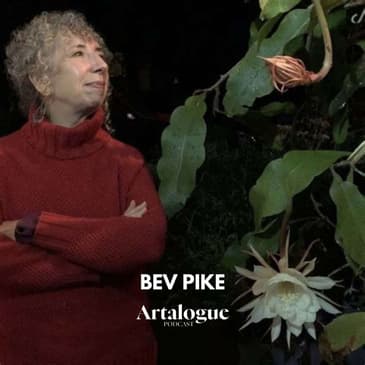
Bev Pike is a Winnipeg artist known for gigantic immersive paintings of architectural utopias. She bases her current series on eccentric three hundred year-old subterranean grottos in England. Pike shows her work in major public art galleries across Canada, most recently at the Dunlop Art Gallery (Regina), Museum London (London), and St. Mary’s University Art Gallery (Halifax). She is the recipient of many major grants from the Canada Council, Manitoba Arts Council and Winnipeg Arts Council. Pike also creates humorous, provocative and feminist Agony Aunt columns in artist books that are in international special collections such as the Victoria & Albert Museum, Tate Modern, University of Bristol and others in England, Canada, Iceland and the USA. She has been a guest speaker from coast to coast and in England. Finally, as a long-time community activist, Pike writes evidence-based satire for the Winnipeg Free Press, CBC, MSN, etc.
In this episode, Bev Pike tells us more about the importance of taking up space. From the scale of her paintings to her satirical writing, Pike's strong convictions as a Feminist means she's not afraid to make herself, or her work, stand out. Additionally, Pike gives some valuable advice for artists regarding grant writing in Canada.
View more of Bev's work.
Connect with the Artalogue:
Madison Beale, Host
Be a guest on The Artalogue Podcast
In her monumentally skilled paintings, pike designs an architecture that addresses the needs of the occupants. In doing so, she creates alternatives to domestic space. In her early drawings, pike invested matrilineal household objects with sentience. Following that, her booed wars, imagined the bed having the ability to feel, perceive or experience. Later, she hypothesized the landforms that hybridized anthropomorphic knitwear with geography and climate emergency turmoil. This led to research about underground refuges, such as bomb shelters and quirky English baroque follies. Currently, pike is creating paintings that lead from one to another with a subterranean labyrinth of shell-encrusted grottoes. The web of caves contains such amenities as stables, dance halls, lakeside tea rooms, spas, seance parlors and a secret rendezvous hideaway and a greenhouse. In all her work, pike makes illusions to eccentric architecture of the past and the embodied experience of the present, while providing antidotes to an apocalyptic future. Bev, thank you so much for being on the show. I'm happy to be here. What are you currently working on?
Speaker 2:I've got a couple of grants to work on a new painting for gestures, for court gestures, so it's called Rock Shelter for Mathia-Din. And Mathia-Din was a court gesture woman for Louis XIV and she was famous. She wore eccentric clothes. She was an activist. She wrote broadsheets, political blasts fighting for equality. She was brave. She dressed as a pirate all the time and carried around a wooden sword. She was amazing. So Mathia-Din is a role model in my imagination. This is an underground shelter for them to hide out if anything bad happens, because there's more and more women who were gestures and there were many women who were court gestures back in the day. So it's fascinating because they got written out of history, but they were brave gals. So in my imaginary world that I'm building underground, I thought they needed a special room, a special grotto, when did you know that you wanted to be an artist?
Speaker 2:As soon as I could draw three H3, as soon as I could hold a crayon, I knew I wanted to be an artist. I grew up in a neurodivergent household, so having something quiet in a corner to do was really a smart idea. That's when it all started. I was in late adolescence. My parents tried to encourage me to become a teacher or a secretary. Now this is in Alberta, so there weren't many opportunities for women. A teacher had to play with puppets and a secretary had to make coffee for men. None of those things really turned my crank, so I got into the art school there and that was that.
Speaker 1:Your paintings are generally quite large-scale and have grown since your Brutal Art Series from 1990. How does scale factor into?
Speaker 2:your work. For starters, I'm a small person but I'm a big feminist, so that is key to these works. I'm also building an underground labyrinth. There's nine paintings so far on the different themes that you outlined there. So in case we have to go and live underground which seems more and more likely all the time we're going to need some places to have tea, to get a massage. So that's what I'm after building and I'm not out of steam on that. Yet. The one coming after is a root shelter, root shelter for wishes. So it's for dreaming. That's the new piece, but right now I'm finishing off the gestures, one for women gestures.
Speaker 1:And what does it mean to create paintings on such a large scale?
Speaker 2:It's a feminist action to take up space. It's really a basic feminist action to do that. I love the proprioceptive elements of viewing these pieces. So you're the viewer, you've got to get up close, you've got to get far away, you have to walk along the front of it and back, because some of the paint is metallic so there's a glint to it and the space changes depending on where the viewer looks at it from.
Speaker 2:I couldn't create pictures. What do I say? Picture a small piece? That would be dead, boring, not interested in that at all.
Speaker 2:I want to build an environment in paint, so two dimensional environment. They have deep space and they take a year to make, and most of that time is building this very deep space that the viewer can then feel they might float in or fly in or run through. There's always two exits as well, so on exhibit, exit from each painting leads to another painting that also has two exits and two entrances. So I'm after building this gigantic labyrinth of different pleasurable grottos and these are based on underground shell grottos from England. There's 17th and 18th century. These are part of Arcadian gardens that rich guys built and it was revolutionary at the time. The Whigs were the government and these were not practical ideals. So the rich guys at the time built over the pig barns, the hunting areas, the horse barns and so on and created lakes for swans and pretend columbariums and fake Gothic ruins. And so you would walk along these long paths thinking deep thoughts, and every once in a while there'd be a dip in the ground and you would enter a shell grotto when I say that, a cave that men built. And then the women would come in after they had dug this big cave out and decorated with seashells. Some of the grottos are decorated not with shells but with shingles, quartz or amethyst Mostly what I've seen. Some of the knobby bits are from Bristol. They're called Bristol Limestone. They look like vertebrae. So there was a fad in the 17th and 18th century. Men were competing with each other I've got 12 galleons going to the Caribbean to dredge up the better seashells than you do, and then everybody can say I've got a whole mine in Czechoslovakia getting the best quartz for my shingles. But the women actually did the making of these things, which is really interesting when you consider what they had to wear. They had to do all this with tight corsets on and long skirts, so they were hampered by the clothing of the day, but nonetheless they went in and built these things.
Speaker 2:It's fascinating to me and very spooky, very scary to go in these Because you enter. The idea is you have a altered experience on entrance. So they're not lit. Some of them have electric lighting now, but in the beginning they were designed so that you would take a dip after your pastoral walk, go into a very dark hole and you could do nothing but stand there.
Speaker 2:You were waiting to see what your senses would tell you. Where's that water that I'm hearing? Am I going to step in it? What's that smell? Was that a bat? All that kind of spookiness? How narrow is it? Is that somebody I don't know coming this way? Did I just hear a dog? Really scary even now. Because they're tiny. The worst ones are really tiny. The passages you have to put your back to the wall to let somebody else go through, even a child. They're not that wide, so they were designed to be secretive in a way and to produce an altered state. So the result was that you would go in and think deep thoughts. That was the whole point, aside from impressing buddy and the land next door in the next county the immediate purpose when you're in these landscape gardens and going through these grottoes is that you would think very deep thoughts, you might write poetry, you might have a trist. They're all lit by candles back in the day, so super spooky, which is a draw for me.
Speaker 1:They sound so interesting and definitely scary. What have been some career highlights for you, Beth?
Speaker 2:Some career highlights are on what would have been my grandmother's 100th birthday in 2004. I gave a talk on my artist book for her at the V&A.
Speaker 1:Wow.
Speaker 2:I know the autobiography of an eccentric line, so that was my first artist book. My grandmother was from Yorkshire, so quite dense, you could say, with eccentrics. Even though she didn't grow up there, her parents were from there, so she was a bona fide eccentric, which influenced me. In the last six or eight years, the Dunlop art gallery toured my solo show called Grotesque. Again, that word is sounding like English grotesque, but grotesque is a 17th century French word for what we might think in English is grotesque, but of course, being French, it has much more nuances than the English word does, so I use the French word. The Dunlop is in Regina and it toured my gallery to the Museum London in Ontario and on to St Mary's University Art Gallery in Halifax. I think it was 2016, 2018, something like that.
Speaker 2:So in the last 15 or 20 years I've made nine trips to England just to look at these underground shell grottos. There aren't that many left, but strangely, new ones are being discovered as people clear their land for suburban development. All of a sudden, somebody last year found a shell grotto in his back garden that had been overgrown for a long time. So there's more showing up, but I love seeing the ones I've already seen. They're all in the south of England because that's where the money was in the 1600s. I'm very lucky.
Speaker 2:Another highlight is to have the respective Lucy LePard, a very well-known, world-famous art historian and feminist art critic. And the last highlight is next year I'm the artist curator at the Art Windsor Essex, so that's the main public gallery in Windsor Ontario. So they've invited me not just to show but to curate from their permanent collection, collegial works, interesting works, works that complement mine. So the first thing I did is say all women. And then now I get to choose. So I have a few months that show opens in July. I have a few months to come up with a thesis there that sounds so exciting.
Speaker 2:I know, really exciting.
Speaker 1:Wow, I can't wait to see what you come up with. Yeah, me neither. I'll let you know. So, to pivot a little bit from your more physical practice, I wanted to talk about your work in satire. What kind of satire do you write?
Speaker 2:You could say it's feminist satire, All feminist, all the time. That's what I do and I've written three or four artist books feminist artist books that consist mostly of agony outcomes that's the English term. They're called Miss Lonely Hearts columns. Here they're advice columns, but I rank them up to be very sardonic, which is quite fun. I've also written satire about developers here in my neighborhood that are taking over and they tend to do things that aren't quite on the plum. I've got lots of ammunition for satire. I wrote a feminist quiz how to tell if you're a feminist Years back. It's a lovely outlet that painting can't give you. If you are able to use words for a political end, that's quite rewarding. So that's why I do it.
Speaker 1:What place do you think satire has in the present day?
Speaker 2:Oh, it's absolutely necessary, isn't it? That's a very trying time, and who doesn't need a laugh? Yeah?
Speaker 1:that's true.
Speaker 2:The other reason for satire is its evidence of intellectual activity. You can't write stupid satire that gets to most people, so it has to have deafness to be credible. So if you try and do heavy hand at satire, it just sounds boring Again. The 16th to 17th century, in Canada as well, were times where there was a lot of satire written and published. Newspapers were just being, the dailies were just being circulated. In that time it's nice as a feminist to have a community of colleagues who do this and who have fueled my own penchant for sending up the bad people.
Speaker 1:Since this podcast is about careers in the arts, I wanted to talk about your work as a grant writing coach as well. I think a lot of people, generally speaking, don't really know where to begin with grants. What is a grant and who is eligible for one? How do grants help artists?
Speaker 2:The grant system really helps people like me who are on a more experimental end of art production. These arts council grants are not intended for commercially oriented artists, because those artists are creating deliberately for the market. They want to sell. What happens is the market is sometimes less than I'll say sympathetic to innovation. So the arts councils exist, and the arts councils here are based on the British Arts Council. They exist to help out people like me who have a passion for doing research, taking on dodgy topics that are never going to sell. There's no market for them.
Speaker 2:This work belongs in public collections where it'll be taken care of Forever and people will get to see it for millennia. These are permanent, safe places for this kind of work. So if you're doing a commercially oriented work or hobby based work, the arts council is not the place for you. If you're going to apply, you always have to have a mentor if you're going to do it right, because it's a bit complex and the complexity comes from a strategy. It's a kind of writing that we don't normally do. So often when people apply for the first or second time, they write as they talk, so they have things like contractions, they have weird grammar, they have half thoughts. So you really can do that.
Speaker 2:This is an intellectual grant. It's to do research, to study something unusual. In general, I'm saying there are specific grants. You can get a Canada Council grant to simply market your work, which means to send it to commercial galleries, but also to international public galleries or national public galleries. In general, I'm going to talk about the arts grants for individuals to make their work in the studio.
Speaker 2:There's one major tip. There's one major tip that we all do and I've been at this some time 40 odd years and we all I still do it. And here's the tip never express an opinion, do not. And the reason why is cause one of the jurors will disagree with you. When people starting out say things like in their grant, everybody knows that blah, blah, blah. Climate change is evil or trucking is good, there's gonna be a juror who disagrees with you. And what that reader will do, what that juror will do, is go off on that tangent. I think blah, blah, blah. You want them to stay focused on your work. To do that, you have to talk about what you're studying, what you're researching, what you're investigating, what you're exploring. That's what you talk about.
Speaker 2:Some people also make the mistake when they first begin to write grants is they get quite braggy because they think that's the winning strategy. It really isn't. It's a really bad idea. Jurors lose patience with that cause. They're interested in finding out what new idea you're looking at. Well, the other thing about arts grants. So they help individuals to explore something new. They also help galleries to exhibit work. So is operating grants for artist's centers as well.
Speaker 2:In all of those cases, no opinions never express an opinion. Stick to the facts. These are research grants, even the ones to institutions. They have to show. We have looked at our audience. We have determined this is what they want to see. Here's how we determine it and then here's what we're going to do about it. We're gonna have these programs and these exhibits. So it's really hard to get rid of opinions. Get rid of opinions, get rid of cliches and if you Google the word cliche, you'll get six billion entries. So lots of examples of cliches that we all use. But really bad idea, because why is that? Jurors don't know what you mean. So if you talk in generalities, like I love mother nature and that's why I'm doing it the juror just gets bored right away. You have to be more specific and you have to relate it to your own research.
Speaker 1:Where does the money come from for these grants?
Speaker 2:These are government grants, but the trick is they're arms length grants, so the government does not have a role in deciding who gets a grant. That's why the independent jury is key. Once that isn't there, independent adjudication isn't there, then you more have a model of a commercial gallery or a cultural center where the government awards money directly because, let's say, fulclarama always performs this way and they're reliable. But arts grants, these are research grants, these are grants for intellectual activity, these are grants for innovation. That's why no opinions, because other people have invented those opinions, so it's a deterrent for the juror. You're gonna go before either three or five jurors if you apply, all of whom have different backgrounds, different media, different races, different cultural codes, and some of them might be tired, some of them might have just woken up badly that day, some of them might be stressed. So, as an applicant, you have to be really crisp about what you wanna do and make it easy for the jury to decide in your favor, if you possibly can.
Speaker 1:I think that's really good advice and I think that's something that not enough art schools, especially you're talking about. I know so many of my friends who are artists who have no idea where, even to begin with, grants. If someone were an artist and they were looking to find a grant, where would they find them?
Speaker 2:There's a two-part answer. If you're looking for a grant, you go to the Arts Council. If you're in Winnipeg, it's the Winnipeg Arts Council and the Manitoba Arts Council, which includes Winnipeg artists as well as anybody in Manitoba. Canada Council includes everybody nationwide. So you apply to all or one of those three agencies.
Speaker 2:I always tell artists to go to Creative Manitoba. It's a wonderful organization that is designed to help artists of all kinds in all media. So if you wanna be a commercial artist, if you wanna be an independent research artist, creative Manitoba can help you. They also have a separate page on their website for coaches so you can pick and choose there and they have some videos of some of us coaches talking about our strategies. So if you're working in new media, let's say, and you wanna know how to do a website including that, there's a coach for that that understands that stuff. If you wanna write a grant, then I can help with that. If you wanna write a writing grant, there might be a coach for that. Go to Creative Manitoba. It's the best place To return to your practice?
Speaker 1:where do you see your art going in the future?
Speaker 2:I'm going to keep working on this underground shell grotto theme as long as I can. As I said before, they do take a year to do so. It's a slow process. There's a lot of detail. I'll backtrack a bit and say that the first 10 months of that year I'm painting garbage. It just doesn't make any sense.
Speaker 2:My original plan smelled. I don't see the space operating the way I intended. So I'm experimenting with everything color, form, shape, line. Eventually, towards the 11th month of those 12 months it starts to gel and then the choices are much easier. But that first 10 or 11 months it's absolute agony. Why I keep doing it? It's some kind of mission, some kind of patience that I have to tackle this. So I'm going to keep working with grottesque. And the next one is place for wishing, making wishes. So we have, like you said in the beginning, we have a spa, we have a horse's stables, we have an underground conservatory, but we don't have an actual dedicated space for making wishes. So I think a root cellar might be perfect for that, and I have images of a destroyed grotto. It was destroyed just after the war that I'm working with Oatland's grotto.
Speaker 1:What do you think your paintings communicate when you're working with grottos? What do you think it's saying?
Speaker 2:That's where public feedback is so important. I know what I'm putting into it, but that's often not what people see. So that's the whole point of showing is to find out what you did, and I love it when people say this was so moving and I just love this part about it and that part about it. Really, that's there, and people will say things like goofy things like why did you put those threatening images across the top that say things to people? Or did you know there's a moose in a yoga pose over there? I love that.
Speaker 1:What advice would you give for someone looking to pursue a career in the arts or as an artist?
Speaker 2:So I'm going to talk multidisciplinary here, because the rules are the same. You just have to read your brains out, research every way. You can Make lots of connections, collect catalogs, look at other galleries' websites, see what they're doing, find your favorite artists and look up the historical periods that refer to those artists. So in my case it's Baroque, so I give that as an example to people I'm mentoring. Find a period that refers to slightly what you're trying to do. Have a look at it, check out the language and use it. Copy paste, use it in your artist's statements. You'll change it. It's not a transgression, but it's a really easy reference, cultivating each artist's own language. So you look at what's been done before, what's being done now, who's showing what now and all over the world. It would be the playground there. One more tip this is the hardest part. Research is easy, it's fun, it's fascinating. The hard part is in the studio. You actually have to dive for the deep water. So when you look up trends or artistic periods or contemporary artists that are fascinating to you, you can't copy that, you can't become part of that. You have to be personal and to do that you have to dig deep inside yourself and see what's there. Yeah, when you're paying, you would link up immediately with mentoring artists for women's art. They have a really extensive website that talks about how to find a good mentor, what that mentor should do with you. They also have a mentoring program, many mentoring programs, some that are remote. I could be mentored by somebody in Montreal if I needed that kind of advice that only that person had.
Speaker 2:Goli, yes, that's the key in Winnipeg, here in Manitoba. Here, carfac is another really important agency and it's got national offices all over the place. They advocate and they have since the 70s for paying artists fees and they've been so successful now that no gallery in the country that seeking public funding through an arts council can get away with not paying artists fees. So an artist fee is when I show, I get $4,000. It's like a rent payment. It's a tribute to the work that I've done and they're showing pride in exhibiting it to their public. So CARFAC is another good place to do your research. I would say those two and create a Manitoba.
Speaker 1:Where can people find your work?
Speaker 2:I have a website, bevpygcom, and recent work is there, let's say the last 15 years is on there. You'd have to Google. If you Google just by name BevPygArt, you'll get four, five or six different pages from different eras of exhibits, so you could see earlier work there. That's how you'd find me. Mostly it's through my website. My email is there.
Speaker 1:And where can people find your books?
Speaker 2:Ah, you have to contact me. There is an artist book museum but it's in storage right now in Vancouver. So there's three or four and they're listed on my website.
Speaker 1:Thank you so much for coming on the show and talking with me. It's been an absolute pleasure. Thank you very much.