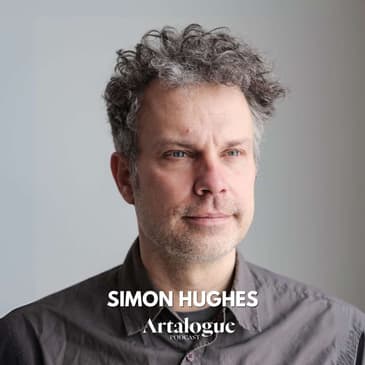
Today on the Artalogue, Canadian artist Simon Hughes chats with Madison Beale from his Winnipeg studio about his creative beginnings, Canadian art and his career. This episode is all about finding your artistic voice in unexpected places.
Hughes reveals how he developed his unique approach that treats watercolors, drawings and canvas paintings as equal expressions, not relegating drawings to mere preparatory sketches. His technique of building translucent layers of color, inspired by Paul Klee, creates a distinctive visual depth that characterizes his work. From his early fascination with Hieronymus Bosch and Surrealism to his later dialogue with Canadian art history, Hughes traces the evolution of his artistic vision with refreshing candor.
The conversation takes a fascinating turn when Hughes discusses his unexpected path from graduating from the University of Manitoba to working in film production between art projects, waiting eleven years before pursuing his MFA in California, and discovering surprising similarities between Winnipeg's and Southern California's art scenes. His recent exhibition "Fire, Flood and All the Feelings" at Blouin Division showcases his ability to blend contemporary suburban landscapes with spiritual elements, creating a modern counterpoint to Lawren Harris's iconic Canadian wilderness paintings.
What makes this discussion particularly valuable is Hughes' practical wisdom about navigating an art career. Rather than waiting for institutional recognition, he emphasizes creating your own opportunities through community engagement and persistent creation. "Wherever you are, that's the place to be," he advises, offering a refreshing perspective on building an authentic artistic life regardless of location or circumstances.
Follow Simon's work at his studio gallery space Fire Door in Winnipeg or on Instagram @simonmhughes to discover more about his artistic journey.
Connect with the Artalogue:
Madison Beale, Host
Be a guest on The Artalogue Podcast
Hi, Simon. Welcome to the Art-O-Log.
Speaker 2:Hello, thanks for having me.
Speaker 1:How would you describe your practice?
Speaker 2:I think the tricky thing about it is I do watercolors and works on paper and I also make paintings. Am I a painter? I'm not really have what you'd consider like a classic painter's art practice where you're just in the studio with paint all over your clothes and like a Willem de Kooning model where you're just like existentially battling the canvas and just churning out work. I have a little bit more of a sort of drawing approach where things are a little more thought out and planned ahead of time. That's one version of drawing, like a design type drawing. So the short answer is it's basically split in half between making work on paper and working on canvas and they're equal. It's not like a painterly practice where you make drawings as a sort of side thing to work out ideas for bigger paintings. They're both equal and the drawings are sometimes bigger than the paintings and the paintings are sometimes smaller. Anyway, that's the short. Actually that was a pretty long answer to that question.
Speaker 1:Or what inspires your work.
Speaker 2:Someone once told me in school ask yourself who you're in a dialogue with and the best answer is like the oldest answer you could give, like how far back can you take that answer? And to pick up on you being in art history, something that kind of really grabbed me when I was in school was when we took Northern Renaissance as an elective. So like the 1500s in the low countries, flanders, belgium and all that or whether they were called that at the time. Those countries had names that were always changing. But things like Hieronymus Bosch and even the less crazy people like there were these sort of obscure Dutch painters like Neer and Broegel is big for me and I go to big museums in other cities. I always seek out those kinds of work because they have tons of detail in them and there's lots to work out. And they were happening at the same time as the Renaissance in Italy, but the agenda was different. The agenda wasn't exactly about innovating in a pictorial way. It was more. There was a lot more about narrative and the world they lived in. The Italian Renaissance did that too, but like big scenes of just peasant life but combined with a really weird surrealist then. So in terms of far back.
Speaker 2:I looked to that and also then in high school I also did a pretty deep dive into surrealism, like we had to pick a movement to study. And I did that and coincided with getting to go on a couple trips with my parents to places with bigger museums and see like Magritte and Salvador Dali and all that. And then a big one for me too was I went Bali and all that. And then a big one for me too was I went.
Speaker 2:I saw a show of Paul Clay in London when I was like 16 years old because I went with my mother to visit her family over there and that really had a big effect on me. His work was very like it's work on paper a lot of the time and I filed it away to try and learn how to paint watercolor like that and couldn't just deal with it for years and years until after I was out of university because it didn't have the patience. It also wasn't encouraged. No one talks about watercolor painting when you're in art school. I came to it later and that's a real touchstone for me with what I do now is the sort of multitude of styles that he developed, and then all kinds of other things inspire me, but from an art history point of view. That's it for the most part.
Speaker 1:And how did you arrive at your current style?
Speaker 2:Yeah, to pick up on the Paul Klee thing, at a certain point I realized I had the patience to try that and I just started working from that starting point of trying to learn how to layer color in a translucent way.
Speaker 2:In art school I majored in painting, but I didn't really deviate from a very opaque oil painting type of way of working. I would just apply paint opaquely, I didn't build it up in clear layers like traditional oil painting, like really old style oil painting would be, and so that sort of watercolor technique really formed the basis of what I'm still doing, like even when I work on painting on canvas. Often I'm still working in that way, like I build things up with clear layers of color so that if you're seeing a certain red, it's actually the accumulation of five different colors to make that red, not mixed. I guess there's a term for that visually mixed, or it's mixed as you see it, because you're seeing all those separate layers at once. So yeah, that all happened about four or five years after I got out of school, like around 2000, where I really took a bit of a break and tried to break it down, to working on paper and develop some technique. And here we are.
Speaker 1:When did you know that you wanted to be an artist?
Speaker 2:The story is supposed to go that you had a passionate drive to create and you couldn't think of anything else. And many people are like that, and I think I always did have a drive to do something visual. I just didn't really. I didn't have a hard idea of what that was going to be Like. Maybe I'd be an animator who worked in movies or I'd be do film or I knew. Cause I think in the back of my mind growing up here which I think we'll get to later you didn't really have the idea that you'd make a career of doing art. So it was always like well, do you? There'll be something for me. Like I knew I liked to arrange visual information on a pretty much two-dimensional plane. Whether that meant art, design, animation, film, I wasn't really sure, but I I had that drive in that vague way as long as I can remember, and then it sharpened up, I think in high school when I was just looking into art history more and surrealism and 20th century stuff, and that's when I made the decision to do fine arts.
Speaker 1:You got your BFA at BU of M. How has Manitoba and the city of Winnipeg shaped your artistic vision and your practice?
Speaker 2:It was really interesting at the time that you both had a very negative view of the city, having grown up here, and yet it was also quite vibrant and there was actually a lot to see. So I think at the time we weren't really not a lot of people were thinking about or at least I wasn't that you get a BFA from the University of Manitoba and make a living as an artist. In reality a bunch of people of my generation did do that, but I think you were resigned at least I was that it wasn't really going to happen and you do this fun art thing in school and then you'd go find some other job, hopefully related. But at the time I graduated from the U of M in 1996. And there was a pretty nice kind of self-contained set of influences Like, yeah, sure, like I said, I got.
Speaker 2:I went on a couple of trips when I was a teenager to see museums in other cities.
Speaker 2:But even if you hadn't done that, you had a pretty good little thing going here in Winnipeg to be influenced by artists who were already around and had careers, like Wanda Koop or Eleanor Bond or people like that, who you might see their work at the Winnipeg Art Gallery in a big show, but then also peers Like I had a lot of people around me at that time in art school that went on to be really interesting artists, who that was also inspiring just to see other people doing things that you you knew were good, even if they weren't necessarily like well-known yet.
Speaker 2:So the kind of scene here was actually fundamentally a good thing, even if it was obscure and off the radar compared to a big center like New York or something. And I think at the time too I started to put a little bit of local content in my work a little bit and at the time that seemed just like almost a joke or something Like it. There's been a lot of like pro Winnipeg local content that's come out since that time, but I think at the time it was almost just like. It was almost like ironic or something that you would put anything to do with Winnipeg in your work, cause we were the city that was ignored, or a smaller center that wasn't really on anyone's radar.
Speaker 1:Yeah, so from there, you then went to California to do your MFA. What was that transition like? And did it. How did it affect your work?
Speaker 2:There is a big gap in between. That time. I took about 11 years off before I went back to school. So it was, the transition wasn't immediate. I did my BFA right after high school. So I felt like maybe I needed a little time to do other things and, like I said, I didn't really expect that I'd make a living.
Speaker 2:So I, after art school, I got into the film industry as a sort of day job and I would work half the year as a painter or other jobs on films and then I do my own work. I would get employment insurance at the end of the season and just do art all winter or whatever it was. And so there was quite a bit of time where I was out of school, but my art career was going well enough that I didn't feel the need to go back yet to do a master's Like. My friend, Paul Butler started this online gallery and he also did art fairs and so my work was and he was showing my work and it got out there a little bit like nationally, and then he got my work and it got out there a little bit like nationally and then he made, got my work into the national gallery stuff. It was always. I was never quite sure if I was going to go back and do an MFA and then at a certain point it was.
Speaker 2:I was already in my 30s and I was thinking I'm not sure where this is all going and at least if I go away to school I'll have a great experience and will at the very least have a master's. So if I need to get a teaching job, I can, because an MFA is the qualification to teach in a university. But yeah, and so then I arrived in Southern California, which on the surface is really different from here, but I always looked towards there in terms of like in the contemporary sense. I always looked to California. There was something about this sort of scene in California that was interesting.
Speaker 2:It wasn't as big and what seemed weird coming from here is they considered themselves underdogs in a kind of art, historical or contemporary art way, which seems crazy when you're from Winnipeg, this city with an area with 10 million people or whatever, thinking they're underdogs with some of the my favorite artists of all time, like Ed Ruscha for example oh, file him under that earlier question about inspiration too. But they still felt like New York ignored them or the international scene ignored them a little bit and they'd really like. It was a very self-contained scene which weirdly felt like Winnipeg and also the kind of the mode of production down there is a little bit similar to here. It's very spread out and sprawling and everyone drives cars. And it's similar to here in that you probably take your car to the store to pick up a bunch of materials and bring it back to some odd industrial space that you're renting or your garage or basement not so much basements there, but it didn't feel like a kind of old world park like in New York or one of the big European centers where you I don't know take the subway to someplace and have to have a stretcher delivered to your little tiny garret up in a building somewhere.
Speaker 2:It had a feel like how we live here, just with better weather and much more stuff to see. That's half the battle of doing a master's, I think, is to go somewhere where you'll just see stuff. Like if you go to another small center, you just Like. The program you're in is one thing, but going out to see shows and lectures and meet people is really like more of it than the program you're in. In that way it is a big boost at the time.
Speaker 1:Yeah, for both of your educational experiences. What were your expectations leaving art school, and has your experience matched what you were expecting?
Speaker 2:When I got my BFA, like I said, there were pretty much no expectations. I immediately got into the early stages of getting into the film industry and worked my way up there, where it was a mix of other people who had BFAs also, who were like visual people, but also just tradespeople, like painters, who came from the kind of house painting side of it. Even the idea of doing a master's wasn't really on my radar at that time. And then once when I got my MFA, in the back of your mind you're hoping oh, someone here is going to see my work and I'll get picked up by a big gallery and it'll all be stardom from there. But that's the best case scenario.
Speaker 2:I think I was thinking like no-transcript and I came back to a scenario where I got turned down for a bunch of teaching jobs but at the same time my work was placed in a biennial at the National Gallery in 2010. Work was placed in a biennial at the National Gallery in 2010. And that led to me getting a gallery in Canada who you know then have been representing my work ever since, and I actually, by trying to get a teaching qualification, accidentally got a bit of an art career. But I think part of that is just the sort of sending the signal that I was serious. Oh, this guy just gave up his life and house and drained his RRSPs to go back to school and show that he was serious in the US by getting an MFA, and that maybe played somewhat into getting picked up by a gallery, and or maybe they just liked my work.
Speaker 1:And speaking of getting serious, when did you first feel like you made it as an artist?
Speaker 2:I'm not sure that's happened. For one thing, I suppose there were levels of that. As I said, I was working with this gallery. That was online, but they would touch down and do events here and there in physical spaces and in 2002, I did a show with them at a sort of borrowed gallery space in Toronto. I had a bunch of watercolors in the show and they basically sold out all of them and it felt like a really good Toronto event. All the people that are seen there embrace the show and there's this, now defunct but like little magazine at the time. That just was the Toronto Art Magazine that put my work on the cover of it because of this show and that sort of felt like in a Canadian way. Oh, this I like, registered in Toronto, which is a biggest center here, obviously in Canada.
Speaker 2:And then the jumping ahead. It would probably be that 2010 moment where my work was in the show at the National Gallery and had been acquired by them and it's not just about the museum buying the work, but then going to the show and being there alongside. It's a snapshot of what's going on in Canada at the time. So you see your work and I was actually in a Winnipeg room with Sarah Ann Johnson and Carl Funk and I think Tim Gardner was in that room. But then you walk around and see all kinds of even like really interested Inuit artists or people from BC and put in a context that was, I felt, pretty high level and that made it feel like, oh, something's really going on here in a good way.
Speaker 1:What does a typical day look like for you as a working artist?
Speaker 2:It's pretty straightforward, just because I have a studio-based practice, which not everyone does necessarily. I just get here sometime around. It depends. I have kids, so there's different things that happen in the morning. People start school at different times and stuff, and it's a nine to five proposition here in the studio. I just show up and see what didn't get finished the day before and I tend to have several things in progress, because I find that I do get stuck and it's always good to have something to move on to if you're not making progress with one thing, to not just sit there and stare at the wall. And yeah, it's fairly dull. It depends if you've never been in an artist studio before, maybe it would be interesting. But yeah, just come to my studio.
Speaker 2:I work on watercolors or acrylic paintings, stop for lunch and then head home around five, six o'clock Occasionally I'll work at home. If I have more like administrative or design stuff to do on the computer, I'll stay home and just do it there, cause it's a little more comfortable. But yeah, not too much to report, just working away on process wise, I work more or less on big flat work tables. I don't necessarily often stand at an easel and paint it. I left over my studio, set up just like our old shops were when I worked in the film industry, like big, long flat work tables, shelves, pails full of brushes and stuff, big sink and, yeah, just moving around standing up working on a few different things at once and listening to the radio sometimes other music, but often just whatever's on either the CDC or college radio stations here in Winnipeg and just work nine to five banker's hours sort of thing.
Speaker 1:Your most recent exhibition, the Fire, flood and All the Feelings, recently closed at Blonde Division in Montreal. Can you tell me more about what inspired the show and what went into pulling it off?
Speaker 2:It was a show, all of work on paper, with one small acrylic painting in the corner and I guess it was a way to previous year. I had a show that was all like large canvas pieces, acrylic and collage on linen and I felt like I was really excited about that body of work on linen and I felt like I'd I was really excited about that body of work but it also felt like it was the, the culmination of that. I didn't really have any more to do with that at that moment and my kind of roots are doing these sort of large. The thing that first got me noticed would be these kind of larger multi-panel watercolor pieces and the gallery was a little more cause I had it was the same gallery I showed the paintings with the just at their Toronto location and we have a bunch of those like maybe it's time to do a work on paper show, just completely different. So it just turned a 180 and went back to this idea of the works on paper and it's a thing where there's just something about drawing and working on paper that lends itself a little more to narrative or a kind of more linear type of storytelling and maybe a little bit of commentary. Like in a acrylic painting, there's just something about the language of it that's a little bit difficult to make Because in the back of our minds, even like to the layman, if you don't know much about art, you are aware that a big painting is something that's like a luxury object in a way. Like a big painting on canvas is as much as a course and drawing Although you certainly there's artists whose work on paper is very expensive and valuable it doesn't read the same way. Like you look at a drawing and you think, oh, it's like a blueprint or it's like a comic strip or a poster. It's or is different somehow. So for that reason it's a little bit easier. It's just a little trickier to make a artist do it successfully. But to make a kind of social commentary in a painting on canvas is a little more difficult or just not as natural as working on paper.
Speaker 2:I'd been experimenting a bit with seems cold to say this, but like I was experimenting with a color palette around, like fire and warm colors, just as a way to challenge myself Because I'd done a lot of work about like ice and the North and Canada and Manitoba, it was like what if I could do something totally opposite. So I've been planning this really big piece about wildfire basically, and so that was the first one, the fire of the title. I did this large thing about just a burning landscape which was done last summer before the things that happened in Los Angeles. But people have said oh, you're peace. What about the fire? It was really like prophetic or something and like it was happening everywhere already. Like we've lost entire towns in Western Canada within the last few years to wildfires, and also that felt a little bit weird to make it so much about something that was so incredibly personal and real for people. So I went in a little bit of a direction where these volcanoes came in also. So it was almost like just a bunch of disasters happening at once combined with this landscape. That was very sort of normal suburban Canada, like there's a Canadian Tire and a Bass Fur Shops and all these things like that in it.
Speaker 2:And then to counterpoint that there was a second piece that was all about a flood of the sort we would have here in Winnipeg, and so a lot of the source material was from documentation of the 1997 floods here or even the 1950 flood in Winnipeg, and then the third part of it with the feelings was about this thing I'd been a little bit obsessed with for a long time, which was these, these drawings from a hundred years ago, from this, a religious sect called Theosophy where they did these.
Speaker 2:They had an idea that you could make illustrations to illustrate all the sort of feelings and emotions people would have. So they'd make these. This died to like thought forms. They called it like angry. Spiky red coal might mean anger or things like that. Or they do these illustrations of a visual idea of the sound coming from a cathedral when a certain piece of music was being performed. So I made four pieces to go along with it, that kind of picked up on that, where it's just these more like plain suburban, contemporary prairie landscapes along the bottom with these big sort of spiritual weird lights in the sky above them. So that's how the fire, the flood and the feelings came about.
Speaker 1:Yeah, Is that the religion that Bertram Brooker was involved in?
Speaker 2:That's right? Yeah, I think so, certainly, lauren Harris was.
Speaker 1:I think both of them.
Speaker 2:Yeah, and interestingly, when I was down in California, there's a theosophy Society still in operation down there and they have this little library, Actually I think, in Altadena. I'm not sure if it was affected by the fires, but I went there to see if they had any information and I was doing this really large piece about Lauren Harris and about his time in the desert and I wanted to maybe see if I could find out anything and they told me, oh yeah, but he was part of the other branch of it. Like they split, every sect obviously has to split apart after a certain amount of time and so they didn't really have any information about his branch of it. But yeah, it was really around with artists, possibly because they had this real visual element to it where they wanted to quantify like spirituality and emotion in visual form, and maybe that's why it really took hold with some artists.
Speaker 1:Yeah, speaking of Canadian art, do you see yourself in dialogue with Harris or that larger canon of Canadian art? Because I noticed when you were talking about your influences, you didn't mention any Canadians.
Speaker 2:Yeah, because I think that came later. Like I didn't you grow up going to the Winnipeg Art Gallery and seeing first of all like lots of great art and then also whatever, because they have the WAG as a very like important Bertram Brooker painting and the influence there. I would say it's like a lot of people read my work that way because I do a lot of stuff about ice and icebergs and Lauren Harris did as well. But it's actually there is this moment and Brooker is tangentially connected to this but there's a moment in Lauren Harris where he is. There was iceberg Lauren Harris. Actually, first there was sort of social commentary Lauren Harris where he'd do like views of the when to him was a ghetto but to us now looks like million dollar townhouses. Fintanero at the time was like the bad part of town and then there's the most legendary iceberg Lauren Harris. And then later there is abstract Lauren Harris. When is when he after he really dove into this theosophy stuff and was hanging out down in the desert in New Mexico. But there's this kind of really interesting middle part which is what I really picked up on with him. And yeah, you're right, I should have probably mentioned a little more Canadian content earlier Emily Carr in there as well, for sure. But this moment in Lauren Harris where it's still a landscape, but in a very there'll be a little mountain at the bottom, but then there's just this crazy abstract blob in the sky, which is what he really wanted to talk about, but he was grounding it somehow in landscape and that's what I find really interesting about him, because there is the.
Speaker 2:Even the Kripa Sevin have a weird parallel to art history. There just could not be more out of the canon of what we would all have learned as the basic progression of art history in the modernist way. No, we don't do trees anymore. No, like you're way too late to be doing trees. What are you doing? But yeah, there was something about their paint handling that was contemporary, modern.
Speaker 2:But yeah, it's definitely that moment in Harris where he's in the middle that I love and that's those pieces I was just describing like the thought form ones from my recent show.
Speaker 2:That's what it's all about, like the tiniest little house on the bottom with this huge spiritual blob above it, but in my case it's like a very kind of. It looks like a house that might be built in headingly in today, 2025. And so it's the idea of being like, yes, lauren Harris, you could go out into the wilderness and have a spiritual epiphany, but maybe someone's having a spiritual epiphany in headingly in their brand new home too, you know, and the wilderness was always a little bit not the wilderness with the group of southern, Like they would turn around from that pine tree and go back to their buddy's cottage who is putting them up and was wealthy and they're in the land also, just like you are. So, anyway, it's that kind of spiritual, abstract but grounded in landscape moment in Lauren Harris that I really really connect to and thanks for bringing that up. Actually, that's something that is pretty significant.
Speaker 1:I was so wrapped up in what you were saying I nerd out so hard when it comes to the group of seven.
Speaker 2:Are you a Canadian art history nerd yourself? Yeah, totally I'm having a great conversation with someone like that the other day too. What someone else wants to talk about this? Yes, let go.
Speaker 1:I love it, I am obsessed with it.
Speaker 2:Yeah, I really like when sometimes one of my favorite books that I go back to all the time is this catalog from it's from the LA County Museum and I think the show was in the 90s or it was quite a while ago.
Speaker 2:I never saw it, I just have the book and the show is called the Spiritual in Art, abstract Painting, whatever 1890 to 1970 or something, and the book is it's completely trying to show an alternative history of abstraction to the sort of Mondrian de Kooning, jackson Pollock linear story. So it goes it weirdly like they had an entire section on Ilma af Klint, like years before she had her big shows more recently and just odd American people like Arthur Dove and Nathan Avery. And then there's a big thing on Lauren Harris and you're like, yes, like it's hard. It's interesting when you see people like that put in context internationally and not just in a raw Canada way, but where you realize, oh yeah, canadian art history isn't exactly just a ghetto, there's context for all of that and these movements were moving around and it's so interesting to me that Warren Harris moved to the desert in New Mexico. I made a huge piece about it, but yeah.
Speaker 1:I feel like it makes total sense in the context of who he was as a person for him to go. He also had just like unlimited money to do whatever but him moving to the desert and getting involved in all of that theosophy stuff. I just make so much sense for him. And I remember seeing my first, more abstract Lauren Harris painting. It was at the Callie Abbott preview in Winnipeg and it was this diagonal Lauren Harris piece with this big yellow kind of explosion happening on a blue background and I was like we never talk about Lauren Harris like this period. I think as well it doesn't fit in with the sort of like nationalistic group of seven narrative that we have about the group of seven and especially about Lauren Harris.
Speaker 2:I just find it so interesting if you want to make these groups and you don't realize, like even surrealism, which I was obsessed with and which still informs my work somewhat, like that group of people, like that was a very short amount of time and that every artist involved in that was probably disowned by the people who were making the narrative about it, like they all went on to do all kinds of different things that didn't really fit in with the group. But you have only a limited amount in art history. Like Salvador Dali is the guy who made the quarks. Let's move on to the next person. Oh, but what about his crazy weird phase where he was doing crucifixion?
Speaker 2:And it's the same with, like we don't have enough time to talk about everything Lauren Harris did in a survey of Canadian art. It's like icebergs, flat pilt application, like anyways, whatever, and let's move on. But when you get a little more obsessed with people and dig deeper, often the kind of less known thing they did is what's really interesting. And in any case, it's always more interesting to dig up the thing that not everyone knows about, yeah, and artists.
Speaker 1:But it's the 100 year anniversary of the breton manifesto too this past year. But was invited to join the surrealist and he was going to sign the manifesto and then he didn't. But we never think about reappel as a surrealist. We're so quick to lump him in with Abax, all these things.
Speaker 2:Oh, he's really appreciated in Europe for a way, with that kind of that period of like European abstract painters that were doing very interesting things that just happened to not be the most canonical abstract stuff of that time.
Speaker 1:To jump back into the interview what have been some more difficult moments in your career and how did you overcome them?
Speaker 2:To be really honest, it's almost like the current moment is one, because I'm just like a middle-aged person and I think for any, for most artists, there's a bit of a lull at this point, unless you're someone who gets discovered and there's working away in a barn somewhere until age 50. And then, wow, there's this completely undiscovered person. But there's the curse of getting a little bit of attention, probably in your early 30s, mid 30s, something like that, and then you've just been around. So there's a ton of different people to go and find now. And in Canada it's a smaller scene where if you sell your work, if you're like a working artist who sells your art there's probably most of the people who collect art in Canada have something of yours already or they've decided they're not interested. So you hit a little bit of a wall and I'm not telling you this to try and get pity, and I still am like surviving and making a living. It just it's a little bit challenging to like at this moment. I feel like I'm churning out some pretty interesting things and I'm doing new stuff that is different from what I did before and it's just a little bit harder to get your voice heard and and get that work out there and again, not really complaining at all Cause I have a great gallery that takes care of me. You also get a little bit you're. You have other things going on, there's a lot of responsibilities and in life as you get a bit older and in life as you get a bit older. So I find it a little bit of a difficult time right now, but I wouldn't trade it than whenever I go down a path in my mind of thinking, ah, maybe I should just pack it in and go get a real job. It's just not even possible at this point. There's no way to do that. So yeah, I would say now would be one kind of tricky moment, and also just the first.
Speaker 2:When I first started my master's, I found it was a little bit difficult.
Speaker 2:I was hitting a bit of a phenomenon where, like I can tell, there was that indifference from the faculty to what I was doing and you can't get over it except by breaking through with your work. Like you can only talk to people so much about what's not working in your work and at a certain point they don't have anything to tell you. They're just like I don't know. What do you want to do you just have to wait it out? And eventually, around the end of the second year of that third three-year program, things started to change and I started doing new work that was completely different than the old work, and then the conversation started flowing again that there was a little bit of a moment where I was stalled out and I found I was like, oh, did I just waste my life coming down here to do this master's program and I'm not going to do anything worth even talking about. But then it you just have to have that faith that the ship is going to turn around.
Speaker 1:What advice would you have for some people looking to become an artist?
Speaker 2:Yeah, it's tough to answer because the path I took is not really that. It's not the typical path, but it's also not unheard of either. If you really know it's what you want, then to just get a good portfolio together, get into the best undergraduate program, you can go right away into a master's program in a big center where people are going to see your work ie New York, los Angeles, london, maybe Berlin, somewhere in Europe and then just hustle. That's what's called the K to MFA approach, which is exactly not what I did, but I guess what I have. As a sidebar to that I would also say just wherever you are, like maybe you do hang around in Winnipeg or whatever town you're from, or you move to New York and try and make a go of it and do a master's.
Speaker 2:I think kind of participation is really important. Let's you know, when I was here, I was involved in the music world also and it was always about you'd have to put on your own shows if you had a band or something, and make your own flyers and put them out. So when it came to art it was like, okay, let's organize a show and let's be out and hanging out and doing stuff all the time and to be generating those connections and and like institutions in a way like that's, people get together and make their own gallery and things like that, and that applies wherever you are. Like you doing that in Winnipeg, like the sort of famous generation of British artists in the nineties Damien Hirst and all those people. That's what they did. They just made their.
Speaker 2:No one really thought of that was not a particular scene that had the eyes of the world on it, but they made it so by just being friends and hanging out, and maybe you started a little DIY project with some friends and this person is this artist, but they also started this series of performance nights or this gallery space or this bizarro band that they're in on the side. Just think being out there doing things as well. Don't count on the institution to get it done for you. It's important you just be involved wherever you are. Wherever you are, that's the place to be.
Speaker 1:That's great advice, Simon. Thank you so much and thank you for being on the Art-O-Log today. It's been wonderful chatting.
Speaker 2:Fantastic. Thanks very much.
Speaker 1:Where can people find your art if they're looking for it?
Speaker 2:Recently my wife and I have opened a little gallery space here at my studio which is called Fire Door. We're on Instagram as the Fire Door because Fire Door was taken and that's essentially just the room adjacent to my studio. But we made it into a gallery space and at the moment you can see my work there. We'll maybe be doing other shows of other people later, but for now I have a bunch of my work up. My own Instagram account is Simon M Hughes, so just my name with the middle initial M and where else that's about it for the moment. Yeah, in Winnipeg you can go to the Windsor Park Library and where else that's?
Speaker 1:about it for the moment.
Speaker 2:Yeah, in Winnipeg you can go to the Windsor Park Library or the Seven Oaks Hospital and see a couple of tile mosaic projects I've done over the years, and that's about the size of it right now.
Speaker 1:Great. Thank you so much, Simon.
Speaker 2:Thank you.