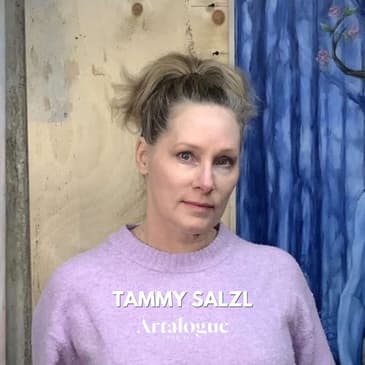
Tammy Salzl, a Canadian multimedia marvel with a flair for storytelling, joins us for episode 8 of the Artalogue! Tammy tracks her journey from reading her brother's comic book stash as a child to her latest solo show at the Vernon Public Art Gallery. Salzl walks us through her evolution from drawing to her current award-winning, multimedia approach. Through installation, film, painting and sculpting, Salzl's latest body of work burrows inside of you like a beautiful parasite.
Salzl's work teeters between beautiful and beastly, often prompting the viewer to draw their own line between these supposed polarities. Her art, steeped in folklore and camp aesthetics, serves as a mirror reflecting the human condition and the rawness of life. Beale quizzes Salzl on the origins of the her favourite work by the artist, “The Compromise” (2011), a piece inspired by environmental impacts on male fertility and the choices we are faced with in an imagined future dystopia. We explore how folklore and myths often expose our deepest fears and desires, and how Salzl translates this into her work.
Follow Tammy on Instagram
Tammy's Website
Connect with the Artalogue:
Madison Beale, Host
Be a guest on The Artalogue Podcast
Tammy Salzel is a Canadian multimedia artist who completed her Master of Fine Arts at Concordia University in Montreal in 2014. Salzel's work is driven by her interest in the power of storytelling and the connection she sees between the human psyche and human kinds relationship with the natural world. Salzel has presented her work across Canada, as well as in Germany, Mexico and the USA. She is an award-winning artist and the recipient of many scholarships and artist grants. Tammy, welcome to the show. Thanks for having me. Pleasure to be here. What are your first memories of art?
Speaker 2:I didn't come from a typical or traditional art background with parents or family that was interested in art. Raised by Samuel Mom she was a secretary. Honestly, I didn't really know anything about art. I didn't go to museums, I didn't go to galleries, but my brother had an extensive comic book collection and so I would steal his comics and read them after he was done, and so I came to the world of visual storytelling and telling tales visually through comic books. I would say that's where it all started for me, and I started doing drawings from those comic books and eventually, when I got to high school, it was the only thing I was really interested in. So art school after that just made the most sense.
Speaker 1:As a multimedia artist. You began with drawing men. That was your first medium.
Speaker 2:Yeah, I think most everyone starts with drawing, and then in my undergrad I quickly drifted to painting. It's the most readily available and easy to transport medium. There's also something that came naturally to me, and I loved how, with paint, you could create anything from your mind and put it to surface in a very immediate way. So all through my undergrad, and then into my master's program as well, at Concordia, I was in painting, working in oil and watercolor.
Speaker 1:How did your practice evolve from painting to a practice that encompasses film and installation and sculpture?
Speaker 2:So I'm making these sort of almost operatic compositions in these paintings pretty rigorous work. And then I realized at some point for me, all I'm trying to do is make the story as appealing and as eye-popping. I'm trying to bring people into a story more than a painting. And so at one point I started to question what would happen if these things came into 3D form. And I had a.
Speaker 2:The gallery I was working with at the time had my work in a solo booth in Art Tronto for the Art Tronto Art Fair and I said I have this weird idea. What do you think? I want to turn this, the small painting I have, into a three-dimensional form. So it was a drawing of a tree house and he was like go for it. So once you give artists opportunity in a green light and a bit of money, then you're able to take risks and make chances. And I loved it. I loved how switching mediums added layers to the story and let the story unfold and grow. So now I just follow the medium which is based in the idea and the story that I'm following, do you?
Speaker 1:have a favorite medium to work in.
Speaker 2:The mediums are dictated by the idea and the story that I'm rambling around in my head, and so whatever I'm currently working on is my favorite medium, and I get really obsessive when I work. So I try to work on several things at once so that I don't get too obsessed with one thing. So once the project gets developed to a certain level whether it's a painting or a installation work or a ceramic piece or a film once I get it to a certain level, I can get pretty obsessed, and so the closer it is to being done, the more obsessive I get. So do I have a favorite medium?
Speaker 1:No, what are you most interested in working on right now?
Speaker 2:I have a script that I just finished writing that I'm really in pre-production with right now and I'm really excited about seeing that come to fruition sometime this year, and I don't know. I've got a few paintings on the go and I'm still recently started working with ceramics making ceramic sculptures, and I'm very fascinated with that, and I've been doing a deep dive into the history of witchcraft and its connection to climate change, so I've been all of those sort of three things are going to be influenced by that interest and that research.
Speaker 1:If, for a moment, we could focus on your film work. I'd really love to talk more about that, because you just had a film called Spots that won a ton of awards and I wanted to ask you about how a film becomes art. How is film a piece of art?
Speaker 2:For me it was by accident. I had been incorporating in my installation work video work embedded within little video screens with things I had shot outside or manipulated video. I had been doing that for a number of years already and I had a residency in Norway and I didn't want to pack a ton of supplies because it's far to go, so whatever I could take in my suitcase. And so I had this very nebulous idea of I've got this costume and I'm going to craft these little characters and I'm going to take pictures of myself out in the Norwegian woods and down by the fjords and see if I can work that way, which I had never done before. But as I was going there, this idea came to mind of a narrative started to form, and I fought the narrative the whole time, thinking no, that's too weird, you can't do that, that won't even work. How are you going to do that? And yet it happened, with me filming myself by hitting record on the camera in costume, with the creatures that I crafted out of polymer clay, running in front of the camera, pushing stop and then piecing all of these things together afterwards in post, and having the good fortune to meet Greg Mulek, who is a award-winning composer and musician that I met in Edmonton and asking him to score this little narrative film that I made, which was called the Belize, and my original intention was to show it in an installation type situation in a gallery, which I've done a number of times.
Speaker 2:And then I had friends say I think this could probably get into some film festivals. So I'm like, yeah, so on a whim, I submitted it and I got into the Edmonton International Film Festival and the Oaxacan Mexican Film Festival and a bunch of others, and so that just started the addiction and I never really looked back from there. So spots is a movie I made with my son during COVID and it's a very different. It's still a distinctly timey-sosal piece but it's a little bit more sweet than I'm normally akin to. My son and I were ensconced in this lockdown and he was just on his screen too much. So I wanted to. He's an aspiring neurodivergent actor and I wanted to do a project with him and, yeah, it's done very well.
Speaker 1:What was it like working with a family member to create this piece of art.
Speaker 2:There's good things and bad things. So especially when it's your kid, someone who struggles with attention, so there's a lot of. In one way it's easier because you can say the things you wouldn't normally say, but that can also work in your detriment when you know there's assumptions that are in place. That would probably be more smooth if those assumptions weren't in place. So there's good and the bad.
Speaker 1:To go back to what you're saying about your working relationship with Greg Mulek, I love the idea of having someone compose a score for a piece of art, whether it's a film, a piece of video work or an exhibition, like in the case of beautiful parasites in Emerald Queendom. How do you think sound impacts an exhibition or a piece of work?
Speaker 2:I think sound is everything For me. It's really important to me to create, whether it's a painting. It's not that a painting can't exist on its own and be its own amazing thing. Of course it can. But as someone who's so impassioned about storytelling and suspending disbelief, music really helps that, creating an immersive space, especially when you're trying to link, for example, in beautiful parasites. It's my first time showing my ceramic work with my paintings and just the material alone there's a disconnect. So how do you create an atmosphere that will connect these things together in a cohesive, flowing way? And music is a wonderful way to do that and create an immersive space, and it also adds another layer to the psychology and the story and the meaning behind what you're doing.
Speaker 1:Do you see the music as sound art or do you see it something outside of fine art or fine art practice that accompanies the exhibition?
Speaker 2:That's such a good question. I feel like it could easily be both. And in fact, greg, you can buy the soundtracks to the work that he's done on several films and art installations. You can buy that separately and listen to it on its own. So I do see it more as music. It depends on the project. So for the Valleys, for example, or spots, it's very much its music, it's a soundtrack. But for Emerald Kingdom, I see that more as sound art. That would be more specifically for a visual art experience. So it depends, yeah.
Speaker 1:An overarching theme in your work is storytelling, from narrative works to installations of immersive worlds that are inspired by folktales. What do you think the importance of storytelling is in your work?
Speaker 2:So stories and fables have been altered and updated periodically for hundreds and hundreds of years, and they tend to reflect the moralities of a current generation, the realities and the moralities that a current generation is hoping to bestow on the next.
Speaker 2:And as much as these tales change, they weave themselves deep into the tapestry of a nation, into who we are. And I'm interested in retelling these tales or as a way to connect our current realities to the legacies of our past. And it's something many other artists have done before me, for example Margaret Atwood or Angela Carter. And so I'm interested in how the ideologies within my own European white settler ancestors, the ideologies and the fact that a lot of these tales are teeming with really horrible things like misogyny and fear of the other, and how these tales have become systematically embedded into our codified possession or perception sorry, towards women, towards different cultures, religions and our perceived dominance over the natural world. And I feel like stories are a way for me to come at these sort of heady, often dark, difficult themes and a vehicle to portray it in a more accessible way that is easily unpackable, it's familiar. That's part of why I'm interested in storytelling.
Speaker 1:I think with your work, specifically when I see your paintings, it just there's such a visceral connection, I feel, with the figures in your work that kind of have these grotesque bodies and that's something that pops up frequently in your work, in all senses of the word. As an artist, what is something about gore and excess that you gravitate towards?
Speaker 2:So in a lot of the visual language that I'm using there is this sort of folklore, childlike, almost camp, aesthetic or easily recognizable forms and stories. But they're delivering a tougher punch than what you normally see on the surface and I think the dichotomy of taking the beauty next to the grotesque and embedding that dichotomy together is a way to to slow the viewer down, and I also think that embedding sort of grotesquery into the image is a way to. It's a pictorial device that can address my own inner anxiety about the world that we live in and the partial realities of what it means to be human.
Speaker 1:I'm really interested in a comment that you made about a work that you titled the Compromise from 2010. When you submitted it to the 2011 Kingston Prize, you said humanity is less a condition than a choice, and that was really striking to me. So can you tell me a bit more about how that relates to this painting, but also your of at large?
Speaker 2:That's interesting because that really does embody a lot of what I think about in all of my work when I work. But for that story in particular there's a bit of a tale. Can I tell you the tale?
Speaker 1:I would love to hear it yeah.
Speaker 2:So the CBC did a documentary called the Disappearing Male, and in that documentary it speculated a link between our environment, which is our toxic environment, and there's an alarming trend in male fertility rates, in birth defects and in disorders that have emerged around the world. So in this documentary on the CBC it proposed the question are males becoming an endangered species? So researchers, jim Brophy and Margaret Keith and they're both sociology professors at the University of Windsor at the time they had been studying the decline of birth in male children in a small First Nation community that was located right next to the infamous chemical valley, which was Canada's largest concentration of petrochemical plants near Sarnia. So they looked at the community birth records since 1984 and they saw a dramatic drop in the number of boys that had been born in the last 10 years, particularly in the five-year period between 1998 and 2003. And of 132 of the First Nation babies born in that small community between 1999 and 2003, only 46 were boys, and typically about 105 boys are born for every 100 girls in Canada there's been growing evidence that the birth sex ratio can be altered by exposure to certain chemicals such as dioxin, pcps and pesticides. And so studies, global studies, so studies done in the States, japan and Europe are also supporting this theory that the so-called endocrine disrupting chemicals have a particular effect on males.
Speaker 2:In the painting, I started thinking about this post-apocalyptic future, where these three young girls, these triplets, who I also think of as the three fates going back to Macbeth fates. They have captured the last male on earth and he's deformed because he's a victim of his environment. And they've captured him, and there's three of them and only one of him. So they must make a compromise. Thus the title of the work the compromise.
Speaker 2:So when I talk about humanity being a choice, in all of the characters that I create I try to reflect the dichotomies that exist within all of us. What are the things that makes this human and what that separate us from animals? Because we are animals, right, and we often try to talk about how we are above an animal. But I think that's a choice that gets made, and especially in today's world, where there's a lot of atrocities happening right now, what is it that could make us human, that would help us rise above that? And just the fact that inside we are all lonely, anxious, vulnerable, fears, powerful, full of hate, full of love, wounded, victorious, barbaric, innocent.
Speaker 1:And so how do you put all of those things because that's what each and every one of us is into one thing that's amazing when you talk about your works being operatic as well, with all of these kind of nasty, luxuriant parts of humanity coalescing into your work. Where else can you see that other than in opera? Right, love operas. Can you tell me a bit about your show Beautiful Parasites that's currently running at the Vernon Public Art Gallery?
Speaker 2:Sure, I was actually really excited about that show because, like I said, it's the first time I'm showing my ceramic works with the paintings, and oftentimes when you work in multimedia, curators don't know what to do with you because your or is she a painter? Is she video installation? And so you've got all these different works. So oftentimes it's hard to show them all together in one area and I'm really liking how the work comes together and it's working really well.
Speaker 2:So beautiful parasite is a term that I, a very endearing term that I have for how I want my artwork to operate and be perceived. I talk about my work creating a sort of a visual punch so it enters the eyes through crafted beauty, through luscious colors and just formal aesthetics, and then, through the grotesquery that we talked about, it sinks down into the gut, turns around and you're like, ooh, why do I feel that easy? And then I want it to rise up to the mind, where it will sink in and ferment and embed itself in your mind like a beautiful parasite that you will walk out of the gallery with and it will stay in your mind for weeks and months to come. And that's what a beautiful parasite is.
Speaker 1:I love that and I think that is so pertinent when it comes to art as well when you see something that really sticks with you and you can't get it out of your brain, but it's also beautiful and it gives you these like rising emotions, right yeah, what's it been like to have your work curated? What's the experience of an artist presenting contemporary work that's curated by someone else?
Speaker 2:That's a good question. In my experience, curators are really generous with trusting artists to know what will work best, and so sometimes they have something specific that they want to show, but most of the time they're like let's work together to make the best show that you think you would like to show, and then so it's usually working towards a show as a long dialogue with many studio visits and back and forth. So in my experience anyway, unless it's a group show and they have something specific, I want this because it fits in the theme of the group show. Generally. If it's a solo show, in my experience it's a very collaborative back and forth where artists have a lot of leeway.
Speaker 1:What have been some career highlights so far.
Speaker 2:It's easy to talk about. I just got this great grant in this award and I got the show. But something that really stuck with me was the few times that I get random fan mail. Which is really humbling and surprising and very touching experience to have someone from Australia who I don't know how they found my work be moved by it enough that they would write me a letter to tell me how much they like my work. So that's happened to me a few times and I can't tell you how touching that is.
Speaker 1:That sounds really nice to have someone go out of their way to tell you how much they appreciate your work.
Speaker 2:In a place that I've never shown and I've never been, and they just yeah, it's an interesting experience.
Speaker 1:It's the beauty of the internet. What are your plans for the future?
Speaker 2:To keep making beautiful parasites. I've got a I got. I'm privileged enough to have gotten a nice grant and I bought myself a killin. I'm going to be making some larger ceramics. I'm really interested in creating these neo-surrealist figures, Like I said, tying them into witchcraft and climate change, and interested in developing this new film, which will be beyond me and my camera and where I'll have to actually have a whole crew of people that I have to actually direct. Oh, terrifying, and just following where my stories take me.
Speaker 1:What advice would you have for people looking to pursue a career as an artist?
Speaker 2:Be brave. Be brave, make what you want to make, not what you think other people want to make. Take your space and you need to be a little bit selfish. Your art needs you to be selfish and also don't take yourself too seriously.
Speaker 1:That's fantastic advice, Tammy. Thank you so much for coming on the Art Alog today.
Speaker 2:Thanks for having me.