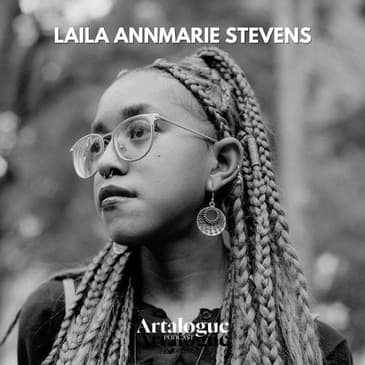
Step into the visual world of Laila Annmarie Stevens, a Black queer photographer based in Brooklyn whose lens captures tender portraits of the people around her. We unpack how growing up in Queens and internet culture shaped the intimate narratives she now crafts with her camera, from the early days of experimenting with a flip phone to her current photography practice encompassing both digital and analog approaches. With major publications showcasing her work and a recently expanded "Clayton Sisterhood Project" that aims to uplift Black women's stories, Stevens is just getting started.
Follow Laila on Instagram: @lailaannmarie
Check out Laila's website: https://www.lailaannmarie.com/
Connect with the Artalogue:
Madison Beale, Host
Be a guest on The Artalogue Podcast
Laila Ann-Marie Stevens is a Black queer photographer and visual artist, born and raised in South Jamaica, queens, and she's now based in Brooklyn, new York. She received her BFA in photography and related media at the Fashion Institute of Technology. Their portraiture is informed by their passion for honoring marginalized youth voices and embracing the fullness of Black life through the creation of a digital safe space. Their work could be described as a raw and intimate perspective. Through her early work in youth organizations, she's incorporated image making to envision a world of inclusion and power. Laila, thank you so much for being on the show.
Speaker 2:Yes, thank you for inviting me.
Speaker 1:What is Queens like?
Speaker 2:Queens is very diverse. It has a multitude of different nationalities and races, ages, family dynamics, backgrounds. It is the blending pot. The entire city is known to be one of the most diverse boroughs In the grand scheme of the landscape. It is the largest and really memorable part of the city.
Speaker 1:What's a typical viewpoint when you're walking through Queens? What do you see?
Speaker 2:There are a lot of parks. There are a lot more parks in Queens than in Brooklyn. I find A lot more residential homes. There's backyards and front yards, Short homes. There aren't as many tall scaffoldings and buildings taking up the landscape, Businesses and family owned restaurants. That's throughout the entire borough.
Speaker 1:How do you think growing up there shaped you as an artist?
Speaker 2:It provided a wider aspect into what it means to have a community that is woven together tightly because you know your neighbor. You are familiar with the people in your community at a higher percentage than in other boroughs or different cities across the nation. I think it provided me a greater landscape into getting to interview and talk to and photograph people that I knew better than individuals that might be from other boroughs or different parts of the community.
Speaker 1:Those are some of your earliest memories of taking photos.
Speaker 2:When I was about nine, my sister was standing at the bus stop and I remember taking these photographs of her on my at the time flip phone. I thought they were the best pictures I've ever taken and I said to her look at, these are so good. She agreed, she made me feel confident about them, even though they were very low resolution and probably not the best angles, but at the time I felt confident about it. I brought up to my parents like, hey, I think I could take really good pictures. At the time it was the Tumblr era, so everybody was taking these quote unquote quality pictures. So that's what they labeled them as quality. And I was like I want to take quality photos and got myself a Canon camera from my parents and started taking pictures of anything that I could.
Speaker 1:Was there any subject matter in particular that you gravitated towards at that age?
Speaker 2:Yeah, I mean once I started to move away from objects which was like the Tumblr subject matter, like markers and apples random water bottles, which is funny to think about. I then moved to photographs of friends, so portraits, and that's my primary focus right now. So, as I started to take more portraits and then was a thematic matter of these are my friends, these are the demographics and identities of my friends, and from there I started to think about these markers.
Speaker 1:From the earliest pictures that you took on your flip phone to the pictures that you're taking on that Canon of your friends, to what you're doing now. How did that style develop from what you're currently doing now? How would you describe your style and how did it progress?
Speaker 2:Yeah, what was interesting is that something I do even now is I take a lot of portraits and natural lighting with the sun. I usually never use artificial or flash and that's because I think there's a lot of beauty in the sun's natural light onto folks, especially darker skin, and technically there are differences in the mechanics that I'm using of the equipment, but stylistically it is pretty the same. I like to use a tighter crop onto folks face. I like to have a really tight focus and closeness to the subject. I like a lot of detail in the hair and the skin. I usually use a tighter lens, Bien� dusty lens. The style now that I'm thinking about it really has not changed much.
Speaker 1:I love that. I think so many artists talk about returning to their, to the work that they were making as children as their best work. Right, it was their purest, most uncontaminated work and I think that's great, that you still have that connection to what inspired you and what kind of ignited that passion in your work. I think that's great and I think it totally comes through as well. So to kind of pivot, how does being black and queer shape and inform your practice now and do you see them as separate aspects of an identity-informed practice or are they inseparable to you as an artist?
Speaker 2:Yeah, for me these are intertwined. I carry both of these identities in myself and in the world. How I interact with the folks that I photograph, the ways in which I approach certain subjects matter, and even the subject matter of assignments that I might be put onto right from photo editors, where the subject matter is blackness and queerness intertwined. And for me, for my personal projects as well, I incorporate both of these identities into many of my projects. If there is one that is a little bit more prevalent then the other, I usually will indicate that, but it is at the same time understood. That is the dynamic of my work and who I am and how I carry myself through the world, and inherently it is going to come across in the work.
Speaker 1:Yeah, when you mentioned about you indicating the more prominent aspect in a photo. What do you mean by that?
Speaker 2:The project might be in regards to queerness or queer folks and that might be the emphasized highlight of that project rather than black history or anything that has to do in direct relation to blackness Versus. I'm doing a project right now called Clayton's Cisterhood Project which talks about legacies of black women. In that project I'm speaking more to blackness in comparison to queerness because the subjects and the work are of all different sexualities and backgrounds, but I still carry these aspects If some of these subjects are queer or if I'm photographing myself into this project. Those are some aspects.
Speaker 1:Could you tell me more about the Clayton's Cisterhood Project? I?
Speaker 2:began it during the summer of 2020 and have been working on it until now. I am currently producing the longer version of the project for my Magnum Foundation Fellowship, and it documents intergenerational families of Black women, what it means to redefine the term girlhood, womanhood and sisterhood, and also what does sisterhood look like, not in terms of gender identity right, but of looking at alternatives to the patriarchy and also emphasis on sister or sister in context to language and dialect within the Black community as well, and it is informed by a lot of Black archival photographs, so I am reiterating it in Black and white film and choosing subjects that are within my now chosen family, in addition to my blood family. So what does my definition of family now look like as a open Black queer lesbian in New York?
Speaker 1:That's so interesting. When it comes to using film for the project, what do you think that offers you as opposed to digital?
Speaker 2:It's more of a traditional homage to older practices of photography.
Speaker 1:In your statement, you mentioned about creating a digital safe space, and I was wondering what does that mean to you?
Speaker 2:I think we are in a digital world and we look at our screens constantly. I think many platforms and spaces online are not held to honor people who look like me and to simply have representation, and so safe spaces in real life are not always possible. But what photography can allow is visibility and representation of POC, marginalized queer folks online, and I hope that my photography can come across these platforms, regardless of what website it is, and be of importance to these people.
Speaker 1:Yeah, I think representation is so important, especially in media, and when you think about how many different types of people have been excluded in photography and just in historical documentation up until recently, I think it just underpins how important your practice is and creating that digital safe space in a world where, like you said, it's not always possible to create in the real world. In your career so far, what have been some memorable moments?
Speaker 2:Yeah, I think the most memorable moment has been photographing the Trans Liberation March for the New York Times Back in 2021, it was my first ever assignment for the New York Times or a larger publication really in general, and this not only meant a lot because the assignment was so close to my heart in terms of the people that I got to interact with, but it was also memorable because it was considerably the hardest career moment I've had to launch myself into and I believe I was prepared, but it was grueling in terms of a career pivot and change into the standards that I've had to hold for myself and it really pushed me. So that was the most memorable.
Speaker 1:Yeah, what do you mean by the standards that you've created for yourself?
Speaker 2:Yeah, I think I would not have, in a million years, think that I was at 20, I think I was 20 at the time that I could shoot for someone so large as them, right? And at the time I held my standards pretty low as to what I believed I could achieve until I was able to meet that and, frankly, not meet it but exceed it right.
Speaker 1:That's incredible. At 20 years old, that is just insane, amazing. Thank you, yeah. What direction do you see your practice going in in the future?
Speaker 2:I really want to be more involved with the community engagement aspects of art making in terms of education, direct involvement as far as organizational association and doing more hands-on workshops, and incorporating these two like in-life, real workshop aspects of community art engagement and making into my photography and journalism practice. I don't exactly know how that will intertwine eventually, but I hope it will.
Speaker 1:What advice would you have for people who are hoping to become photographers or photojournalists?
Speaker 2:For me. I think the most important subject matter that I took away from first starting was identifying issues or topic matters that really mattered to me and thinking about how visualizing these subjects in your own perspective could emphasize or change the way in which other people can view the topic in the same way that you may right. Identifying these problems, these issues, looking at what you would like to change and how could your art be a tool for that change. I think everyone is capable of being passionate about something and evoking a change in that.
Speaker 1:I think it totally speaks to the power of photography to create those changes. Layla, thank you so much for being on the show. Is there anything that you would like to plug?
Speaker 2:Look out for updated images from Clayton Sisterhood Project in January from my fellowship.
Speaker 1:Where can people find you on Instagram? Is your website any other ways to interact with your work?
Speaker 2:My Instagram is at LaylaAnmarycom. These are my main platforms.